How to Choose Binding Services for Professional Documents
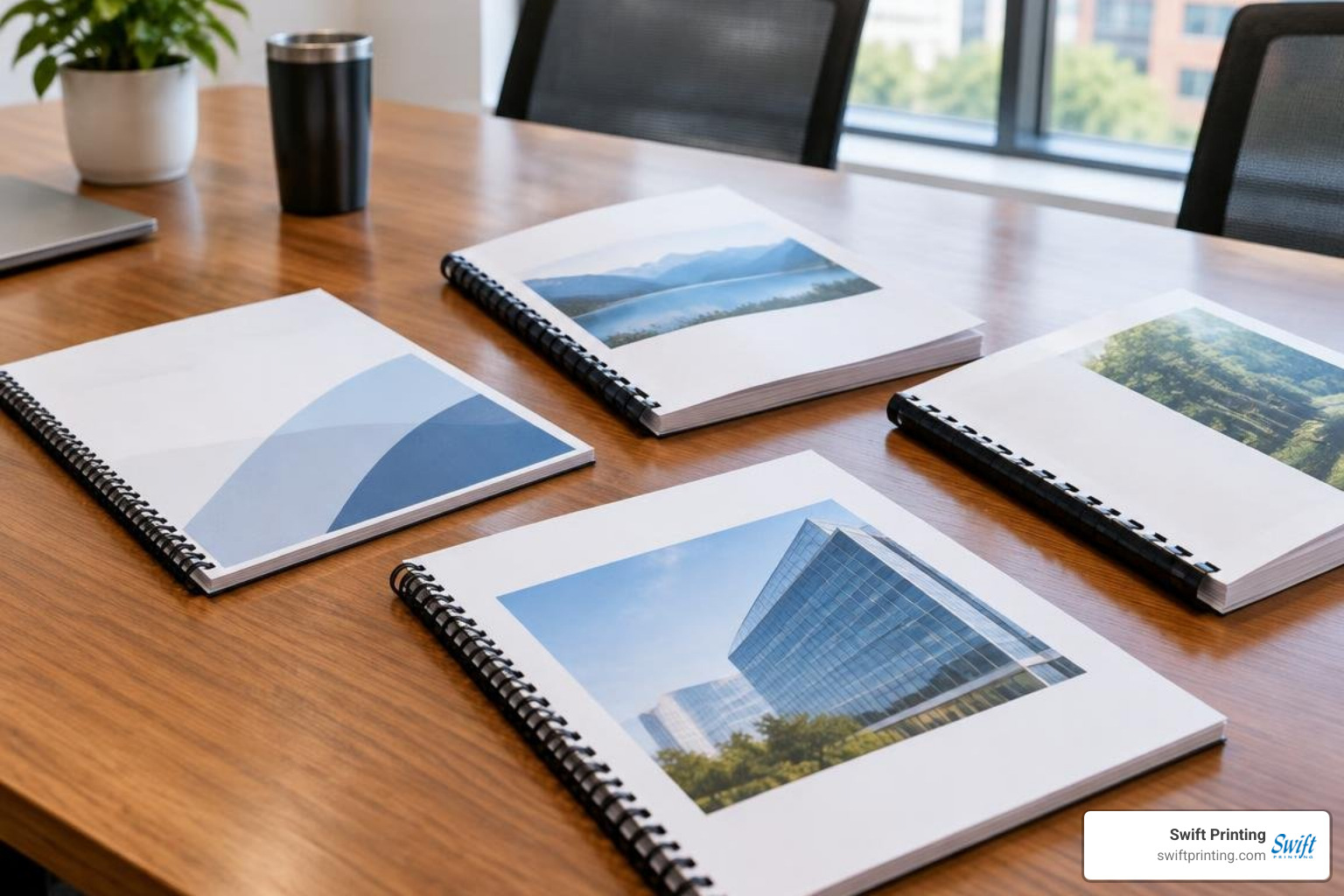
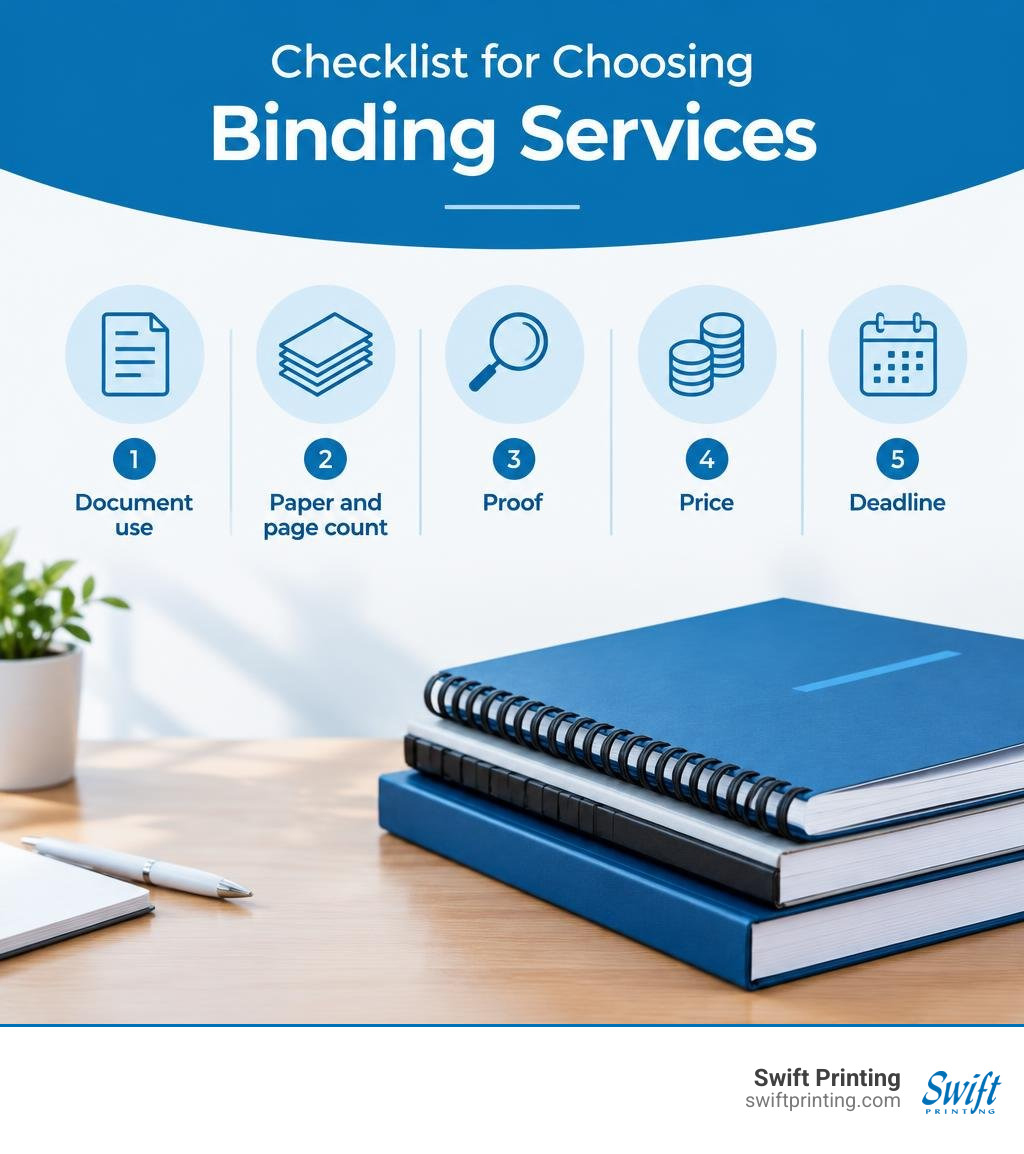
The right binding services keep your pages secure, make the document easy to use, and give it an impressive finish that suits its exact purpose. Before choosing a provider, ask which binding styles fit your page count and paper stock, whether printing and finishing can be coordinated under one roof, and when you can review an advance physical proof. Always secure a clear turnaround schedule and project timeline before production begins.
Those questions matter whether you are preparing a high-stakes board report, an extensive legal presentation, or an authoritative booklet for clients. A polished cover will not rescue an executive document if pages are awkward to turn, the spine cracks during review, or the finished job arrives late.
I’m Jessica Gutowski-Slaydon, president of Swift Printing in Grand Rapids. My daily work with boutique commercial printing and specialty finishing has taught me to always start with how a document will be handled, and then choose custom binding services that honor your brand standards and strict delivery milestones.
Key Factors When Evaluating Professional Binding Services
When your firm distributes documents to executives, judges, board members, or high-value clients, physical presentation directly reflects your brand reputation. A flimsy spine, misaligned margins, or cracking covers can quickly diminish the perceived authority of your work. Evaluating a commercial print and bindery partner requires looking beyond basic paper trimming to inspect mechanical durability, structural integrity, and aesthetic finesse.
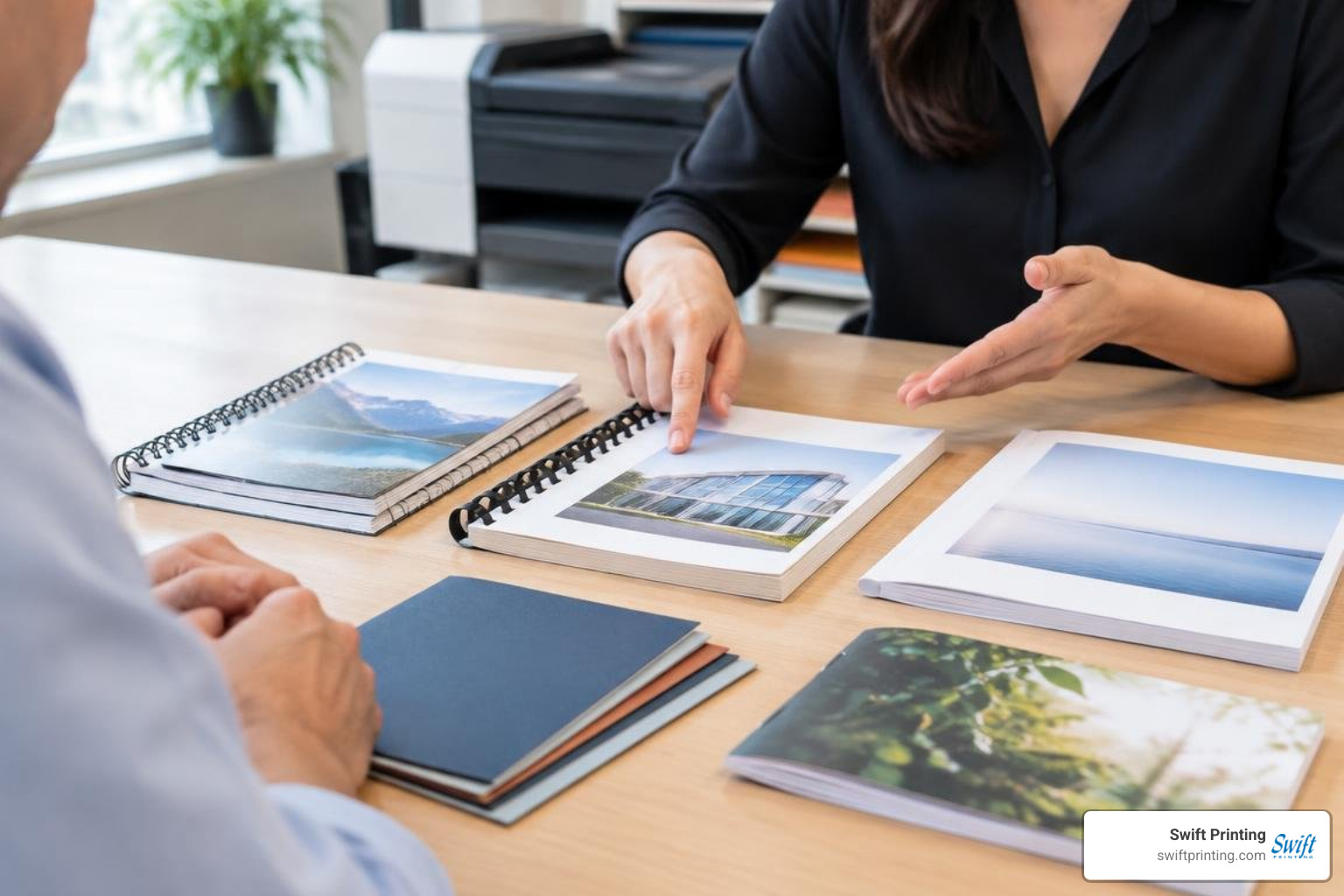
A truly reliable finishing partner understands how physical stress affects different binding styles over time. For example, documents referenced daily—like clinical protocols, municipal master plans, or legal compliance binders—require heavy-duty mechanical bindings, while formal proposals demand the sleek, seamless spine of thermal or adhesive methods. Exploring advanced bindery options early in the design stage ensures your document balances visual elegance with functional longevity.
Matching Document Types to Specialized Binding Services
Every corporate or institutional publication has unique handling requirements:
- Legal Briefs and Evidentiary Packets: Law firms require bindings that keep dozens or hundreds of exhibits organized without loose pages slipping free. Secure double-loop wire or heavy-duty thermal tape provides maximum security during litigation.
- Medical Manuals and Training Guides: Healthcare environments demand lay-flat functionality so physicians and technicians can reference procedures hands-free. Choosing durable coil bound booklet printing allows pages to wrap a full 360 degrees without damaging the spine.
- Consulting Proposals and Pitch Decks: High-stakes business development materials require crisp, executive finishes. Wire-o and perfect binding convey refined sophistication on boardroom tables.
- Board Packets and Financial Audits: Quarterly and annual reviews benefit from the durability of versatile coil spiral binding or the clean book-like spine of case binding, accommodating thick page counts cleanly.
Paper Stock, Page Count, and Margin Specifications
A common misstep in professional print design is overlooking how binding mechanics impact page layout. The physical spine consumes interior space, known as the gutter margin. If your bindery fails to guide you on gutter adjustments, important text, chart axes, or footers can get swallowed by the fold.
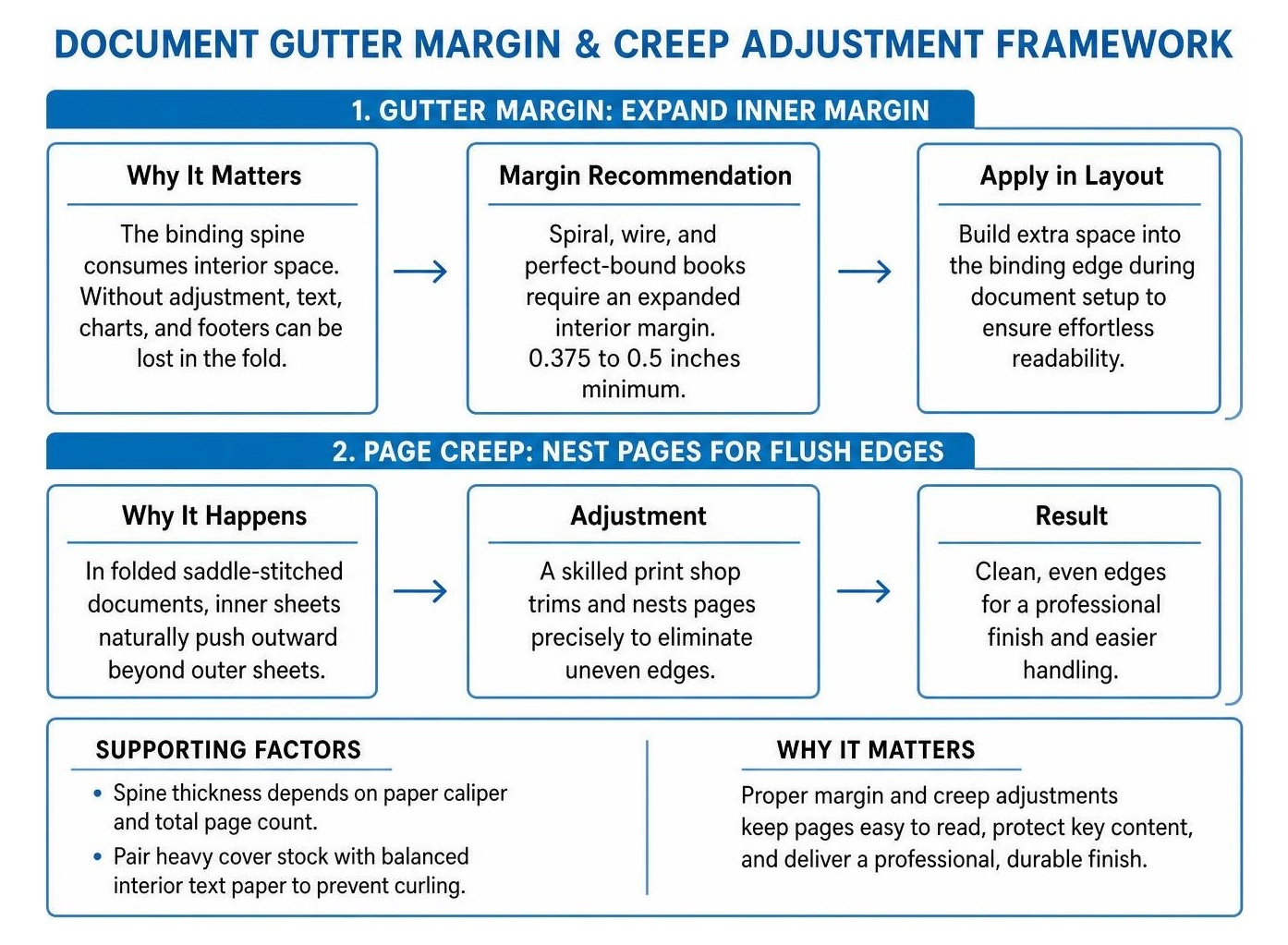
- Gutter Margins: Spiral, wire, and perfect-bound books require an expanded interior margin—typically 0.375 to 0.5 inches minimum—to ensure effortless readability.
- Page Creep: In folded saddle-stitched documents, inner sheets naturally push outward beyond outer sheets. A skilled print shop trims and nests pages precisely to eliminate uneven edges.
- Spine Thickness and Paper Caliper: For square-spine perfect binding, spine width depends on text sheet caliper (thickness) and total page count. Consulting an in-depth commercial book printing guide helps you calculate spine dimensions accurately before finalizing your cover art.
- Cover Stock Selection: Pairing heavy cover stock with balanced interior text paper prevents curling and protects documents through heavy distribution cycles.
Comprehensive Checklist for Selecting Commercial Binderies
Choosing a commercial partner requires evaluating equipment capabilities, craftsmanship, and production rigor. High-end boutique printing demands meticulous attention to detail at every stage of production.
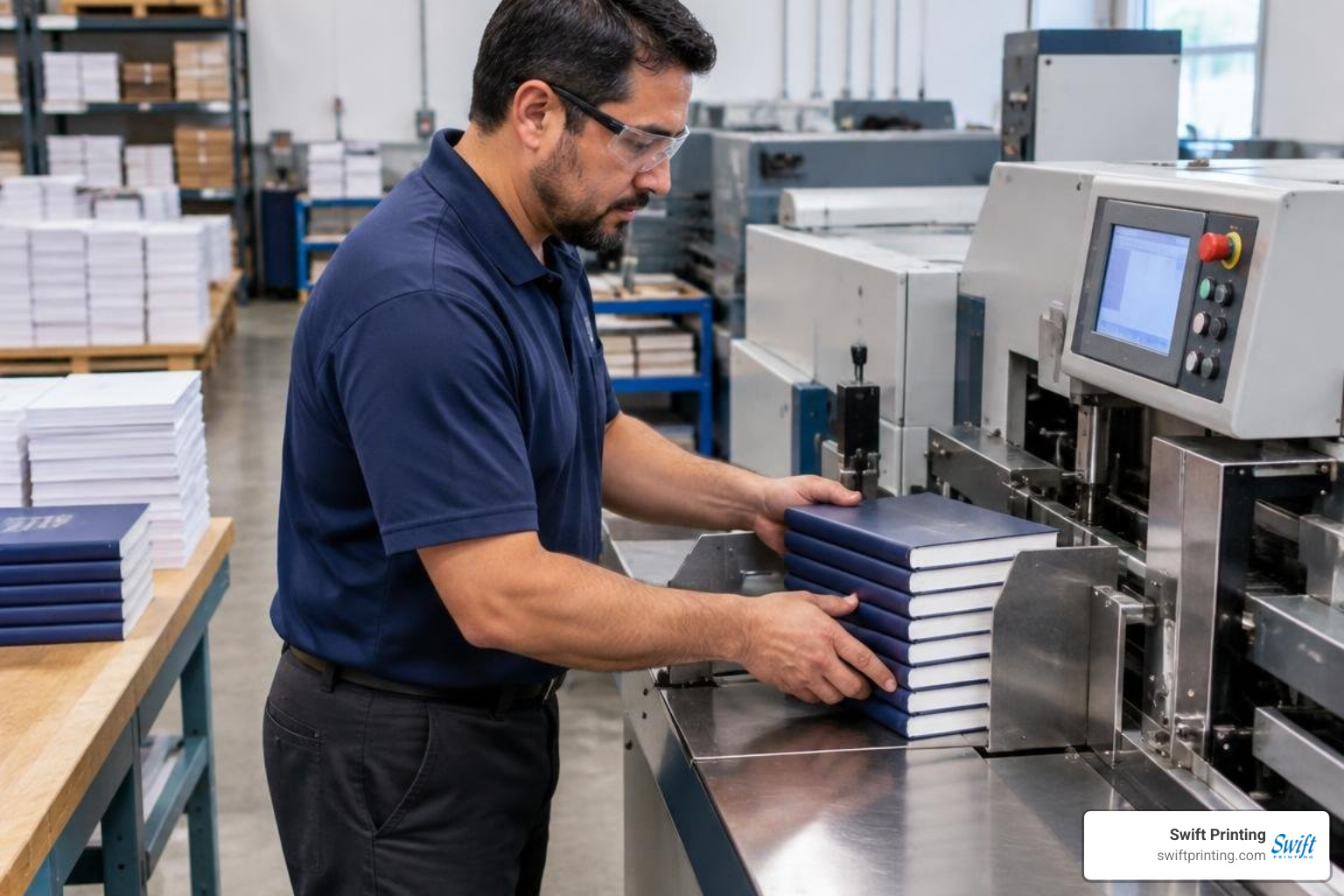
Before committing to a print run, verify these vital capabilities:
- In-House Mechanical Equipment: Does the shop operate dedicated automatic punchers, industrial stitchers, and automated square-back gluers?
- Precision Trimming Capabilities: Clean, three-knife trimming ensures smooth, professional page edges without feathering or burrs.
- Proofing Process: Will you receive a physical, trimmed, and bound proof to review spine tension, paper feel, and alignment before full production?
- Archival and Preservation Standards: Academic and archival institutions, such as those cataloged in academic library resources like LibGuides: Binding Services: Home, emphasize strict standards for spine stamping, durable endpapers, and acid-free construction.
Bindery Capabilities and Finishing Equipment
A full-service commercial print facility should offer a complete spectrum of finishing techniques under one roof:
- Saddle Stitching: Ideal for streamlined publications, booklets, newsletters, and corporate programs up to 64 pages.
- Spiral Coil Binding: Continuous durable plastic coil that resists crushing, perfect for workbooks and field manuals.
- Wire-O Binding: Double-loop metal wire delivering a modern, clean aesthetic for high-end corporate presentations.
- Perfect Binding: Adhesive-bound square spine offering a true bookstore-quality appearance for annual reports, directories, and comprehensive softcover volumes.
- Hardcover Case Binding and Foil Stamping: Rigid hard covers paired with metallic foil-stamped spines, setting the benchmark for commemorative volumes, archival records, and deluxe corporate portfolios through professional commercial book binding.
Quality Control, Durability, and Archival Standards
A premium binding must withstand real-world use without failing. Temperature fluctuations, page tension, and rough handling test the limits of low-grade adhesives and cheap bindings.
Professional binderies employ high-grade polyurethane reactive (PUR) or ethylene vinyl acetate (EVA) hot-melt adhesives for perfect binding, preventing pages from pulling free over time. Reviewing a comprehensive booklet printing guide can help you identify the right balance of paper weight, grain direction, and bindery reinforcement for long-term durability.
Turnaround Reliability and Full-Service Binding Services
When filing legal documents, launching client campaigns, or hosting annual board meetings, delivery deadlines are firm. Working with an integrated, local printing and binding partner eliminates the logistical delays and miscommunications that occur when printing at one vendor and shipping to an off-site trade bindery.
Choosing dependable local book printing in Grand Rapids gives you direct access to experienced technicians, swift physical proof reviews, and confident scheduling for time-sensitive distributions across West Michigan, Rockford, Ada, Belmont, Kalamazoo, and Lansing.
Comparing Common Document Binding Formats
| Binding Method | Optimal Page Count | Lay-Flat Capability | 360-Degree Wrap | Best Suited For |
|---|---|---|---|---|
| Saddle Stitch | 8 – 64 pages | Yes | No | Executive summaries, event programs, policy booklets |
| Plastic Coil | 16 – 400+ pages | Yes | Yes | Training guides, technical manuals, recipe books |
| Wire-O | 16 – 250 pages | Yes | Yes | Board decks, consulting proposals, client presentations |
| Perfect Bound | 40 – 500+ pages | Moderate | No | Annual reports, softcover books, product catalogs |
| Hardcover Case | 60 – 800+ pages | Moderate | No | Commemorative books, legal archives, premium publications |
Frequently Asked Questions About Binding Services
What is the difference between coil binding and wire-o binding?
Plastic spiral coil uses a continuous flexible plastic filament threaded through round or oval holes, allowing pages to rotate 360 degrees without kinking or bending out of shape. Wire-O binding uses pre-formed pairs of metal wire loops crimped through square or round punches. While both allow documents to lay completely flat on a desk, Wire-O delivers a more formal, metallic executive finish, whereas plastic coil offers superior crush-resistant durability for everyday reference.
How do page counts affect the choice of binding style?
Page count and paper caliper directly dictate structural feasibility. Saddle stitching requires page counts in multiples of four and becomes bulky or prone to springing open beyond 64 pages. Perfect binding requires a minimum spine thickness—typically at least 40 pages on standard paper—for the adhesive to form a strong, flat bond. For intermediate documents, spiral coil and Wire-O accommodate a wide range of thicknesses by varying the element diameter.
Can binding and printing be completed in a single integrated workflow?
Yes, working with a turnkey commercial printer ensures printing, collation, folding, punching, and binding occur in an uninterrupted workflow. This eliminates shipping delays between separate vendors, preserves color fidelity across covers and text sheets, and ensures accurate trim and gutter alignments throughout production.
Conclusion
Elevating your corporate and legal documents requires a finishing partner dedicated to craftsmanship, precision, and reliable execution. Swift is a high end print shop setting the standard for printing in the boutique business, and our team focuses on delivering flawless presentations that represent your organization with distinction. Whether you need board decks, legal portfolios, or comprehensive corporate publications, trust Swift Printing to deliver exceptional quality from initial proofing to final delivery.