Why Coil Spiral Binding Works for Modern Booklets

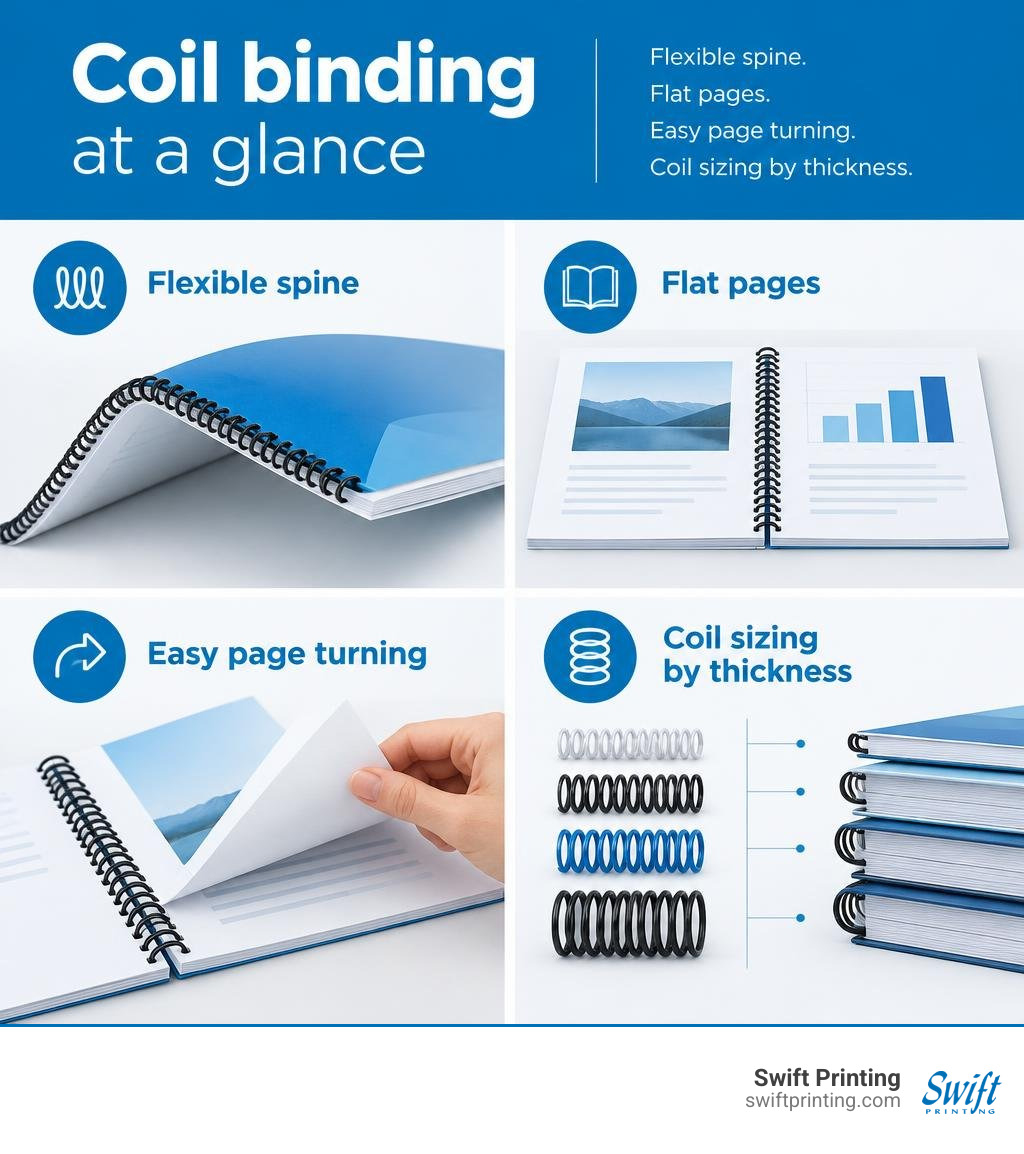
Coil spiral binding holds pages together with a flexible coil threaded through holes along one edge. It lets a booklet lie flat or fold back on itself, making it a practical choice for training guides, reports, workbooks, and other documents people use often. If you need a booklet that is easy to handle, start by checking its finished thickness and choosing a coil size that gives the pages room to turn.
A well-made coil-bound booklet can also feel at home in a client meeting or boardroom. The cover, paper, and coil color all play a part in how the finished piece represents your organization.
I'm Jessica Gutowski-Slaydon, president of Swift Printing in Grand Rapids, Michigan. My work helping customers choose paper, formats, and specialty finishing has shown me why coil spiral binding is worth considering when a booklet needs to look professional and work well in daily use.
What Is Coil Spiral Binding and How Does It Compare?
At its core, mechanical binding encompasses any method that secures loose leaves using a physical spine inserted through pre-punched holes along the gutter edge. While traditional case binding or adhesive methods rely on glues and heat, mechanical methods offer exceptional page stability and unique functional benefits. Modern mechanical binding has a rich history dating back to the early 20th century. During World War II, a major shift occurred as durable synthetic polymers began replacing metal wiring, leading directly to the resilient plastic continuous coils we rely on today.
When designing professional publications, selecting the correct format is essential. Organizations often evaluate several different mechanical binding types to find the balance between visual style, capacity, and functional durability.
| Binding Method | Spine Material | Max Page Capacity | 360-Degree Page Turning | Lay-Flat Ability | Best Use Case |
|---|---|---|---|---|---|
| Spiral Coil | Continuous Plastic Filament | Up to 450 Sheets | Yes (Complete fold-back) | Excellent | Manuals, training guides, reports |
| Twin-Loop Wire | Formed Metal Wire Pairs | Up to 250 Sheets | Yes (Complete fold-back) | Excellent | High-end executive proposals |
| Plastic Comb | Cylindrical Plastic Spine | Up to 500 Sheets | No (Opens flat only) | Good | Internal drafts, quick reference |
| VeloBind | Rigid Plastic Prongs | Up to 750 Sheets | No (Book-style spine) | Limited | Legal briefs, formal filings |
Mechanics of Coil Spiral Binding vs. Comb and Wire
The mechanical advantage of continuous plastic filament lies in its inherent shape memory. Unlike twin-loop wire spines, which can bend or crush under pressure in a briefcase or shipping carton, plastic coil flexes and bounces back to its original circular profile.
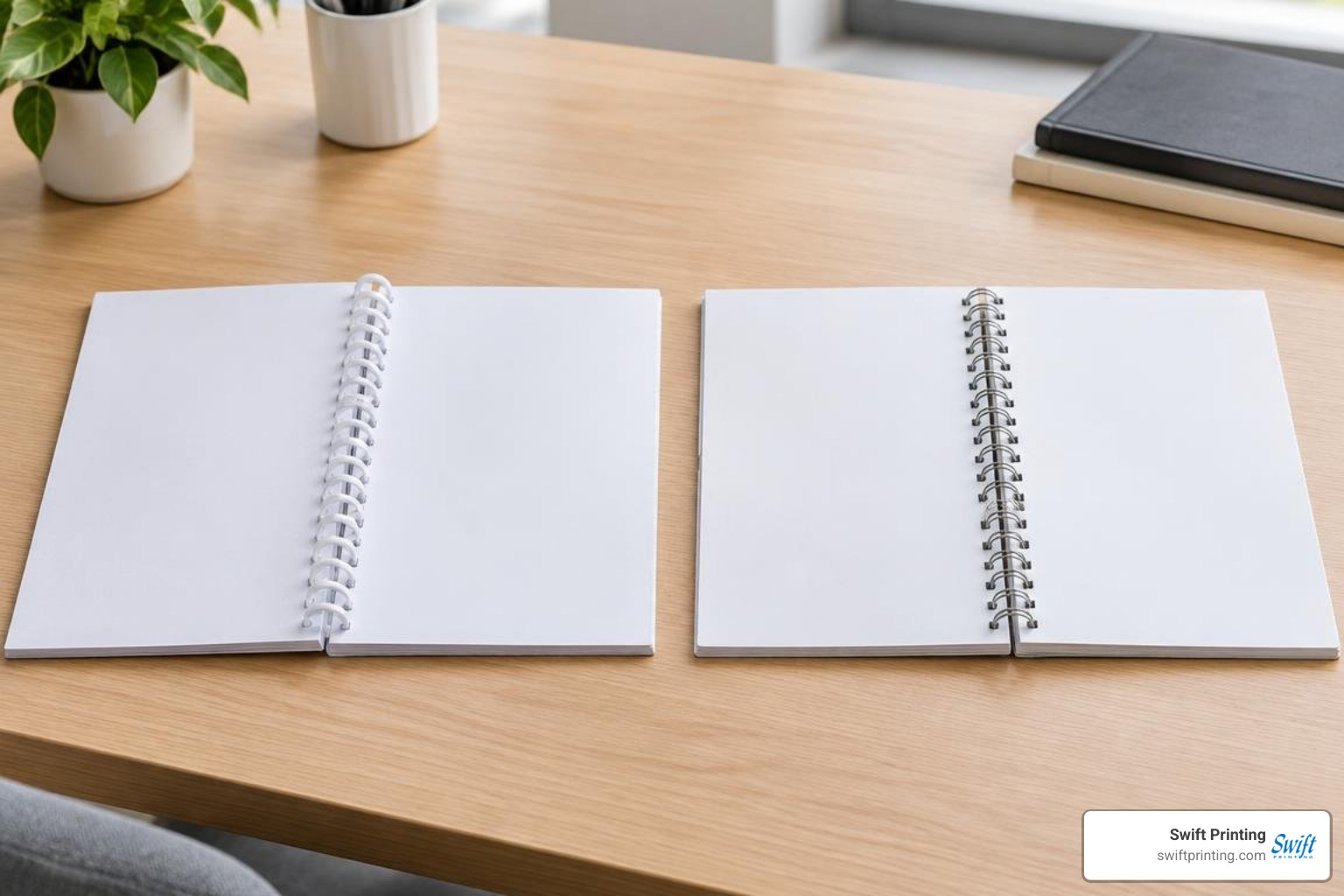
While comb binding relies on interlocking plastic fingers that can catch or open during heavy use, a continuous spiral strand threads entirely through the document block from top to bottom. For high-demand applications, exploring robust commercial book binding techniques ensures your documents withstand repeated handling without page separation.
Lay-Flat Usability and 360-Degree Rotation
One of the defining functional advantages of spiral coils is true 360-degree rotation. Readers can open a document and fold the front cover completely behind the back cover, cutting the required desk footprint in half. This makes the format indispensable for busy workspaces, such as hospital workstations, executive conference tables, legal desks, and podiums. Pages turn smoothly across the helical spine without binding or popping loose, offering effortless, hands-free reference during crucial presentations.
Technical Specifications: Pitches, Diameters, and Materials
Achieving a clean, elegant finished booklet requires precise alignment between sheet count, paper caliper, hole spacing, and coil dimensions. Understanding these technical parameters ensures your materials function smoothly without page binding or unnecessary bulk.
Selecting the Right Pitch for Coil Spiral Binding Projects
Pitch refers to the exact number of holes punched per linear inch along the binding edge. Choosing the right pitch dictates the strength of the bind and determines how easily pages glide around the spine.
- 4:1 Pitch (Standard): Four holes per inch (0.250-inch center-to-center spacing). This is the industry standard for most business and institutional applications, compatible with a broad range of coil diameters from small booklets up to high-capacity manuals.
- 5:1 Pitch (High-Density): Five holes per inch. This tighter pattern provides a refined look for smaller, thinner booklets, though it is typically reserved for documents under 1 inch in thickness.
- 3:1 Pitch (Heavy-Duty): Three holes per inch. Primarily used for very large volumes and thick book blocks, allowing heavy-gauge filament to pass cleanly through larger punched holes.
When coordinating custom coil-bound booklet printing, selecting the appropriate pitch and gutter margin ensures your printed text and graphics remain unobstructed by the punched edge.
Coil Sizing and Eco-Friendly Material Options
Spine diameters range from 6 mm (1/4 inch) for thin handouts holding roughly 30 sheets, all the way up to 50 mm (2 inches) accommodating approximately 450 sheets of standard text weight.
Modern commercial production incorporates sustainable plastic coil manufacturing processes. Spines can be manufactured using high-grade PVC, fully recyclable PETG compounds, or reclaimed polymers containing over 95% post-commercial waste. With over 45 standard color options available, organizations can effortlessly match their brand standards or use color coding across multi-volume document sets.
| Coil Diameter (mm / inches) | Approximate Sheet Capacity (20# Bond) | Recommended Book Block Thickness |
|---|---|---|
| 6 mm (1/4") | 30 Sheets | Up to 1/8" |
| 8 mm (5/16") | 50 Sheets | Up to 3/16" |
| 10 mm (3/8") | 70 Sheets | Up to 1/4" |
| 12 mm (1/2") | 90 Sheets | Up to 3/8" |
| 16 mm (5/8") | 125 Sheets | Up to 1/2" |
| 20 mm (3/4") | 170 Sheets | Up to 5/8" |
| 25 mm (1") | 215 Sheets | Up to 7/8" |
| 38 mm (1-1/2") | 310 Sheets | Up to 1-1/4" |
| 50 mm (2") | 440–450 Sheets | Up to 1-3/4" |
The Step-by-Step Production Process and Equipment Features
Creating a high-end coil-bound booklet requires meticulous bindery craftsmanship. Every step—from sheet alignment to the final dual-end crimp—influences how the finished piece handles in the reader's hands.
Precision Punching, Inserting, and Crimping Techniques
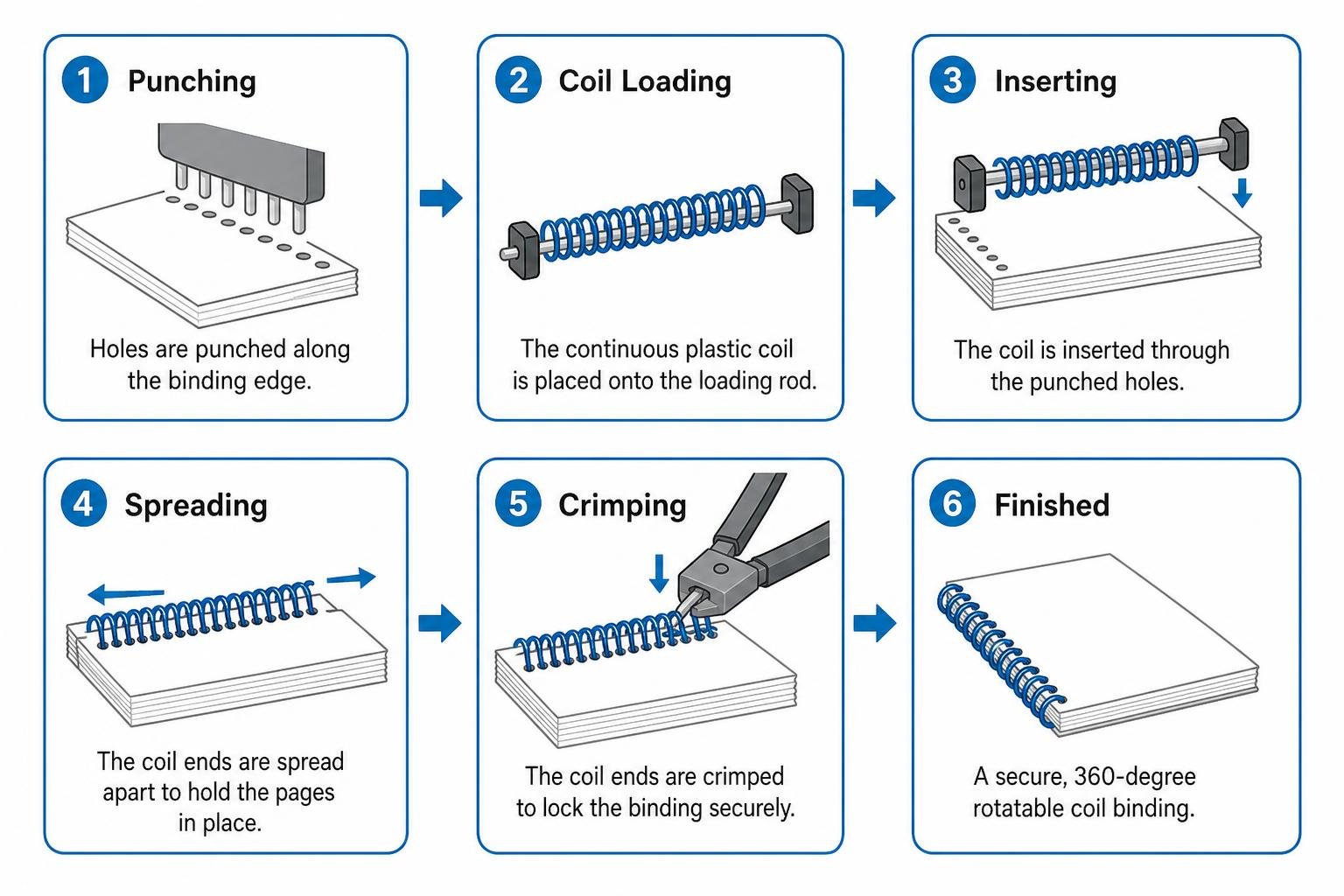
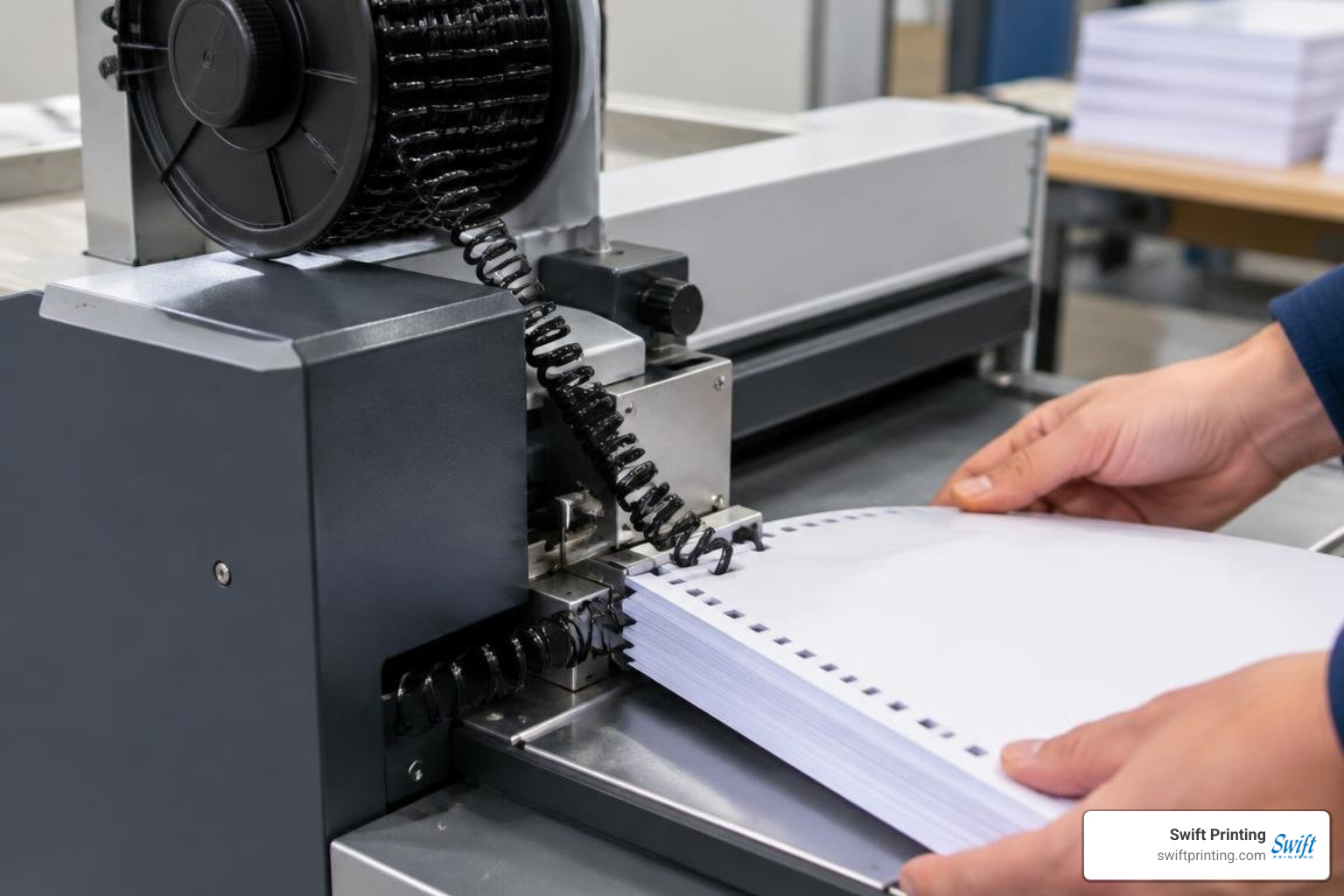
- Precision Paper Punching: Pages are jogged perfectly square and punched along the gutter. Commercial dies produce clean, uniform holes—either round or oval. Oval holes offer a slight mechanical advantage by allowing the helical coil to advance naturally at an angle with minimal friction.
- Spine Insertion: The plastic coil is threaded through the first several holes. An electric roller mechanism spins the continuous coil through the entire length of the document stack in seconds.
- Dual-End Cutting and Crimping: Specialty crimping pliers or automated pneumatic blades cut the excess plastic filament and bend the terminal ends inward at a 45-to-90-degree angle. This secure crimp prevents the spine from unspooling during use.
Understanding these detailed bindery options here at swift helps clients select the right finishes for their presentation booklets, employee manuals, and boardroom reports.
Production Machine Features for Custom and Oversized Documents
Commercial print shops utilize heavy-duty equipment designed to handle demanding specifications:
- Disengageable Punch Pins: Allow operators to deactivate individual punch pins. This prevents half-punched or notched holes on non-standard sheet dimensions, such as custom legal filings or square booklets.
- Open-Throat Punch Design: Enables continuous punching across oversized documents, architectural proposals, and large-format spreadsheets by sliding sheets through multiple punch passes.
- Adjustable Punch Depth: Modifies the distance between the punched holes and the paper edge. Thicker books require deeper margins to ensure pages do not tear under their own weight.
For a complete overview of booklet production formats, our booklet printing ultimate guide 2026 offers in-depth insight into page setup and bindery workflows.
Ideal Professional Applications for Coil-Bound Booklets
Because of its structural integrity and functional convenience, spiral coil binding is widely specified by law firms, medical groups, engineering consultancies, and municipal offices across West Michigan.
Corporate Handbooks, Legal Briefs, and Medical Manuals
- Healthcare Protocols: Clinical reference books must lie flat on nursing station counters without snapping shut. Laminated index tabs and synthetic water-resistant paper pair seamlessly with durable plastic coils.
- Corporate Training Workbooks: Ideal for multi-day seminars where attendees write notes, flip pages constantly, and fold booklets back to save space on classroom desks.
- Legal Filings and Case Files: Large deposition transcripts and exhibits remain secure and organized across hundreds of pages without spine failure. When comparing mechanical binding to folded booklet formats, our a4 saddle stitch guide 2026 illustrates how page count influences spine selection.
Brand Customization with Vibrant Color Match Options
Coil binding supports sophisticated custom branding. Spines can be matched to corporate color schemes, whether paired with heavy frosted poly covers, embossed linen cardstocks, or soft-touch laminates. For executive presentations requiring a traditional bookshelf presence, concealed coil binding encloses the spiral spine inside a hardback or wrapped cover, allowing titles to be stamped along the spine while maintaining full lay-flat functionality.
For broader commercial publishing strategies, consult our commercial book printing guide 2026 to evaluate how various binding options impact reader engagement.
Frequently Asked Questions About Coil Binding
Can pages be added or removed from a coil-bound document?
While coil binding is considered a permanent bind, documents can be revised if necessary. To update content, the crimped end is snipped off, the plastic coil is spun out of the punched stack, revised pages are inserted, and a fresh coil is wound through and re-crimped. This ensures document security during normal use while retaining serviceability when updates are required.
What is the maximum document thickness for spiral coil binding?
Spiral coil binding accommodates book blocks up to 2 inches thick, which translates to roughly 440 to 450 sheets of standard 20# copy paper or 200 to 250 sheets of heavier premium text stock. For extensive documents, selecting proper finishing options for printing ensures gutter clearance and page flexibility are fully maintained.
Are plastic spiral coils recyclable?
Yes. Modern plastic coils produced from PETG compounds are fully recyclable within standard municipal and commercial plastic recycling streams. When recycling a booklet, the plastic coil can be spun off the paper stack, allowing both the paper and the polymer spine to be processed in their respective recycling streams.
Conclusion
Spiral coil binding remains a cornerstone of professional document finishing because it effortlessly bridges durability, visual elegance, and everyday usability. Whether you are producing critical medical procedural guides, legal presentations, or corporate training collateral, choosing the right coil diameter, pitch, and cover materials ensures your documents perform reliably under heavy use.
At Swift Printing, we are a boutique print shop setting the standard for printing excellence. From our facility in Grand Rapids, Michigan, we partner with professional services, healthcare systems, and regional organizations across Ada, Belmont, Rockford, Kalamazoo, and Lansing to produce bespoke printed materials done right and on time. If you are planning your next publication, our local team is ready to guide you through paper selection, cover embellishments, and precision mechanical binding. Explore our full range of solutions at Swift Printing or reference our book printing grand rapids guide 2026 to get your project started today.