Commercial Book Binding and Industrial Printing Demystified
Methods and Mechanics of Commercial Book Binding
To understand modern commercial book binding, it helps to see how the industry evolved. Historically, bookmaking was an exacting handcraft. Medieval artisans folded parchment sheets into small booklets called signatures, hand-stitched them with linen thread, and secured them between heavy wooden boards wrapped in leather. This painstaking approach ensured books lasted for centuries, but it made volume production impossible.
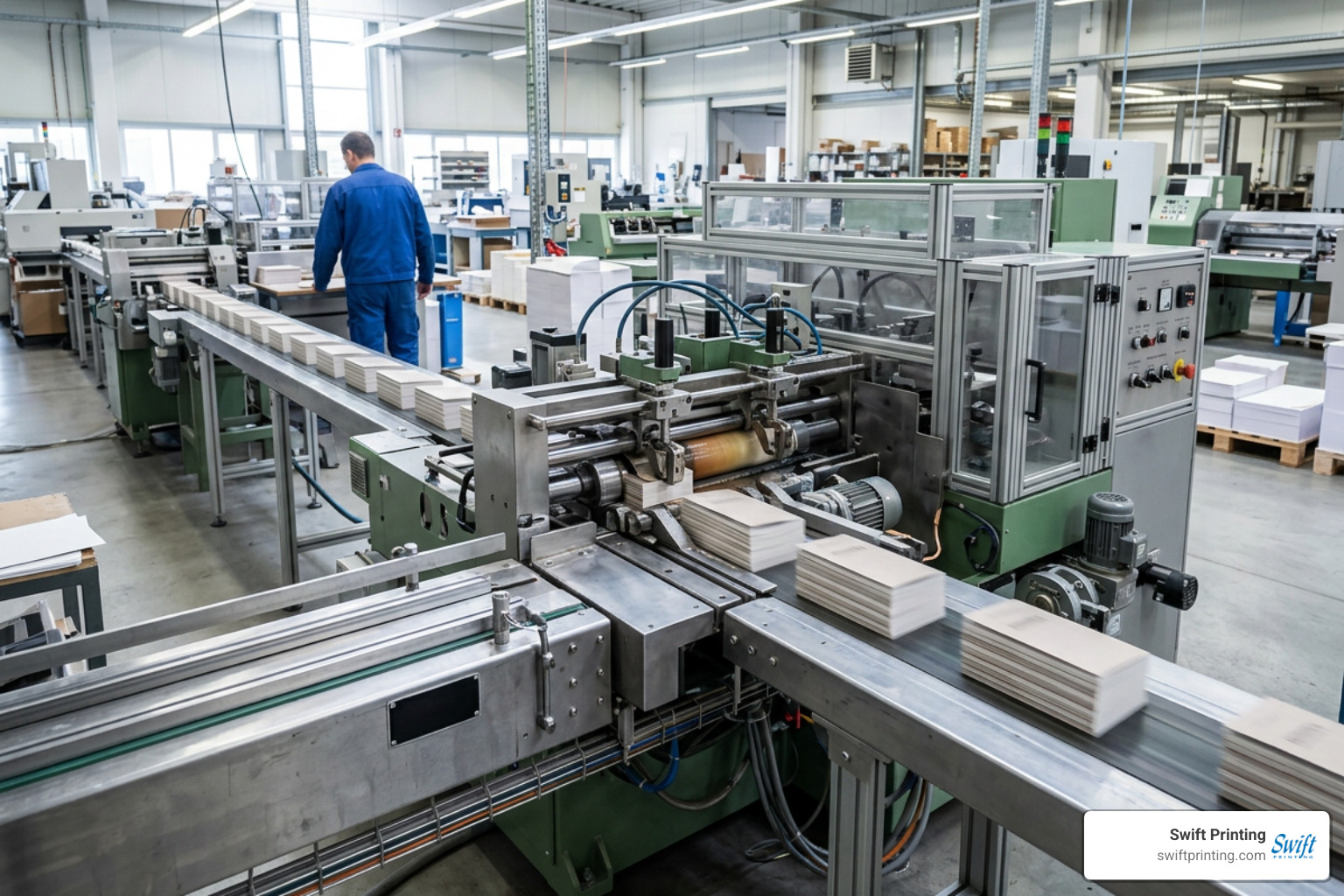
The Industrial Revolution transformed this landscape. In the 19th and 20th centuries, automated folding, mechanical sewing, and high-speed rotary trimmers replaced hand tools. Today, modern binderies combine traditional mechanical principles with high-speed automation to produce thousands of finished volumes per hour.
Different publications demand different binding mechanics. Here is how the primary commercial methods compare:
| Binding Method | Structural Mechanics | Best For | Typical Durability | Lay-Flat Capability |
|---|---|---|---|---|
| Perfect Binding | Cut leaves glued directly to cover spine with EVA or PUR adhesive | Paperbacks, thick catalogs, corporate reports | Moderate to High | Low to Moderate |
| Case Binding | Sewn or glued book block attached to rigid boards via endpapers | Hardcover fiction, textbooks, reference books | High to Extreme | Moderate to High |
| Saddle-Stitching | Wire staples driven through the centerfold fold line | Magazines, event programs, thin booklets | Low to Moderate | High |
| Spiral / Coil | Continuous plastic coil threaded through punched edge holes | Cookbooks, training manuals, workbooks | Moderate | Complete (360°) |
| Wire-O / Double-Wire | Twin-loop wire spines crimped through punched rectangular slots | Annual reports, executive presentations | Moderate to High | Complete (360°) |
Choosing the correct finishing option hinges on page count, reader usage, and budget. For instance, saddle-stitching works exceptionally well for lighter documents under 64 pages, while thicker corporate manuals require the structural support of mechanical wire or perfect binding. To explore how these choices fit into your post-press production, review our overview of behind the print: what happens after the ink dries.
Softcover vs Hardcover Mechanics
The primary structural divide in book manufacturing lies between softcover (paperback) and hardcover (case-bound) mechanics.
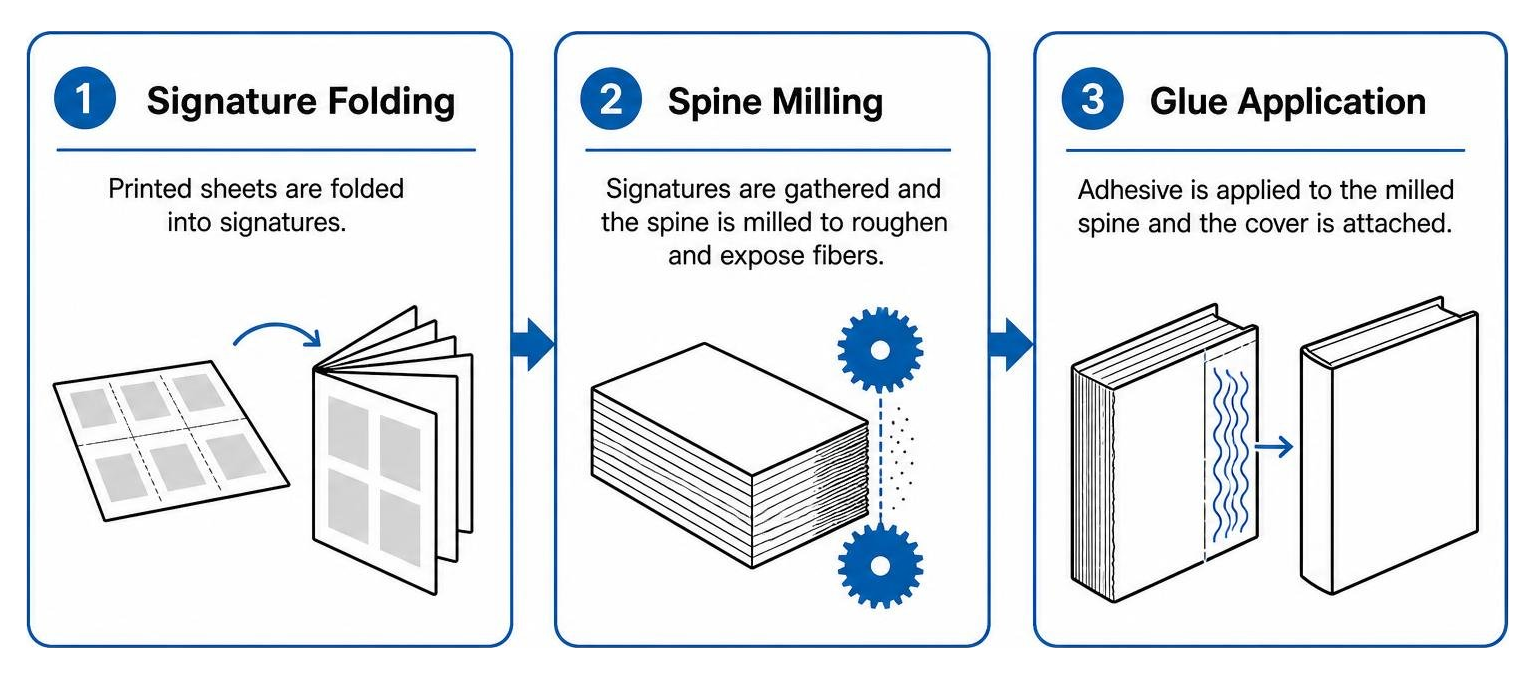
Softcover production generally uses trade paperback or mass-market paperback techniques. Printed press sheets are folded into multi-page sections called signatures (typically 8, 16, or 32 pages). In standard trade paperbacks, these signatures are gathered, milled flat along the spine edge to expose individual fibers, and glued directly inside a heavy cardstock cover.
Hardcover binding takes a more complex approach. Rather than relying solely on glue to hold single leaves, premium hardcovers use Smyth sewing (sewing through the fold). Each folded signature is stitched along its spine fold line before being joined to adjacent signatures. This creates a strong, flexible book block.
Because the pages are sewn through the center of each fold rather than cut into loose leaves, Smyth-sewn books offer superior lay-flat capability without tearing. Proper layout planning before printing ensures margins and creep are accounted for prior to folding. Learn more about preparing your files in our guide on behind the print: what happens before your project ever hits the press.
Adhesive Technologies and Cover Material Durability
In adhesive-based commercial book binding, glue selection directly controls spine strength, lay-flat performance, and long-term shelf life.
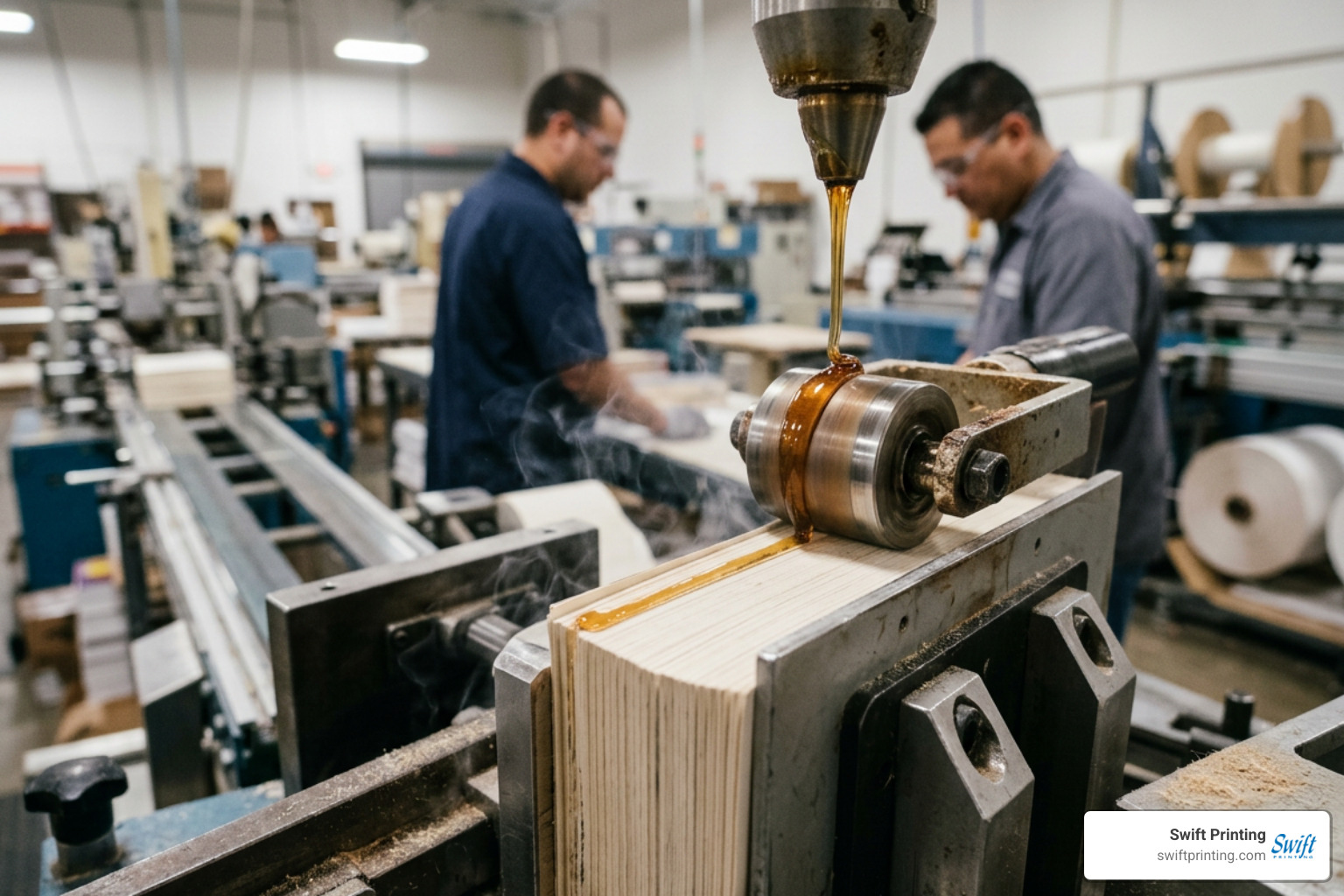
Commercial binderies rely on two main adhesive technologies:
- EVA (Ethylene Vinyl Acetate): A traditional hot-melt thermoplastic glue. It melts quickly, sets in seconds, and provides a cost-effective solution for standard uncoated paper stocks. However, EVA can become brittle over time or degrade when exposed to extreme temperatures.
- PUR (Polyurethane Reactive): A modern adhesive that cures through a chemical reaction with atmospheric moisture rather than simple cooling. Once cured, PUR forms a molecular cross-linked bond that is virtually indestructible.
PUR adhesive offers exceptional pullout resistance on heavy, coated, or synthetic paper stocks that EVA struggle to hold. It also remains flexible across extreme temperature ranges (-40°F to 200°F) and allows books to lay flatter without cracking the spine.
Cover materials also influence durability and aesthetic feel:
- Roxite F Buckram: A durable poly-cotton cloth with an acrylic coating. It has been the gold standard for institutional library bindings for over a century due to its resistance to water, mildew, and abrasion.
- Standard Bookcloth: A woven fabric laminated to a paper backing, offering a classic tactile texture.
- PU Leather & Genuine Leather: Premium synthetic or real leather surfaces used for executive volumes, luxury editions, and custom Bibles.
- Heavyweight Coated Paper: Standard 10 pt to 12 pt cover stock, often finished with gloss, matte, or soft-touch lamination to protect softcover books from scuffs.
To compare all cover materials and finishes for your next project, explore our detailed list of finishing options for printing.
The Commercial Hardcover Workflow from Block to Case
Manufacturing a hardcover book requires two independent production paths that join in a final assembly stage called "casing-in."
- Book Block Preparation: Printed press sheets are folded into signatures and gathered in numerical order. The spine is glued or Smyth-sewn, and the remaining three edges are trimmed using a three-knife trimmer.
- Case Construction: Heavy greyboard or chipboard (typically 1.5 mm to 4.0 mm thick) is cut to size for the front cover, back cover, and spine stiffener. A automated case maker applies glue to the cover wrap material, places the boards with tight precision, and folds the edges neatly over the board perimeters (turning-in).
- Casing-In: The finished book block is aligned inside its rigid case. Glue is applied to the outer faces of the endpapers (the folded sheets tipped onto the front and back of the book block), securing the block to the inner covers.
- Pressing and Creasing: Machine clamps apply heavy pressure along the book's outer hinges while applying heat to set the adhesive and form clean joint creases.
Spine titling conventions vary across international markets. The American and English convention prints spine text top-to-bottom. When the book lies flat, cover facing up, the title remains right-side-up. Conversely, many European countries use a bottom-to-top convention, allowing titles to be read vertically when books stand upright on a shelf.
Specialty operations like academic thesis binding follow strict formatting guidelines that dictate foil stamping, margin dimensions, and casing rules for institutional archives.
Quality Control in Commercial Book Binding Production
Maintaining strict quality control prevents common bindery defects like weak hinges, misaligned covers, and page pullout.
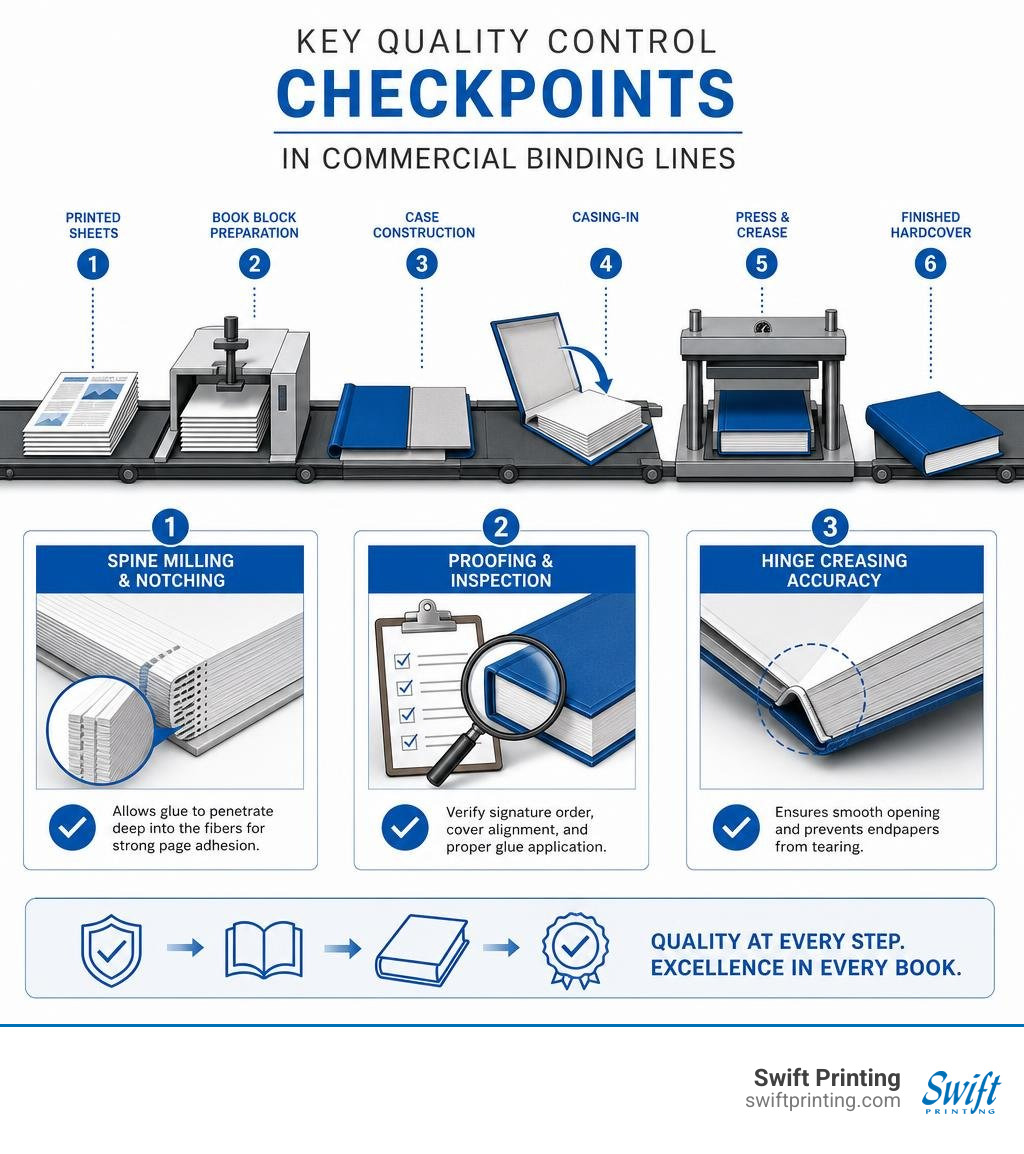
Key quality checks include:
- Spine Milling and Notching: Before gluing perfect-bound books, mechanical blades mill off the spine folds and carve small notches into the paper block. This lets the adhesive penetrate deep into the fibers, preventing individual pages from pulling free.
- Proofing and Inspection: Operations perform sequential inspections throughout production—checking signature gathering, cover alignment, and glue application density before mass production runs.
- Hinge Creasing Accuracy: Ensuring precise pressure along the hinge joint guarantees the cover opens smoothly without tearing the endpapers away from the spine block.
When planning production timelines, accounting for adhesive curing and quality inspection steps ensures flawless execution. You can check our standard scheduling guidelines on our turnaround times page.
Industrial Equipment and Machinery Selection
Selecting the right commercial machinery depends on volume requirements, setup speed, and formatting diversity.
- Manual & Tabletop Equipment: Best suited for short runs, custom editions, and print-on-demand shops where manual adjustments allow maximum custom flexibility on single-copy orders.
- Semi-Automatic Machines: Ideal for short-to-medium runs. A prime example is the KY-380 Case Maker, which combines manual cover placement with automatic board feeding. Achieving mechanical positioning accuracy within ±0.05 mm, a theoretical speed of 2 pieces per minute, and job setup times under 5 minutes, semi-automatic units significantly reduce setup downtime.
- Fully Automatic Inline Lines: Designed for high-volume commercial production. These systems feature automated signature gatherers, inline binders, three-knife trimmers, and robotic stackers that process thousands of books per hour with minimal operator intervention.
Integrating modern PLC (Programmable Logic Controller) touchscreens allows operators to save exact job dimensions, cutting changeover times from nearly an hour down to under 5 minutes. Learn more about our equipment setup by visiting bindery options here at Swift.
Restoring Classic Texts vs Modern Commercial Book Binding
While commercial bookbinding relies on speed and automation, restoring historic or rare books requires a completely different approach.
Unlike high-speed commercial lines, conservation focuses on reversibility and historical accuracy. Restorers avoid aggressive hot-melt glues, using water-soluble Polyvinyl Acetate (PVA) glues or archival wheat starch pastes instead. Spines are reinforced with 100% cotton backing cloth to restore hinge strength without altering the book's structural integrity.
Frequently Asked Questions About Commercial Binding
What is the difference between EVA and PUR perfect binders?
EVA is a traditional hot-melt adhesive that sets quickly as it cools, making it ideal for low-cost, uncoated paper runs. PUR (Polyurethane Reactive) cures through a moisture-activated chemical process that forms a much stronger, more flexible bond. PUR is the preferred choice for heavy stock, coated papers, or books that must lie flat without cracking the spine.
How do top-to-bottom and bottom-to-top spine titling conventions differ?
Top-to-bottom orientation is the standard convention in North America and the UK; when a book lies flat with the front cover facing up, the spine text reads correctly from left to right. Bottom-to-top titling is commonly used in Continental Europe, making the spine readable when the book stands upright on a shelf.
What key factors determine whether to choose manual, semi-automatic, or fully automatic machines?
The primary factors are daily production volume, setup changeover frequency, and labor costs. Manual and semi-automatic machines excel at short-run print-on-demand jobs with setup changeovers under 5 minutes. Fully automatic lines require longer setup times but deliver significantly lower per-unit costs on long production runs.
Conclusion
Understanding commercial book binding allows you to make informed decisions for your print projects, balancing durability, aesthetic appeal, and overall cost.
At Swift Printing in Grand Rapids, Michigan, we bring decades of industrial craft to every project we touch. As one of only two Certified B Corporations in the global printing industry, we pair state-of-the-art bindery capabilities with an uncompromising commitment to people, community, and environmental stewardship.
Ready to bring your next book project to life with eco-friendly commercial finishing? Explore Swift Printing Commercial Services or reach out to our team today to get started!