Step-by-Step Guide to Ordering an A4 Saddle Stitch Booklet
Step 1: Design Specifications and Layout for an A4 Saddle Stitch Booklet
To successfully design and order an a4 saddle stitch booklet, build your artwork to finish at 8.27 x 11.69 inches (210 x 297 mm) by designing flat A3 spreads (11.69 x 16.54 inches / 297 x 420 mm). Ensure your document uses a total page count in strict multiples of four (such as 8, 12, 16, 20, or 24 pages), incorporates a standard 0.125-inch (3 mm) bleed on all exterior margins, maintains a 0.25-inch (6 mm) safety margin inside trim edges, and exports as a single-page CMYK PDF at 300 DPI in sequential reading order.
Getting your layout right at the start saves time, money, and headaches on press. In North America, standard letter size (8.5 x 11 inches) is widespread, but international distributions, global corporate presentations, and specialized mailers frequently require standard A4 dimensions governed by the ISO 216 international paper standard.
When you assemble an A4 saddle-stitched piece, your document starts flat as an A3-sized spread before being folded in half down the center spine and fastened with sturdy wire staples. Understanding Now You're Talking Our Language: Printing Terms and What They Mean so Your Projects Look Their Best ensures that terms like bleed, trim, and creep are second nature when communicating with our bindery team.
Always include a standard 0.125-inch (3 mm) bleed on all four sides of every page. Keep crucial live text and graphics at least 0.25 inches (6 mm) inside the final trim line to protect them during high-speed mechanical cutting and trimming.
Page Imposition and Multiples of Four
Because a saddle-stitched booklet is constructed from folded sheets nested inside one another, every single physical sheet of paper creates four distinct numbered pages (front left, front right, back left, back right). As a result, your page count must always be a multiple of four: 8, 12, 16, 20, 24, and so on.
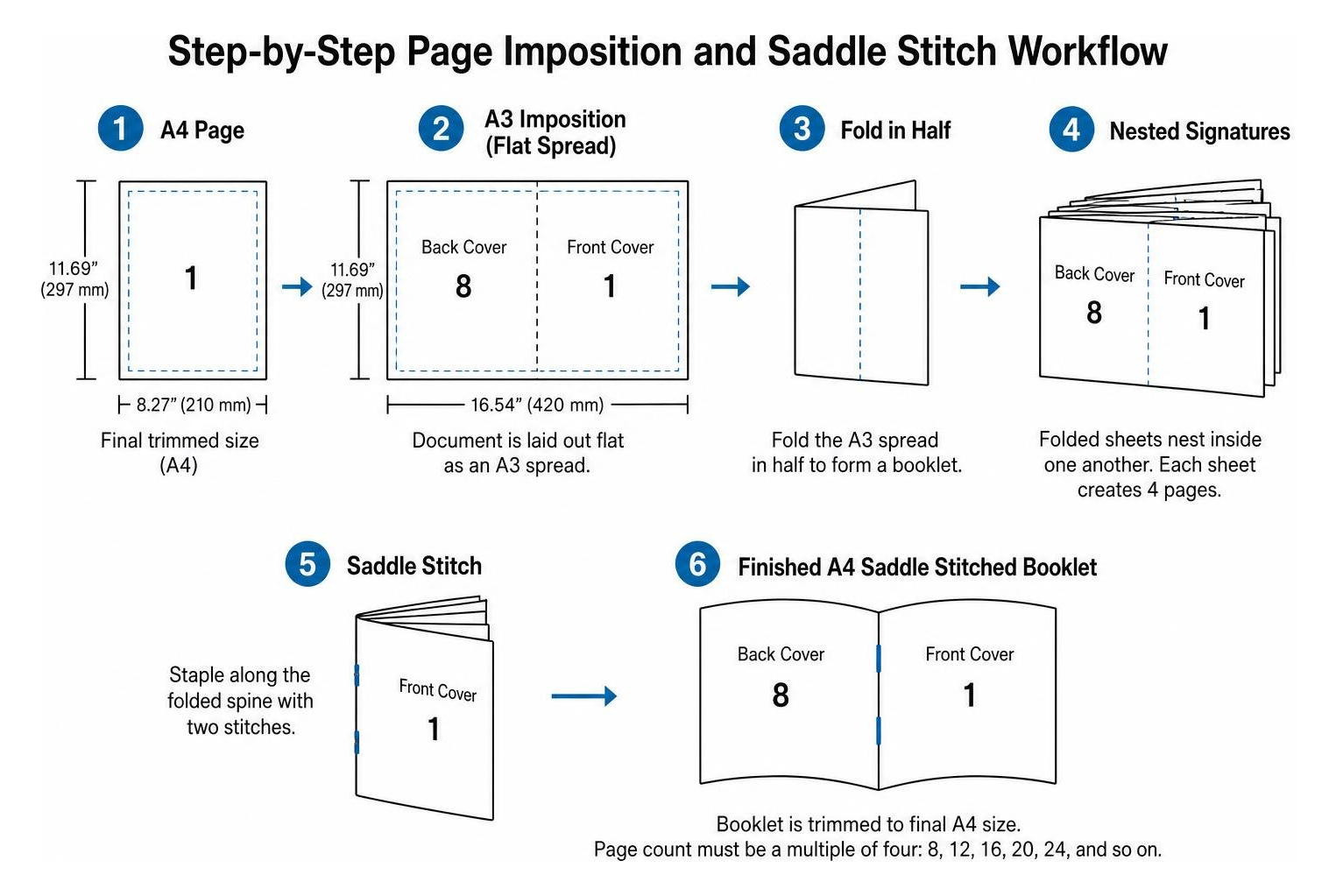
If your artwork file has 10 or 14 pages, your production team will have to insert blank pages to balance the sheet imposition. Keep page numbering aligned sequentially from the front cover (Page 1) to the back cover so our automated prepress software can easily position the spreads for folding and stitching.
Choosing Paper Weight and Page Count for an A4 Saddle Stitch Booklet
Paper weight influences readability, durability, mailing costs, and spine bulk. For standard self-cover booklets—where the cover uses the exact same paper stock as the interior pages—we recommend 50 lb to 80 lb text stock (80 gsm to 120 gsm).
- 50 lb to 60 lb Text (80 to 90 gsm): Lightweight, economical, and ideal for publications ranging from 8 to 12 pages, especially when secondary mailing folds are planned.
- 70 lb to 80 lb Text (100 to 120 gsm): Offers higher opacity to prevent ink show-through on image-heavy catalogs and corporate reports.
- Heavy Cover Option (80 lb to 100 lb Cover / 215 to 270 gsm): Adds a premium feel, though it increases spine rigidity and limits secondary folding options.
When projects exceed 32 pages, page creep occurs: the innermost sheets are pushed outward past the outer sheets. A skilled commercial printer will automatically calculate and compensate for creep during prepress file handling.
Step 2: Preparing Artwork and Prepress Verification
Before sending files to press, thorough prepress verification ensures that colors render accurately, spine alignment matches imposition templates, and fine details stay crisp. Reviewing The 10 Most Common Print File Mistakes and How to Avoid Them helps eliminate missing fonts, low-resolution imagery, and incorrect color profiles before production begins.
Export your artwork as a high-resolution, print-ready PDF (PDF/X-1a or PDF/X-4 standard) using individual, single-page reading order rather than pre-imposed reader spreads. Ensure all images are formatted in CMYK at 300 DPI or higher, and verify that all fonts are fully embedded or converted to outlines.
Key prepress checks to verify before submitting your files:
- Color Profile: Convert all RGB elements, spot inks, and Pantone colors to standard CMYK unless your project specifically quotes dedicated Pantone station passes.
- Image Resolution: Keep raster graphics at a minimum of 300 DPI at 100% scale to avoid visible pixelation during commercial offset or digital printing.
- Bleed and Crop Marks: Include full 0.125-inch bleed extensions past the cut line, while keeping crop marks outside the bleed zone.
- Transparency Flattening: Flatten complex vector transparencies and drop shadows or utilize PDF/X-4 compatibility to preserve live vector paths cleanly.
Step 3: Secondary Finishing and Crash Folding Options
Many organizations require an A4 booklet that can fit neatly into standard mailing envelopes without switching to large, expensive flat-rate catalog envelopes. This is where secondary post-press finishing comes in. Exploring the full range of Bindery Options Here at Swift helps you choose the most reliable route for folding, scoring, and envelope insertion.
| Finishing Method | Best Volume Range | Equipment Used | Key Advantages | Primary Limitations |
|---|---|---|---|---|
| Manual / Semi-Automated Creasing | 50 – 500 units | Hand creasers, tabletop friction units | Low initial setup cost; gentle on spine | High labor time per unit; inconsistent throughput |
| In-House Knife / Digifold Systems | 500 – 1,400 units | Morgana Digifold, knife folders | Consistent automated crease and fold; prevents cracking | Requires precise roller gap and spine positioning |
| High-Speed Commercial Inserters | 1,400+ units | Dedicated inline folding & mailing equipment | Maximum throughput; lowest unit labor cost | Strict paper stock and page count limits |
Crash Folding an A4 Saddle Stitch Booklet for Direct Mail
Crash folding is the mechanical process of taking a fully bound, saddle-stitched booklet and making a secondary right-angle fold across the spine. An A4 booklet (210 x 297 mm) is typically folded in thirds to DL size (210 x 99 mm), which measures roughly 4 x 8.27 inches.
This DL finished size slips easily into standard DL or #10 commercial mailing envelopes, allowing businesses to qualify for standard USPS letter rates rather than costly flat rates. For successful crash folding, stick to 8 to 12 pages on lightweight stock (80 to 120 gsm) to keep spine thickness manageable.
Mechanical Limitations and Folder Equipment
Standard buckle folders rely on rubber rollers that pinch paper into a folding plate. When feeding a multi-page saddle-stitched spine into a buckle folder, standard friction rollers can slip or buckle unevenly, potentially damaging the wire staples.
To prevent spine damage and paper tearing:
- Use knife-folding mechanisms, which guide the booklet through the fold with a mechanical blade rather than friction plates.
- Open roller gaps slightly to accommodate the added thickness of the stitched spine.
- Pre-score or crease thick stock along the fold lines to prevent surface toner cracking.
Step 4: Selecting Commercial Binding Workflows and Run Sizes

Whether you need 250 copies for a regional conference or over 1,400 pieces for a recurring direct-mail campaign, choosing the right production workflow controls your bottom line. Our comprehensive guide to Commercial Book Binding highlights how run length and equipment selection drive overall efficiency.
For short runs (under 500 units), manual or semi-automated creasing keeps setup costs manageable. For medium-to-large runs exceeding 1,400 units, high-speed automated stitching and inline folding drastically reduce manual labor overhead, delivering lower per-unit pricing in USD alongside swift turnarounds.
Frequently Asked Questions About A4 Saddle Stitched Booklets
Can an A4 saddle-stitched booklet be folded to DL envelope size?
Yes. An A4 booklet (210 x 297 mm) can be crash-folded down to DL size (210 x 99 mm, or approx. 4 x 8.27 inches) to fit standard DL or #10 mailing envelopes. To ensure a flat, neat fold, keep the page count between 8 and 12 pages on 50 lb to 80 lb text stock (80 to 120 gsm).
What is crash folding in commercial print finishing?
Crash folding refers to applying a secondary fold to an already bound, stitched, or glued piece. Because the wire staples and nested sheets add physical bulk, crash folding requires knife folders or creaser-folder systems to fold cleanly across the spine without jamming or tearing.
What is the most cost-effective folding method for runs over 1,400 pieces?
For runs of 1,400 pieces or more, automated inline knife folding or specialized mailing-house finishing equipment is the most cost-effective solution. Automated setups minimize labor overhead, ensure consistent fold alignment, and keep unit costs low.
Conclusion
Creating a successful A4 saddle-stitched booklet comes down to smart upfront planning—from confirming page counts in multiples of four to selecting the right stock weights for post-press crash folding.
At Swift Printing, we blend decades of hands-on bindery expertise with an unwavering commitment to sustainable, responsible manufacturing. As one of only two Certified B Corporations in the commercial printing industry worldwide, we make sure your print collateral supports both your business goals and the planet. Reach out to Swift Printing today to review your project specifications, request paper samples, or get a custom quote.