How to Choose the Right Commercial Book Printing Service
Advantages of Commercial Book Printing
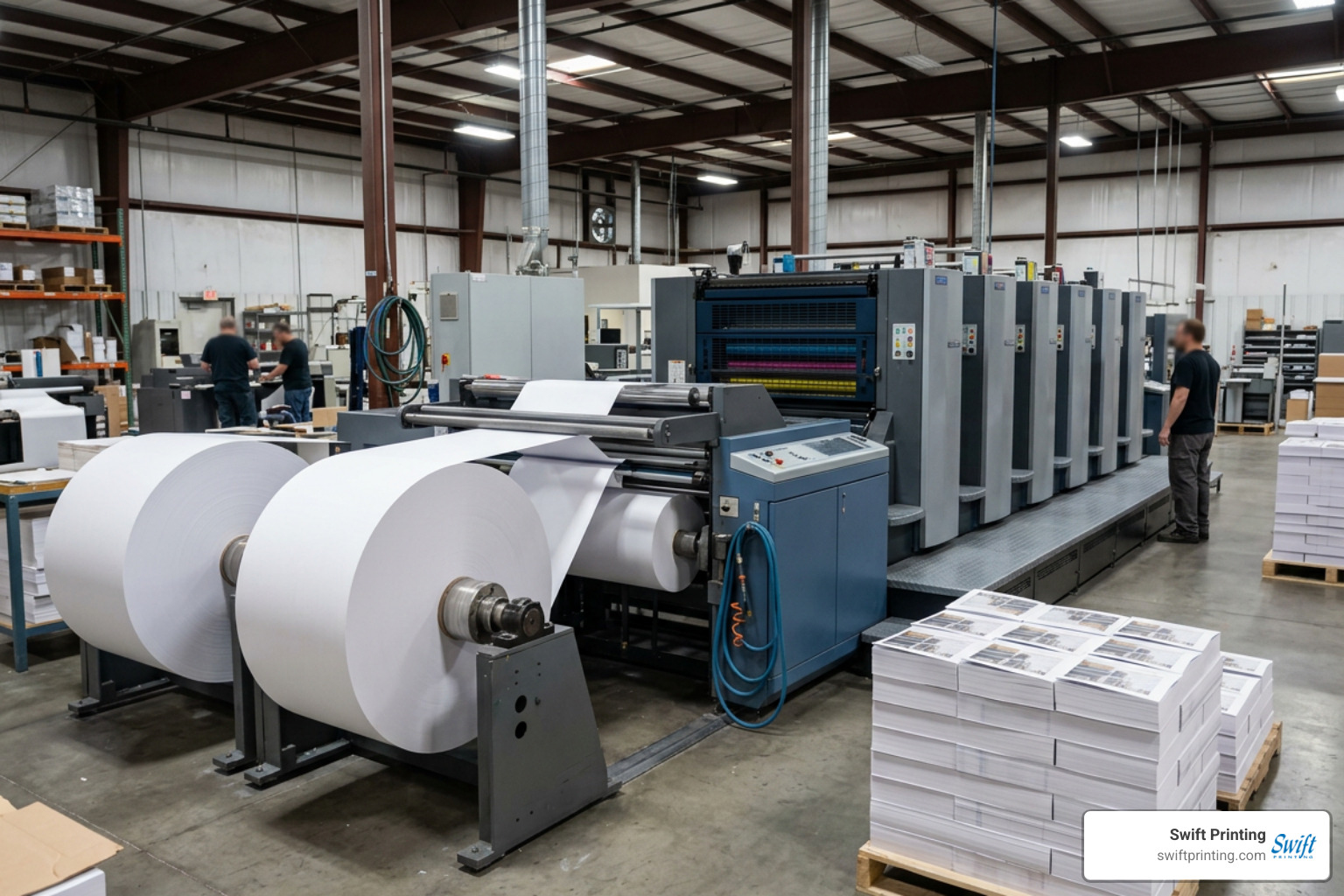
When you choose commercial book printing, you unlock a realm of production flexibility and economic advantage that simply isn't available through standard print-on-demand (POD) platforms or simple copy shops. Print-on-demand services are convenient for single copies, but as soon as your project requires volume, distinct finishes, or specialized paper, commercial printing becomes the clear winner.
In fact, total commercial printing market shipments demonstrate how integral physical media remains to business operations, with the U.S. industry generating $78.4 billion in shipments in recent years—and books taking up roughly 8% of that overall volume. Choosing commercial production gives you complete inventory control and significant per-copy savings while delivering high-end tactile quality that builds creditability for your brand.
Evaluating Minimum Order Quantities in Commercial Book Printing
One of the first questions clients ask us involves minimum order quantities (MOQs) and pricing scaling. While print-on-demand prints one off at a high unit cost, commercial printing relies on economies of scale.
Consider the average market costs in the United States: printing a standard 200-page paperback book typically costs around $3.50 per copy for a modest run of 1,000 copies. However, when you scale that volume up to a run of 10,000 copies, the unit price drops dramatically to approximately $1.20 per copy.
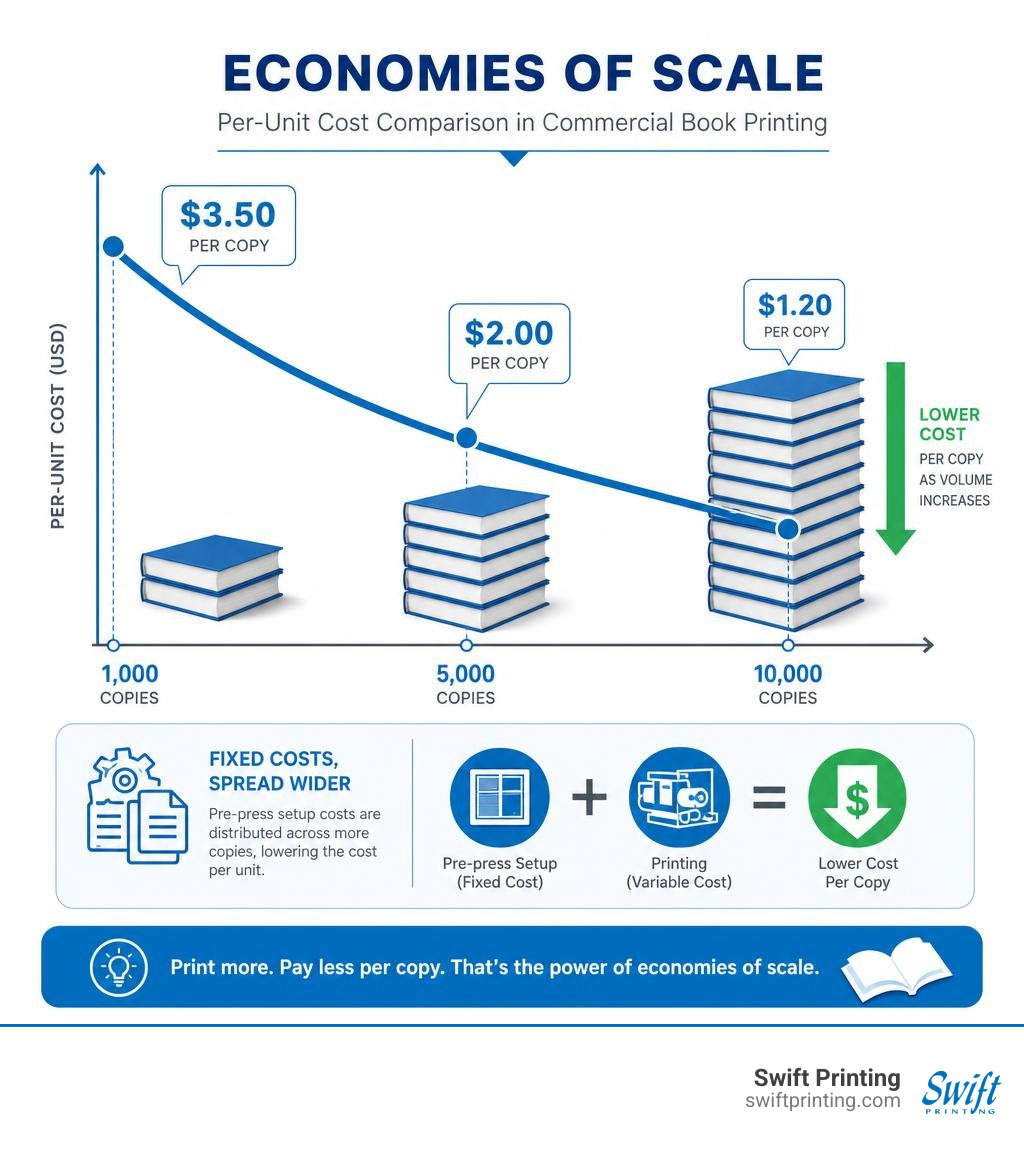
This steep price drop happens because fixed pre-press setup costs (such as prepress file handling, plate making, and press adjustments) are distributed across a far greater number of units. When evaluating your volume needs:
- Short Runs (100–500 copies): Ideal for limited printings, local distribution, or targeted corporate events.
- Medium Runs (500–2,000 copies): Excellent balance of reduced per-unit costs without forcing you to store massive amounts of physical inventory.
- Large Runs (2,000+ copies): Delivers maximum cost efficiency and lowest unit pricing for wide retail or organizational distribution.
Exploring our full line of print Products can help you visualize how different formats scale efficiently across volume tiers.
Print Quality and Customization Control
Beyond the financial savings, commercial book printing grants complete creative authority over your final product. Instead of choosing from two or three basic stock paper options, you have access to an incredible library of paper stocks, custom trims, and finishings.
You can select precise cover embellishments like foil stamping, embossed text, spot UV coatings, or specialized soft-touch laminates. You also gain accurate color matching using Pantone Matching System (PMS) inks alongside standard CMYK processing. This control guarantees that corporate branding guidelines are meticulously respected, ensuring your cover images and internal illustrations match your digital assets flawlessly.
Comparing Production Methods: Offset vs Digital Printing
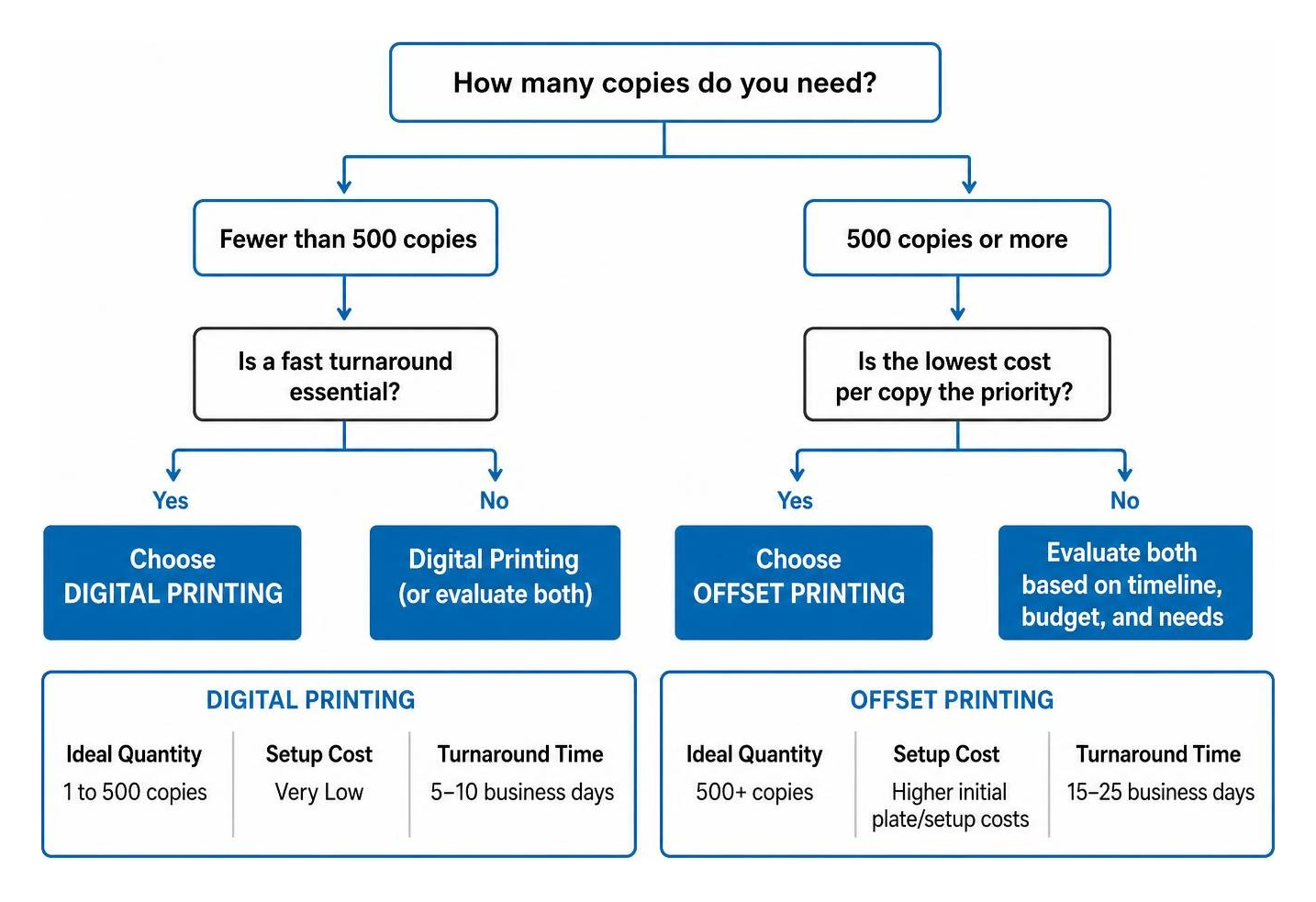
Choosing between offset press production and high-end digital presses is one of the most vital technical decisions in commercial book printing. Both methods deliver professional results, but they serve different volume thresholds, turnaround requirements, and budget structures.
| Feature | Digital Printing | Offset Printing |
|---|---|---|
| Ideal Quantity | 1 to 500 copies | 500+ copies |
| Setup Cost | Very Low | Higher initial plate/setup costs |
| Turnaround Time | 5–10 business days | 15–25 business days |
| Per-Unit Cost | Flat rate per unit | Decreases significantly as quantity rises |
| Color Precision | Excellent CMYK matching | Perfect PMS color matching & specialty inks |
| Paper Versatility | Standard digital-friendly stocks | Unrestricted range of specialty paper & weights |
Offset Printing for Large Runs
Offset printing remains the gold standard for high-volume commercial production. In this traditional process, inked images are transferred (or "offset") from aluminum plates onto a rubber blanket, and finally onto the paper.
Because offset printing requires physical aluminum plates for each ink color and detailed web press setups, initial setup times and costs are higher. However, once the press starts rolling at high speed, the cost per copy drops exponentially.
Offset turnaround times generally range between 15 and 25 business days depending on bindery complexity and custom finishing options. If you are planning a large production run requiring exact PMS brand matching or metallic accent inks, review our specialized Offset Printing solutions to see what is possible.
Digital Printing for Short-Run Commercial Book Printing
Digital printing has transformed modern publishing by eliminating physical press plates altogether. Advanced toner and high-speed production inkjet technologies directly transfer digital print files onto paper.
This technology allows for rapid setup and variable data capabilities. Turnaround times for digital book runs are swift—typically 5 to 10 business days. Digital printing makes short-run book production (under 500 copies) financially viable, allowing organizations to maintain agile, demand-driven inventory control without sacrificing visual quality. Learn more about how modern Digital Printing makes quick turnaround publications affordable and accessible.
Key Binding Types and Paper Stock Selection
A book’s binding and paper selection define its physical presence. The tactile feel, spine strength, and page texture tell your reader just as much about your brand quality as the written words inside.
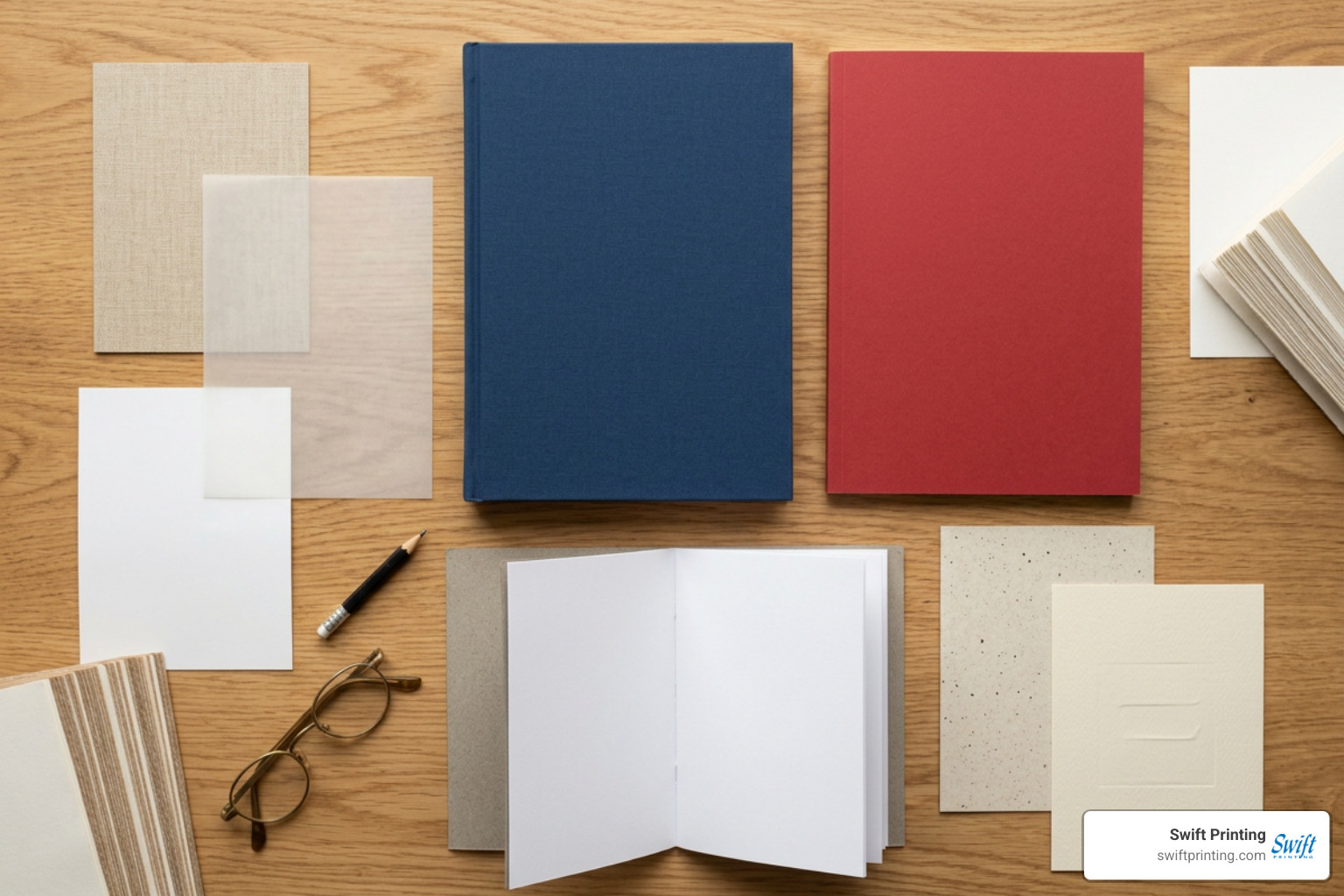
Selecting the Right Binding Option
Selecting the right binding style depends on your page count, intended reader usage, budget, and overall aesthetic goals.

- Perfect Binding: The classic choice for softcover books, manuals, and thicker catalogs. Stacked pages are trimmed and secured to a flexible cover spine using heavy-duty hot-melt or PUR adhesive. Requires a minimum spine thickness (typically at least 0.125 inches or ~40–50 pages).
- Case Binding (Hardcover): The premier choice for keepsake coffee table books, high-end corporate histories, and retail novels. Leaves are sewn or glued into rigid board covers wrapped in cloth, leatherette, or printed paper. Offers maximum durability and high prestige.
- Saddle Stitching: Ideal for slimmer publications like booklets, event guides, and short catalogs under 64 pages. Folded sheets are nested inside one another and bound with wire staples along the spine. Extremely cost-effective and lies relatively flat when opened.
For an in-depth breakdown of practical spine width calculations and bindery selections, explore our detailed guide on Bindery Options Here at Swift as well as our broader overview of Finishing Options for Printing.
Choosing Paper Weight, Finish, and Opacity
Paper selection fundamentally affects both the feel of your book and total printing expenses:
- Paper Weight: Text pages generally range from 50 lb to 80 lb text weights, while covers range from 80 lb to 120 lb cover weights. Heavier text paper gives a feeling of luxury, while lighter weights reduce overall book thickness and freight shipping costs.
- Coated vs. Uncoated Finish:
- Coated Paper (Gloss, Matte, or Satin): Perfect for photo books, art catalogs, and marketing materials. Ink sits on top of the smooth coating, creating vibrant colors and crisp image detail.
- Uncoated Paper: Standard for text-heavy novels, poetry, and workbooks. It provides a warm, natural feel with zero glare, making it easier to read for extended periods and simple to write on with a pen.
- Opacity Level: Higher opacity prevents "show-through" or ink bleed-through, which occurs when text from the opposite side of the page is visible. Heavy ink coverage (like image graphics) requires higher opacity paper stock.
The Commercial Printing Process and File Preparation
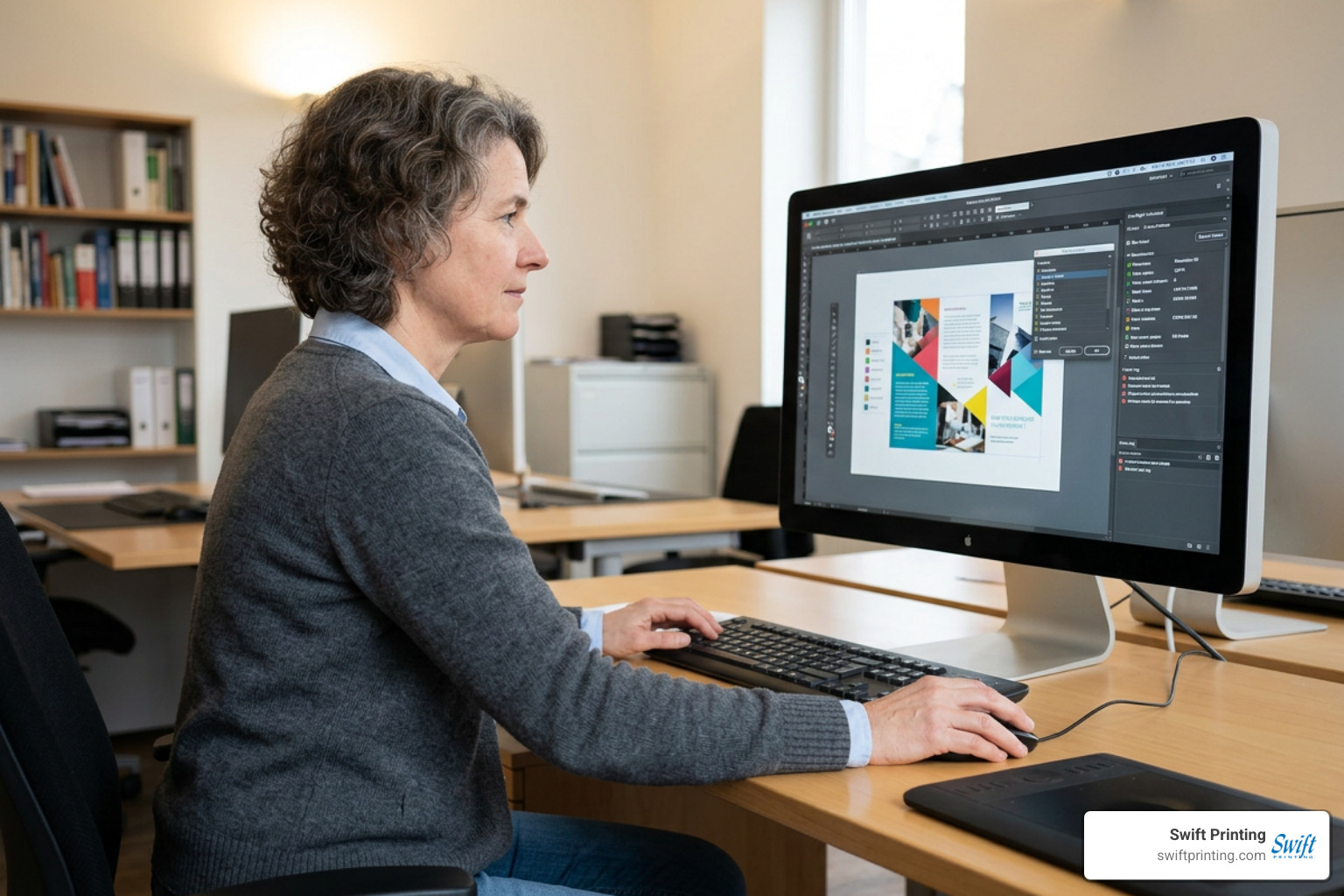
A seamless commercial printing run relies on proper pre-press preparation. Preparing your digital files correctly upfront guarantees that your final printed books match your original vision without unexpected delay or cost overruns.
Preparing Your Files and Avoiding Common Mistakes
To avoid common production headaches, check your files against these core pre-flight criteria:
- Include Bleed Margins: Always extend background colors or artwork 0.125 inches (1/8") beyond the actual trim edge to eliminate white borders when pages are trimmed.
- Color Mode (CMYK vs. RGB): Convert all digital graphics to CMYK. Computer screens display images in RGB mode, but commercial printing presses require CMYK inks.
- Resolution Check: Ensure all interior photos and graphics have a resolution of at least 300 DPI (dots per inch) at 100% printed scale to avoid pixelated printing.
- Font Embedding & Live Area: Outline or embed all fonts, and keep critical body text inside a safe margin at least 0.25 inches away from the trim edge and gutter.
For a full checklist to safeguard your press run, read our article on The 10 Most Common Print File Mistakes and How to Avoid Them.
Pre-Press, Proofing, and Final Delivery
Once your files enter production, our team executes a structured pre-press workflow:
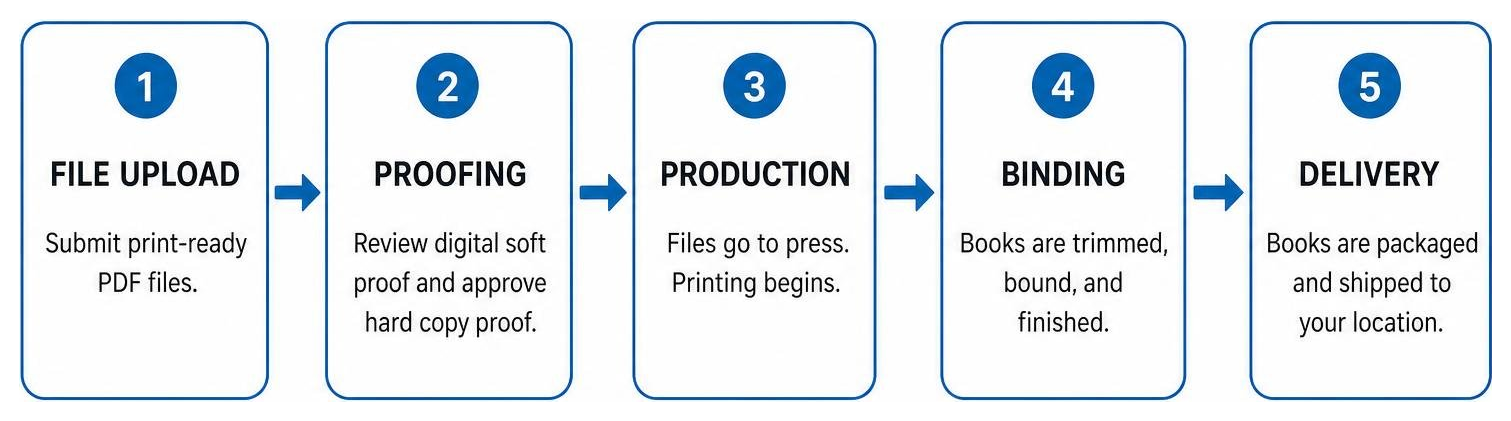
- Digital Soft Proofing: A PDF soft proof provides a quick review of pagination, text alignment, and layout structure.
- Physical Hard Copy Proofing: For critical color accuracy and material verification, a physical hard proof allows you to inspect print colors and paper stock before the full run begins.
- Press Check & Quality Assurance: Pre-press operators inspect color density, trim boundaries, and bindery registration throughout production.
- Finishing & Freight Logistics: Completed books are precision-trimmed, bound, packaged, and shipped safely directly to your storage facility or distribution center.
Frequently Asked Questions About Commercial Printing
If you're exploring Printing near me Grand Rapids or seeking advice on full-service Commercial Printing, here are direct answers to common project questions:
What is the typical turnaround time for commercial book orders?
Digital printing orders are generally completed within 5 to 10 business days. Offset printing orders typically take 15 to 25 business days due to plate creation, ink drying times, and complex bindery operations.
How does print volume affect the cost per book?
Larger print runs lower your cost per book because fixed setup fees (such as press setup and paper calibration) are divided across more copies. Additionally, bulk purchasing of raw paper stock reduces baseline manufacturing costs.
What proofing options should I request before full production?
Always review a digital soft proof for copy layout accuracy. For high-stakes color work or brand-sensitive marketing catalogs, request a physical hard proof printed directly on the selected paper stock to verify physical color output before production starts.
Conclusion
Choosing the ideal commercial book printing partner comes down to finding a team that balances technical press precision, material choice, turnaround speed, and transparent communication. By matching your project scope with the right production method, binding style, and paper stock, you ensure your physical books leave a lasting impression on every reader.
At Swift Printing, based in Grand Rapids, Michigan, we bring decades of expert craftsmanship to every single print job. As one of only two Certified B Corporations worldwide in the commercial printing industry, we proudly prioritize people, community, and planetary health alongside full-service printing capabilities.
Ready to bring your next book project to life? Visit our Commercial Printing Page to request a custom quote, request sample paper stocks, or speak directly with our experienced print specialists today.