How to Plan a Business Mailing That Arrives Ready to Make an Impression

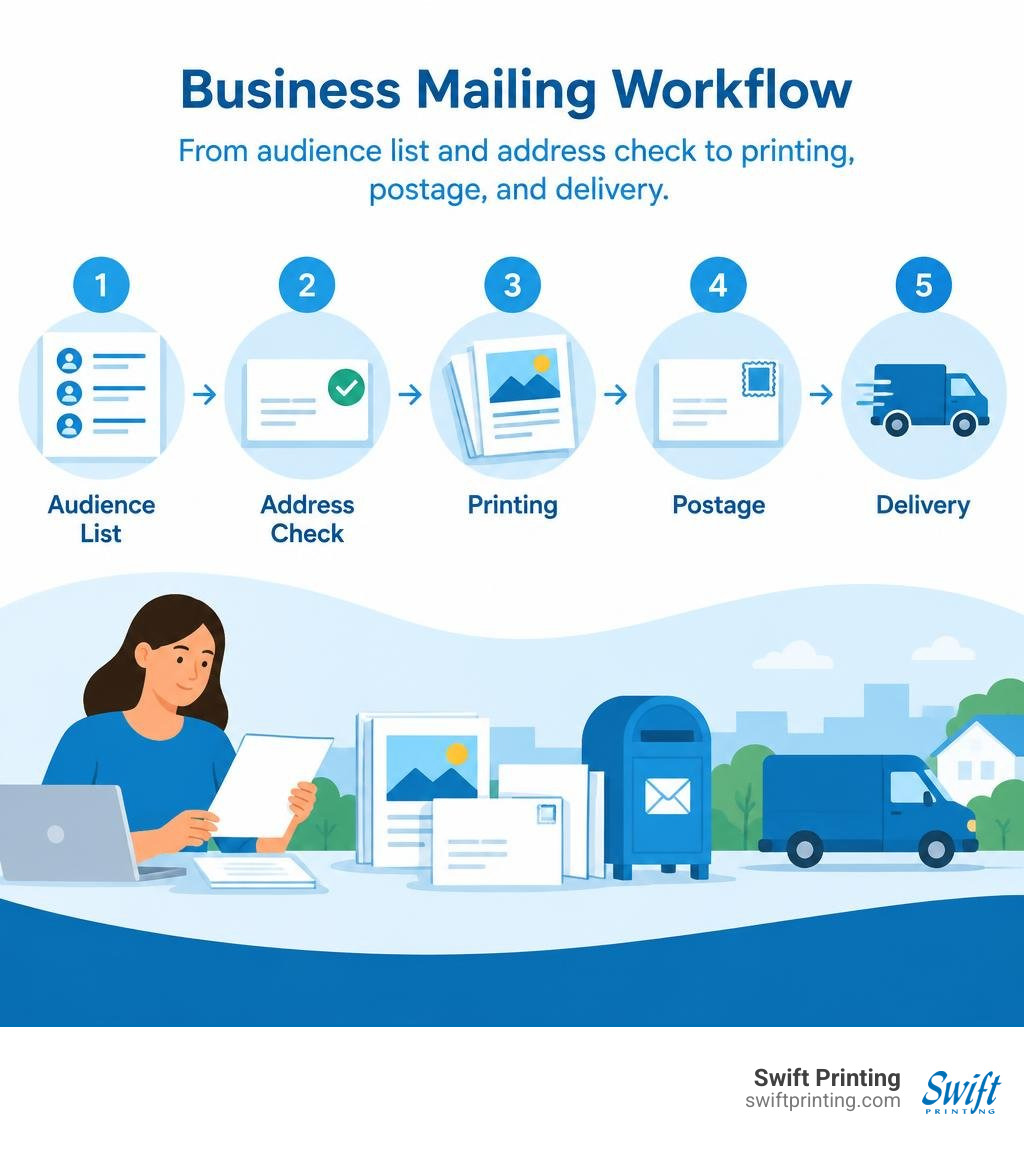
For a successful mailing, start with the people you need to reach. Check each address, choose a format that fits your message, and select a USPS service based on the item and your deadline. Before sending, confirm the size, weight, postage, and any need for tracking or proof of delivery.
That planning matters as much as the finished piece. A well-printed letter or postcard can represent your business beautifully, but it still needs an accurate address and the right postal preparation to reach its reader.
I'm Jessica Gutowski-Slaydon, president of Swift Printing in Grand Rapids. Since joining our family business full time in 2014, I've helped organizations plan printed mailings, from postcards and newsletters to direct-mail campaigns.
How to Choose the Right Mailing Service
Selecting the appropriate mail class ensures your critical communications reach clients, patients, or constituents right on schedule. Each domestic service operates under specific handling rules, speed expectations, and physical parameters.
| Mailing Service | Delivery Window | Ideal Items | Tracking & Features |
|---|---|---|---|
| First-Class Mail | 1–5 Business Days | Letters, postcards, billing statements, legal notices | Fast standard delivery for lightweight paper mail |
| Priority Mail | 2–3 Business Days | Client portfolios, contracts, product samples | Includes USPS Tracking and standard insurance |
| Priority Mail Express | 1–3 Business Days | Time-sensitive filings, urgent medical records | Fastest service with a money-back guarantee |
| USPS Ground Advantage | 2–5 Business Days | Parcels, merchandise, corporate gift boxes | Full tracking included for items up to 70 lbs |
| Media Mail | 2–8 Business Days | Books, manuscripts, educational binders | Specialized handling for qualifying media only |
How to choose a mailing service for each item
Every mail piece has distinct structural and regulatory requirements. Standard rectangular cards and lightweight business correspondence belong in First-Class Mail, which offers dependable transit for items such as annual client reviews, invoices, and standard announcements. Reviewing the official First-Class Mail requirements helps confirm that your envelopes fall within standard parameters rather than large envelope or parcel classifications.
When sending bulkier materials like bound reports, sample kits, or high-end promotional packages, upgrade to USPS Ground Advantage or Priority Mail. For educational institutions and research consultancies sending qualifying bound books or manuscripts, Media Mail provides specialized handling, though contents must exclude general advertising.
How to match delivery speed to mailing needs
Matching your delivery deadline to the right postal class prevents missed filing dates and client delays. During standard operations, First-Class Mail delivers across the country in 1 to 5 business days, making it ideal for routine correspondence. For time-critical filings, Priority Mail arrives in 2 to 3 business days, while Priority Mail Express delivers in 1 to 3 days with a money-back guarantee.
When planning holiday mailings or year-end notices, account for peak seasonal volume. To ensure arrival before December 25, ship First-Class Mail and USPS Ground Advantage items by December 17, Priority Mail by December 18, and Priority Mail Express by December 19.
US Mailing Addresses and How to Prepare a Mailing
Every day, the USPS processes over 425 million pieces of mail using automated optical character readers. Properly formatting your addresses and preparing your envelopes guarantees smooth machine sorting without manual delays.
How to format a US mailing address
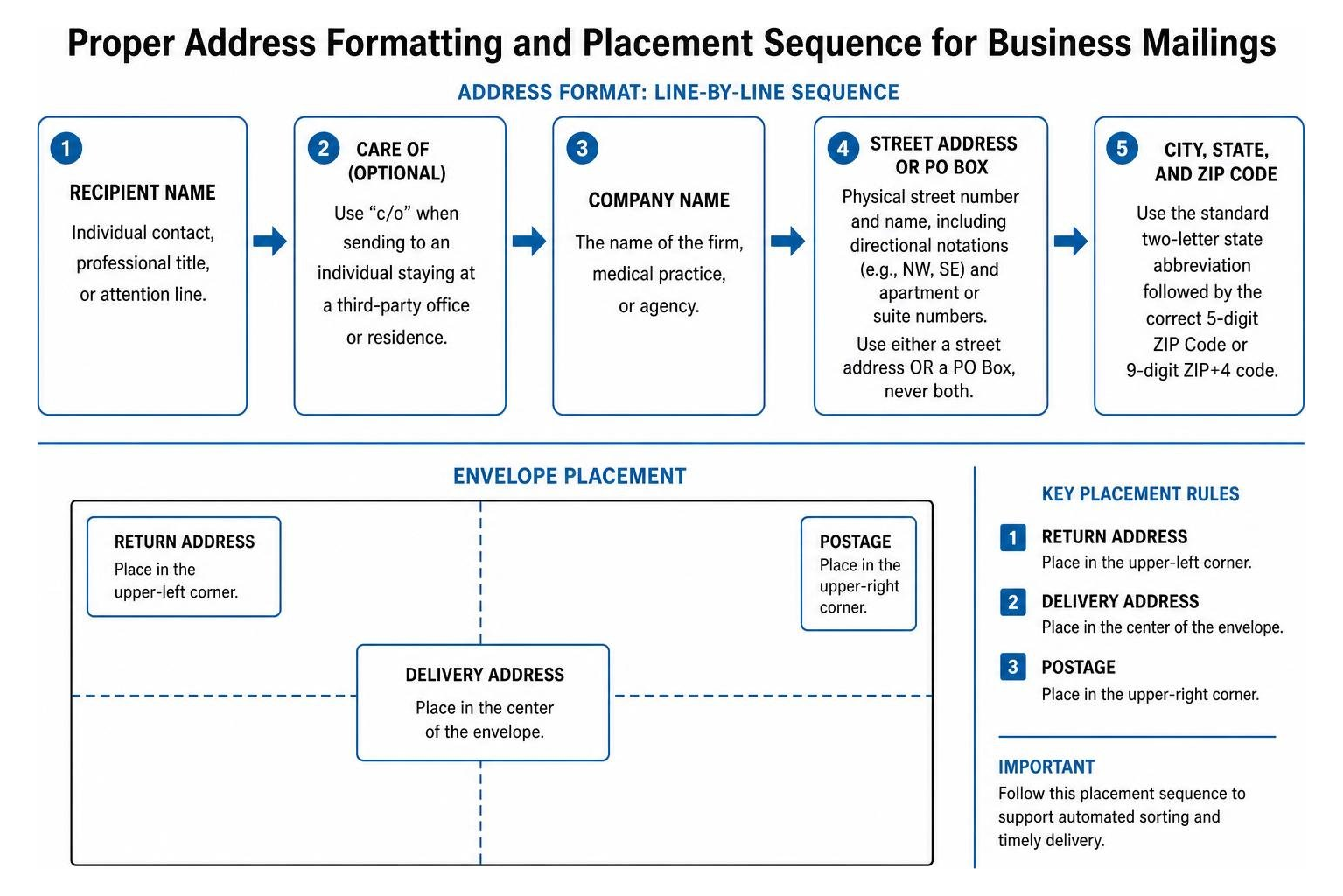
A standard US mailing address requires a clean, structured layout printed in uppercase lettering with no punctuation. Place the delivery address in the center of the envelope and your return address in the upper-left corner.
Follow this line-by-line structure:
- Recipient Name: Individual contact, professional title, or attention line.
- Care of (Optional): Use "c/o" when sending to an individual staying at a third-party office or residence.
- Company Name: The name of the firm, medical practice, or agency.
- Street Address or PO Box: The physical street number and name, including directional notations (e.g., NW, SE) and apartment or suite numbers. Never place both a PO Box and a street address on the delivery line; choose one.
- City, State, and ZIP Code: Use the standard two-letter state abbreviation followed by the correct 5-digit ZIP Code or 9-digit ZIP+4 code.
For complete styling rules, consult our guide to professional address formatting before generating recipient databases.
How to prepare a mailing for processing
To pass through high-speed postal sorters, letter envelopes must be rectangular, constructed of paper, and measure between 5 to 11-1/2 inches long, 3-1/2 to 6-1/8 inches high, and no more than 1/4 inch thick. Keep the contents flat and flexible. Letters that are rigid, square, vertical, lumpy, or sealed with clasps, string, or buttons are classified as nonmachinable and require manual hand-canceling.

When preparing parcels:
- Select a sturdy box with adequate space for cushioning on all sides.
- Wrap items individually and perform a shake test to confirm nothing shifts inside.
- Seal all flaps and seams using 2-inch-wide plastic packaging tape or reinforced paper tape; avoid cellophane tape, masking tape, string, or twine.
- Place a duplicate address label inside the box in case the outer label is damaged.
- Adhere strictly to published USPS mailing standards to ensure parcels do not exceed the maximum allowable weight of 70 pounds.
How to determine required postage and send your mailing
To calculate the proper postage, weigh your sealed piece on an accurate digital postal scale. Standard First-Class letters cover up to 3.5 ounces, while large envelopes (flats) can weigh up to 13 ounces. Any piece exceeding these limits transitions into parcel service.
Once weighed, you can generate shipping labels from your office using online tools like Click-N-Ship or affix standard postage stamps in the upper-right corner. Small stamped letters under 10 ounces and under 1/2 inch thick can be dropped into your office outgoing mail, a neighborhood collection box, or local mail drop locations. Parcels and stamped mail exceeding 10 ounces must be handed directly to a postal employee at a retail counter or scheduled for carrier pickup.
Extra Services, Special Destinations, and Managing Mail
High-value documents, sensitive legal notices, and confidential patient records demand extra security and verified delivery records.
How to add security or proof to a mailing
- Certified Mail: Provides official proof of mailing and recording of the delivery date and time. Ideal for compliance filings, legal contracts, and tax documents.
- Registered Mail: The most secure USPS service. Items are placed in locked cages, manually logged at every transit step, and covered with insurance protection up to $50,000.
- Return Receipt: An optional add-on for Certified or Registered Mail that returns a physical green postcard or electronic PDF displaying the recipient's signature.
- Signature Confirmation & Adult Signature: Requires the carrier to obtain a signature before release, ensuring sensitive medical or legal materials are handed directly to authorized personnel.
- Certificate of Mailing: Supplies a date-stamped receipt at the counter verifying that your piece was accepted into the mailstream on that specific day.
- Insurance: Provides indemnity coverage up to $5,000 for lost or damaged domestic merchandise and document replacement.
How to handle military, international, fragile, and restricted items
When sending mail to military personnel stationed overseas at APO, FPO, or DPO addresses, format the address using the service member's full name, unit number, and box number. Use APO or FPO as the city and AA, AE, or AP as the state. Never write the host country or foreign city name on the envelope, as this routes the piece into foreign postal networks. Military mail is processed through the domestic network.
For international shipments, attach an itemized customs declaration form detailing contents, weight, and purpose. Review country-specific import restrictions beforehand. If sending fragile glassware or sensitive equipment, mark the exterior clearly as "FRAGILE," cushion hollow spaces thoroughly, and ensure hazardous materials like lithium batteries or chemicals meet strict postal transport limits.
How to manage mail while away or moving
If your office is relocating or closing for seasonal renovations, utilize official postal management tools:
- USPS Hold Mail: Keeps incoming mail securely stored at your local post office for 3 to 30 consecutive days. Explore different USPS Hold Mail options to select an in-person or carrier-delivered batch return.
- Standard Mail Forwarding: Reroutes First-Class and Priority Mail to a new office address for up to 12 months.
- Premium Forwarding Service: Packages all incoming residential or commercial mail into a weekly Priority Mail shipment sent directly to your temporary location.
- Informed Delivery: Provides authorized managers with daily digital grayscale previews of incoming envelope exteriors before physical carrier drop-off.
Business and Campus Mailing Workflows
High-volume mailings require automated preparation and careful list management to maintain deliverability.
How businesses prepare a large mailing
To qualify for commercial bulk processing, businesses must prepare at least 200 marketing pieces or 500 First-Class letters at one time.
Streamline large production runs by applying these practices:
- Data Hygiene and Move Updates: Run address databases through National Change of Address (NCOA) software and Coding Accuracy Support System (CASS) certified tools to correct errors before printing.
- Presorting: Group mail pieces by ZIP Code and carrier route to bypass regional sorting steps.
- Automated Barcoding: Apply Intelligent Mail Barcodes (IMb) via high-speed inkjet equipment to facilitate automated routing.
- Permit Imprints: Use approved postal indicia instead of physical stamps to accelerate processing.
Review official commercial mailing guidance to understand permit requirements, and follow our proven mailing preparation best practices to ensure every batch complies with postal regulations.
How campus mail differs from standard USPS mailing
Campus mail systems at colleges, universities, and large medical complexes operate as hybrid internal networks. Interoffice mail circulates within department routes using reusable envelopes marked with the recipient's full name, department, and campus building. For residential students, incoming parcels and letters are received at a central mail hub and sorted into secure student lockers or hall desks.
Reviewing a real-world campus mail service example illustrates how internal routing numbers and specific residence hall designations prevent packages from getting misdirected during high-volume move-in periods.
Frequently asked questions about mailing
What information should a US mailing address include?
A complete address requires the recipient's name or business title, company name, specific street address (or PO Box), secondary unit or suite number, city, two-letter state abbreviation, and correct 5-digit or 9-digit ZIP Code.
Where can I buy stamps or send a package?
You can purchase stamps online via the USPS Postal Store, at local post offices, or through grocery stores and banks. Packages can be shipped via Click-N-Ship online, handed to postal counter clerks, dropped in collection boxes (if under size and weight thresholds), or scheduled for daily carrier pickup.
What should I do if a mailing is delayed or returned?
Verify the address against postal records for missing apartment numbers or incorrect directional markers. Check the tracking number for delivery exceptions, confirm the sender return address is intact, and initiate a USPS Help Request or Missing Mail search if an item remains stalled.
Conclusion
A successful mailing connects your organization directly with the people who matter most. By choosing the right service class, preparing durable packaging, formatting addresses accurately, and leveraging USPS tracking tools, you ensure your important communications arrive on time and intact.
At Swift Printing, we are a high-end print shop setting the standard for printing in the boutique business. Whether you are a law firm sending vital legal notices, a medical clinic mailing patient updates, or a consulting agency launching a targeted client campaign, our Grand Rapids team provides the precision and dependable service you need. Reach out to explore our comprehensive commercial printing and mailing support and let us help your next mailing make an exceptional impression.