How to Master Address Formatting in 7 Simple Steps
7 Steps to Master Address Formatting for Flawless Delivery
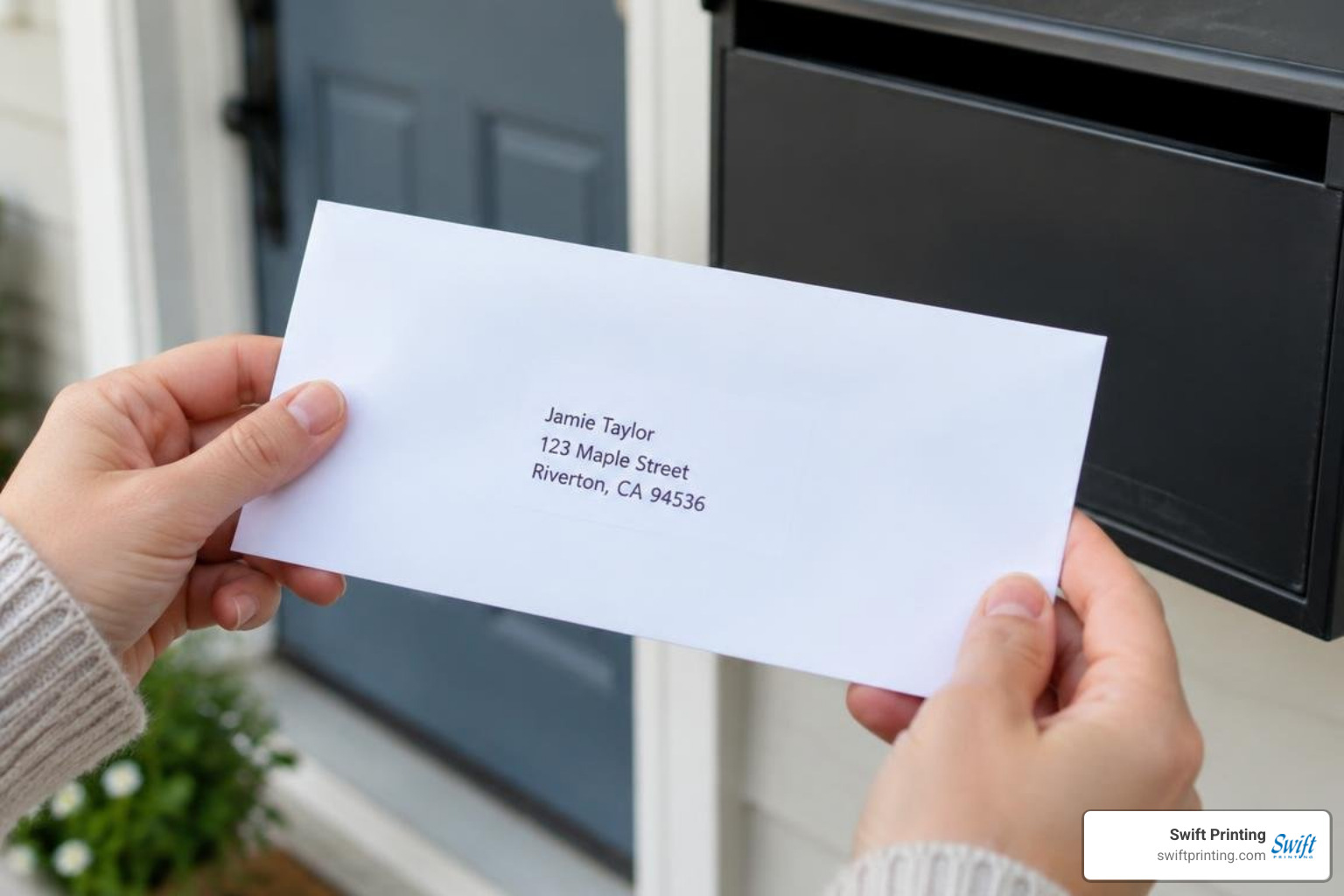
To format an address correctly, standardize the recipient line, street address, and secondary unit designators; use uppercase lettering; omit punctuation; and place the city, state, and ZIP Code on the final line. Following these steps helps your mail move through automated sorting equipment without unnecessary delays.
When an envelope travels through modern sorting infrastructure, optical character recognition (OCR) scanners read the text from bottom to top, searching for delivery points and routing codes. A single misplaced symbol or unrecognized abbreviation can cause an automated reader to reject a piece, routing it to manual sorting and causing unnecessary delays.
To achieve seamless processing, the United States Postal Service establishes precise guidelines outlined in USPS Publication 28. Following these standards ensures Delivery Point Validation (DPV) can match your records directly with official postal files.
Step 1: Standardize Street Names, Directionals, and Secondary Unit Designators
Every delivery line contains specific components that must appear in a consistent sequence: primary street number, predirectional, street name, street suffix (or postdirectional), and secondary unit designator.
Directional indicators prevent confusion across sprawling municipal grids. If an address sits on "East Michigan Avenue," standardizing the predirectional as "E" ensures automated matching algorithms process the record instantly. Similarly, postdirectionals like "SW" must be placed after the street suffix rather than attached haphazardly to the street name.
Secondary unit designators require careful attention. Common business designations include Suite (STE), Floor (FL), Building (BLDG), and Department (DEPT). Residential mailings frequently use Apartment (APT) or Unit (UNIT). The USPS explicitly advises against using the pound sign (#) if the proper unit designation is known. Place the secondary designator at the very end of the street delivery line. If the line exceeds character recommendations, place the unit information on its own dedicated line directly above the street address.
| Component Type | Full Name / Description | Official USPS Standard Abbreviation | Improper / Common Misuse |
|---|---|---|---|
| Street Suffix | Avenue | AVE | Av., Avenue., Ave |
| Street Suffix | Boulevard | BLVD | Blv, Boul, Bvd |
| Street Suffix | Drive | DR | Drv, Dr. |
| Street Suffix | Parkway | PKWY | Pkwy., Pky, Prkwy |
| Street Suffix | Street | ST | Str, Str., St. |
| Directional | North / Northwest | N / NW | No., N. / N.W., No.W. |
| Directional | South / Southeast | S / SE | So., S. / S.E., So.E. |
| Secondary Unit | Suite | STE | Ste., Suite #, # |
| Secondary Unit | Apartment | APT | Apt., Apartment #, # |
| Secondary Unit | Building | BLDG | Bldg., Bld. |
| Secondary Unit | Floor | FL | Fl., Flr, Floor # |
Step 2: Implement Official USPS Address Formatting for Punctuation and Casing
Automated sorters process capital letters with maximum accuracy. While mixed-case text can still be parsed, adopting full uppercase lettering eliminates character misinterpretation.
More importantly, automated sorting prefers the complete omission of punctuation on envelope delivery blocks. Do not insert periods after directional abbreviations or street suffixes, and remove commas between the city and state. Maintain single uniform spacing between words, use the standard two-letter state abbreviation, and separate the state from the ZIP Code with one or two spaces.
When maintaining databases for commercial communication, the USPS recommends storing delivery address information across fields supporting a minimum of 30 bytes, with an optimum allocation of 64 bytes to align perfectly with the National ZIP+4 database.
Adding the 4-digit add-on code to the basic 5-digit ZIP code identifies a specific geographic segment, such as a city block, an office tower floor, or an individual department. For editorial publications, corporate letterhead, or formal styling, institutions such as the Western Michigan University Writing Style Guide provide helpful guidance on balancing postal standards with formal typography.
Formatting for Special Delivery Points and Multi-Channel Contexts

Not every piece of mail travels to a standard commercial storefront or residential mailbox. Addressing methods must adapt when routing items to post office boxes, rural routes, overseas military personnel, or across digital platforms. Applying proven mailers best practices ensures special recipients receive their correspondence without operational friction.
Step 3: Structure PO Boxes, Rural Routes, and Military Mail (APO/FPO/DPO)
Postal facilities, remote delivery corridors, and military postal branches operate under specific routing frameworks:
- Post Office Boxes: When sending mail to a physical post office box, list
PO BOXfollowed by the number. Omit periods, hyphens, and the word "Post." If both a physical street address and a PO Box are associated with your recipient, place the destination where you want the mail delivered on the line directly above the city, state, and ZIP Code. The automated system always delivers to the address line immediately preceding the city-state-ZIP line. - Rural and Highway Contract Routes: Rural routes use designated identifiers. Format these using
RRfollowed by the route number and box number (e.g.,RR 2 BOX 152). Highway Contract routes use the abbreviationHC(e.g.,HC 64 BOX 33). - Military Addresses (APO/FPO/DPO): Overseas military mail connects civilian infrastructure with the Military Postal Service Agency. Never use a foreign city or host country name in a military address, as this causes the piece to be routed into international customs instead of the military system. Use the recipient's full name, rank, unit, and box number (or Postal Service Center
PSC). Replace the city withAPO(Army Post Office),FPO(Fleet Post Office), orDPO(Diplomatic Post Office). For the state field, useAA(Armed Forces Americas),AE(Armed Forces Europe, Middle East, Africa, Canada), orAP(Armed Forces Pacific), followed by the assigned 9-digit ZIP+4 code.
Step 4: Adapt Addresses for Single-Line Text, Invoices, and Digital Interfaces
While multi-line, punctuation-free uppercase blocks are the gold standard for physical envelopes, multi-channel communications require clean, single-line adaptations.
When formatting an address for an email signature line, digital invoice footer, executive business card, or corporate website, commas serve as essential visual dividers. In a single-line layout, separate the street address, secondary suite designator, and municipality with commas, while maintaining standard spacing between the state abbreviation and ZIP Code:
- Single-Line Digital Standard:
Swift Printing, 404 Coldbrook St NE, Grand Rapids, MI 49503 - Corporate Header Standard:
Attn: Legal Department, 100 Ottawa Ave NW, Ste 400, Grand Rapids, MI 49503
For online forms and e-commerce applications, developers frequently rely on libraries like @fragaria/address-formatter or packages such as localized-address-format to parse input fields and render output dynamically across both single-line and multi-line visual structures.
Navigating Global Standards and Cross-Border Postal Conventions

Global direct mail requires an understanding of diverse international formatting conventions. The Universal Postal Union (UPU) sets overarching postal protocols, but each sovereign country retains distinct addressing hierarchies, postal code conventions, and character placement rules.
Step 5: Understand Global Postal Code Variations and Locality Structures
Postal codes vary considerably worldwide:
- Alphanumeric Systems: Countries like the United Kingdom (
SW1A 1AA), Canada (K1A 0B1), the Netherlands (1012 JS), and Malta use structured combinations of letters and digits to pinpoint precise delivery zones and city blocks. - Strict Numeric Codes: France, Germany, Italy, and Spain use 5-digit numerical structures, whereas Japan uses a 7-digit hyphenated format (
100-0001). - Administrative Variations: In Belgium, most towns connect to a single code, while major hubs like Antwerp span multiple zones. In Saudi Arabia, postal codes frequently cover entire municipal divisions.
- Countries Without Postal Codes: Approximately 50 countries—such as Angola, the Maldives, and Yemen—operate without postal codes, relying instead on dependent localities, landmarks, and structural descriptions to complete delivery.
Step 6: Adapt Address Formatting for International Postal Systems
When addressing global mailings, the fundamental structure shifts depending on the destination nation:
- United Kingdom: British addresses move from specific to broad, frequently featuring dependent localities and a designated "Postal Town" in uppercase directly above the alphanumeric postal code.
- Germany and Mainland Europe: In Germany and several central European nations, the house number traditionally follows the street name (e.g.,
Schillerstraße 10). The postal code precedes the city name on the penultimate line. - Japan: Traditional Japanese addressing follows a top-down hierarchical model starting with the prefecture, followed by the municipality, district, block number, and individual building, often written with the postal symbol (〒). When addressing from abroad in Latin script, this sequence is reversed to follow Western standards, placing the country name clearly on the final line.
- Colombia: Colombian addresses often forgo traditional street names in favor of an intersecting grid system indicating the distance from cross streets (e.g.,
Calle 72 # 10-34).
For cross-border mailings, write the destination country name in full uppercase English on the absolute final line of the address block.
Data Hygiene, Spreadsheet Structuring, and Automated List Verification
High-precision mail distribution relies on clean data management. Maintaining pristine contact databases prevents wasted mail pieces, protects your brand reputation, and ensures on-time delivery for vital legal notices, healthcare reminders, and marketing campaigns.
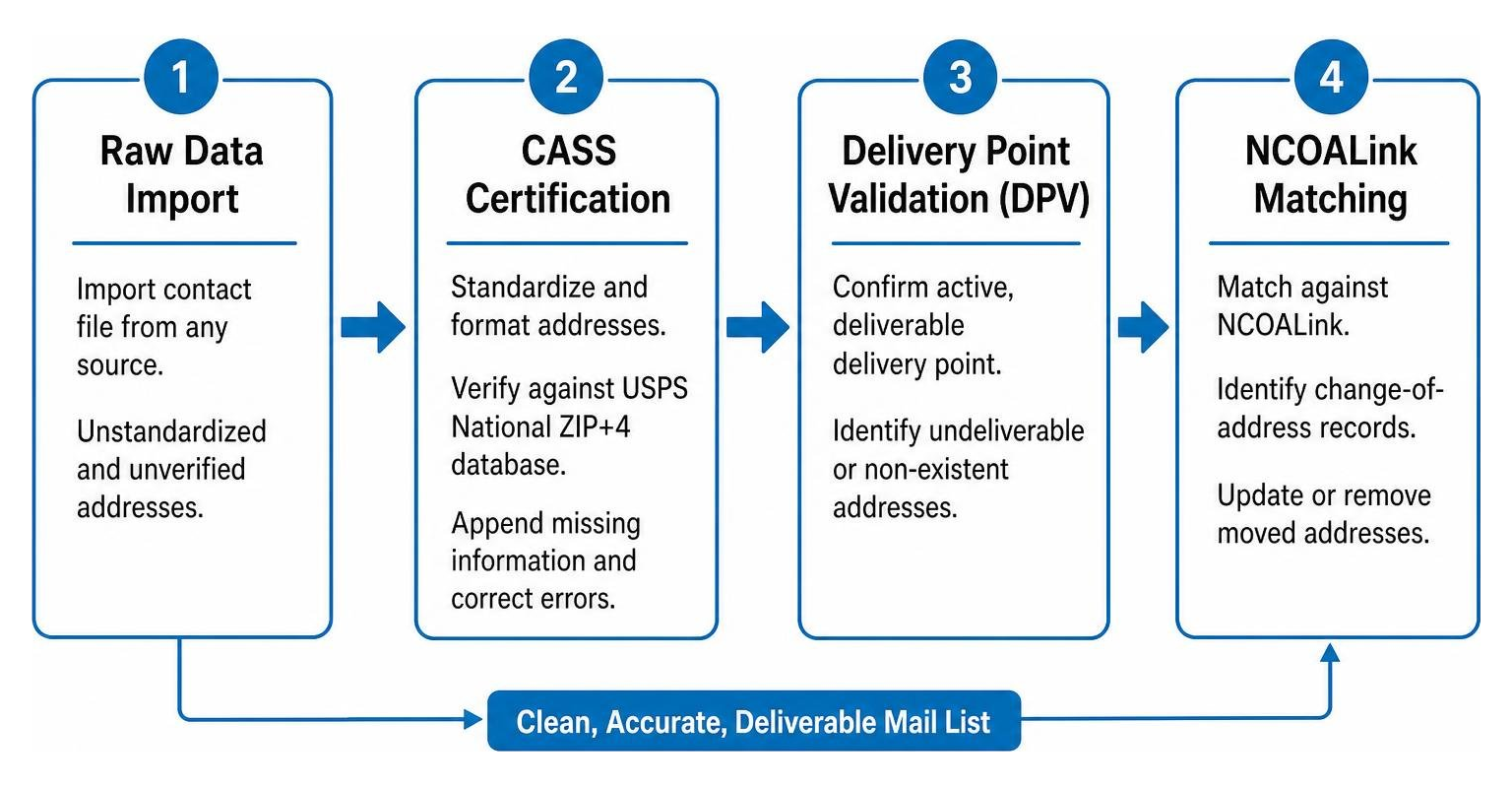
To maintain top-tier database health, professional mailers employ specialized address standardization tools:
- Coding Accuracy Support System (CASS): Software that evaluates address records against the USPS National ZIP+4 database, correcting spelling mistakes, appending missing directionals, and verifying valid delivery points.
- Delivery Point Validation (DPV): A technology confirming whether an address represents an active, physical delivery receptacle capable of receiving mail.
- NCOALink (National Change of Address): A comprehensive database containing approximately 160 million permanent change-of-address records filed by individuals, families, and businesses over the preceding 48 months.
Step 7: Cleanse and Organize Address Spreadsheets for Commercial Mailing
Preparing your dataset correctly before sending it to your print partner ensures maximum efficiency. Review our practical guide on how should I format addresses in Excel or Google Sheets for a mailer to establish your file cleanly.
- Segment Elements into Discrete Columns: Never merge recipient names, street details, cities, states, and ZIP codes into single spreadsheet cells. Maintain separate columns for
First Name,Last Name,Company Name,Address Line 1,Address Line 2,City,State, andZIP Code. - Preserve Leading Zeros in Postal Codes: Spreadsheet software often treats numeric postal codes as integers, automatically deleting initial zeros in regions like New England (e.g., turning
02108into2108). Format all postal code columns as text fields to preserve essential leading zeros. - Purge Inactive Records and Duplicates: Identify and merge duplicate accounts sharing identical delivery points to prevent sending redundant pieces to the same office.
For businesses organizing large campaigns, integrating professional direct mail printing ensures your files are pre-sorted and fully certified before they enter the processing stream.
Frequently Asked Questions About Postal Standards
Do I need to include punctuation like commas and periods on mailing envelopes?
No. For automated postal processing on envelopes and packages, the USPS recommends omitting all punctuation, including periods after abbreviations (like ST or STE) and commas between the city and state. Leaving punctuation out allows high-speed optical character recognition (OCR) sorting cameras to read and route mailpieces without scanning errors. Punctuation remains recommended for single-line addresses inside emails, letters, and website text.
What is the proper way to format an address when both a physical street and a PO Box exist?
Place the specific location where you want the mail delivered on the line immediately above the city, state, and ZIP Code line. If you prefer delivery to the PO Box, write the physical street address on the line above the PO Box, and place the PO Box line right above the city and state. The automated sorting machines read addresses from the bottom up and prioritize the delivery point positioned immediately above the city-state-ZIP block.
How often should businesses update their mailing lists against change-of-address databases?
The USPS Move Update standard requires commercial mailers to verify their lists against an approved address-updating method—such as NCOALink—at least once every 95 days prior to the mailing date. Regularly cleaning your database ensures compliance, reduces undeliverable mail, and keeps your communication current with clients who have recently relocated.
Conclusion
Precision in address formatting reflects the professionalism of your organization. Whether you are sending formal legal correspondence, patient communications, corporate reports, or direct marketing materials, standardizing every address component ensures your message reaches its intended recipient without delay.
At Swift Printing, we are a high end print shop setting the standard for printing in the boutique business. We work closely with corporate teams, medical practices, law firms, and educational institutions across Grand Rapids and West Michigan to bring their print communications to life with unmatched craftsmanship and technical reliability.
When you are ready to prepare your next corporate correspondence or direct mail campaign, review our guide to formatting a spreadsheet for a mailing. Partner with us to ensure your mailings are printed beautifully, processed accurately, and delivered right on time.