Custom Die Cut Brochure Production: Advanced Print Finishing and Shape Design
What Is a Die Cut Brochure?

A die-cut brochure is a printed brochure trimmed into a custom shape or given features such as windows or shaped tabs. Unlike a standard rectangular brochure, it can use its shape to highlight a message, reveal an image, or fit into a presentation package. For a law firm, nonprofit, or other organization, the best design is one that makes the information easier to notice and use, not just different for its own sake.
Start with the brochure's purpose. Then choose the shape, paper, fold, and finish together so the piece looks good and opens cleanly.
I'm Jessica Gutowski-Slaydon, president of Swift Printing, a high-end print shop in Grand Rapids. My work with brochures, paper selection, specialty finishing, and project planning helps customers turn a die cut brochure idea into a practical print plan.
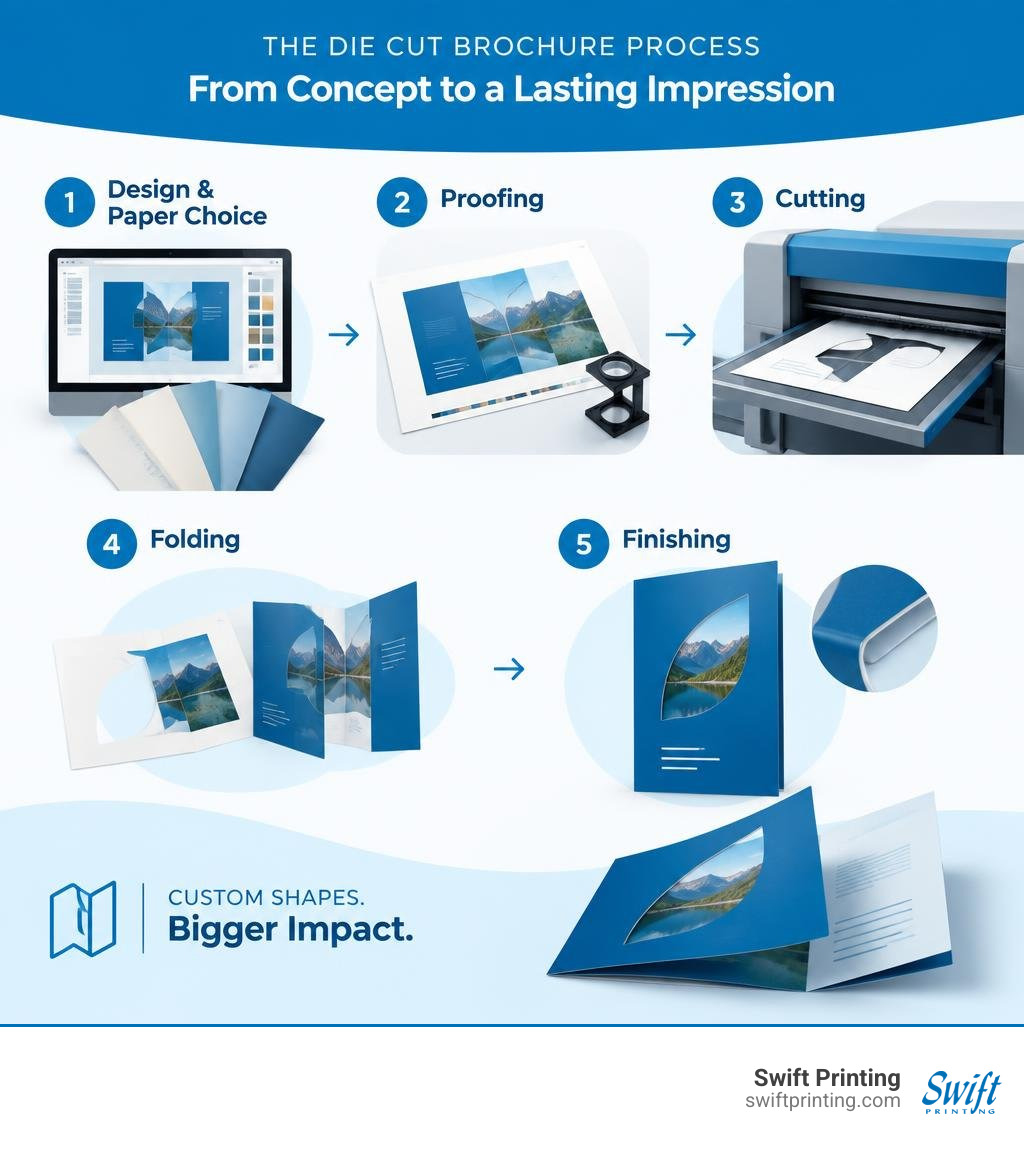
Why Invest in a Die Cut Brochure for Corporate and Professional Marketing
When communicating with executive leadership, prospective partners, or high-value clients, standard rectangular collateral often blends into the background. Professional organizations, including legal practices, healthcare networks, corporate consultancies, and municipal agencies, require print collateral that commands attention and conveys authority.
Custom contours transform traditional collateral from a passive document into an interactive experience. Physical engagement with print materials increases brand recall and deepens comprehension. When recipients physically interact with unique tabs, peek-through windows, or shaped edges, they spend significantly more time engaging with the core messaging.
Investing in tailored brochure printing allows organizations to anchor their visual identity in tangible physical form. Whether designing an annual report or an executive service brief, custom-cut profiles create immediate distinction.
| Collateral Attribute | Standard Rectangular Brochure | Custom Die Cut Brochure |
|---|---|---|
| Tactile Engagement | Conventional edge handling | Contoured edges, stepped panels, reveals |
| Brand Recall | Moderate baseline retention | High retention via interactive mechanics |
| Visual Hierarchy | Linear grid constraints | Dynamic multi-layered reveals and windows |
| Structural Options | Standard folds only | Integrated folder pockets, custom tabs, contours |
| Ideal Application | Bulk event handouts | Executive presentations, proposals, luxury kits |
Designing a Custom Die Cut Brochure for Maximum Brand Impact
Creating an effective shaped brochure requires balancing creative visual concepts with structural engineering. The contour must serve a clear purpose—such as framing key data, creating intuitive index tabs for different practice areas, or revealing an underlying graphic when folded.
Bespoke shapes can echo an organization’s architectural profile, corporate logo, or signature service offerings. For instance, incorporating a reveal window on the cover panel allows crucial statistics or imagery on the inner spread to show through prior to opening. Sophisticated structural variations can even incorporate interactive pop-ups or folded mechanical elements like custom origami inserts that unfold smoothly alongside the panels. Following proven principles for brochure design for local organizations ensures that every structural element enhances readability rather than distracting from the message.
Substrate Selection and Paper Weights
Selecting the appropriate paper substrate is critical for custom-cut collateral. Standard lightweight copy papers lack the structural integrity required to hold crisp die-cut contours, clean score lines, or intricate cutout windows.
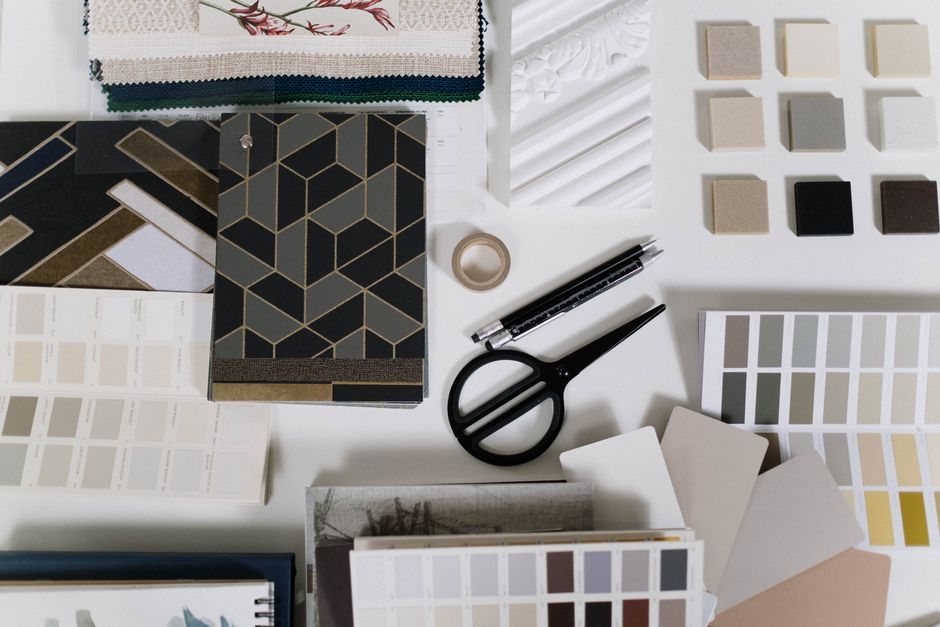
Premium die-cut pieces generally demand rigid cover stocks ranging from 8pt to 12pt, or heavyweight folding box board. These heavier calipers ensure:
- Edge Definition: Clean separation during high-speed cutting without fraying or feathering.
- Structural Stability: Panels remain flat and crisp without curling when exposed to environmental humidity.
- Tear Resistance: Delicate bridge areas, tabs, and intricate lattice cuts maintain their form over repeated handling.
- Clean Creasing: Deep, consistent scores that prevent toner or paper fibers from cracking along fold lines.
Sustainable paper choices, such as FSC and PEFC certified boards printed with vegetable-based inks, provide premium tactile substance while aligning with modern corporate sustainability standards.
Premium Embellishments and Finishing Techniques
Die cutting reaches its full visual and tactile potential when paired with complementary embellishments. Applying specialty surface finishes transforms heavy paperboard into an executive-tier presentation tool.
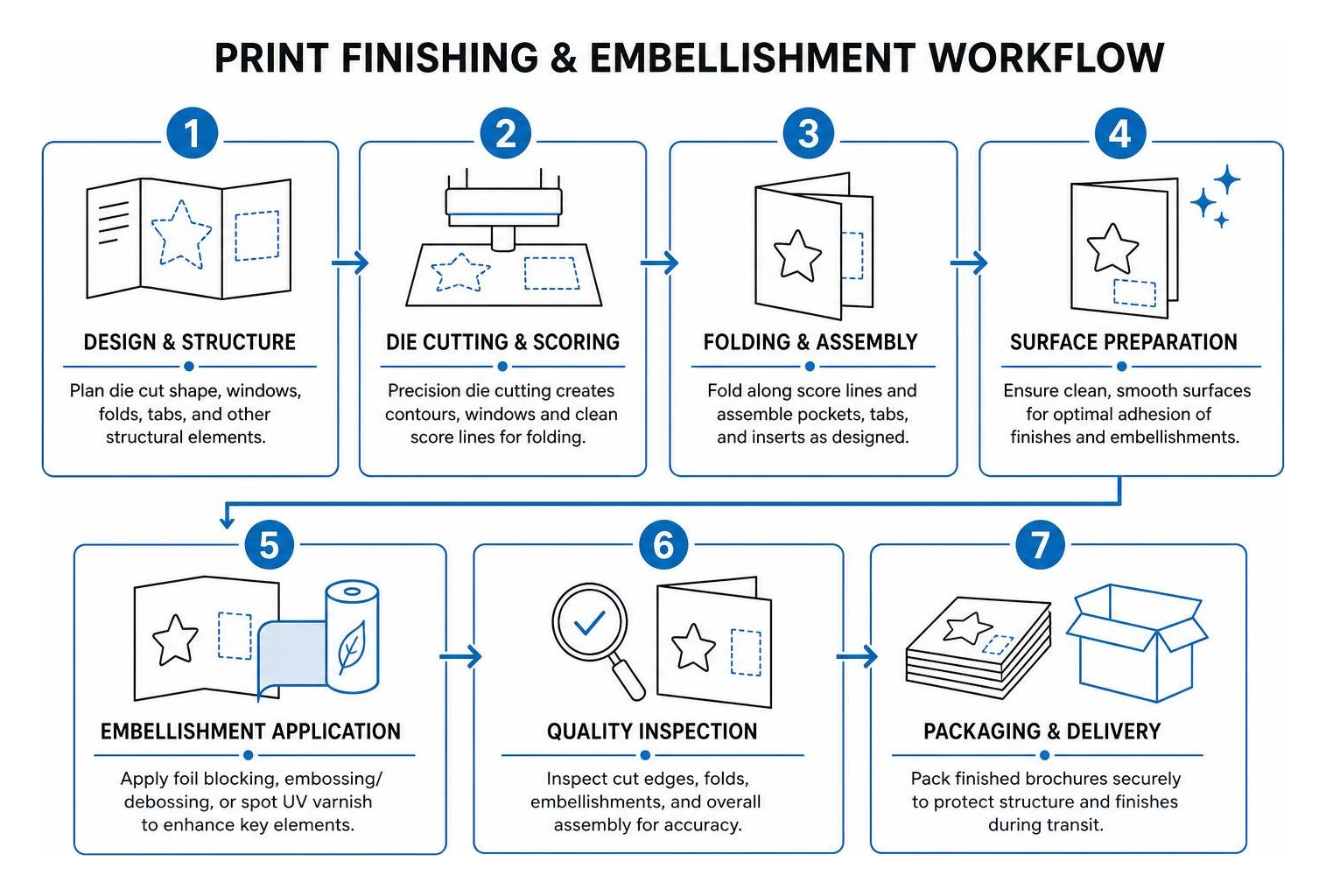
Popular high-end finishing options for printing include:
- Foil Blocking: Applying metallic or pigmented foil using heat and pressure to accentuate logos, titles, and contour edges with brilliant reflectivity.
- Blind Embossing and Debossing: Raising or depressing targeted areas of the substrate without ink, creating understated, tactile textures that invite touch.
- Spot UV Varnish: Applying a high-gloss liquid coating cured via ultraviolet light over specific text, patterns, or images to contrast sharply against matte backgrounds.
- Soft-Touch and Anti-Scuff Lamination: Laying down an ultra-smooth, velvety protective film that prevents fingerprint smudges, protects against edge wear, and provides a luxurious hand-feel.
Understanding the detailed mechanics of behind-the-print post-press finishing ensures that decorative coatings, score channels, and cut lines harmonize seamlessly without causing substrate distortion or delamination.
Structural Engineering, Fold Types, and Panel Geometry
A successful multi-panel brochure depends on meticulous structural mathematics. When paper is folded, paper thickness introduces "creep" and "push-out" effects, where inner panels are pushed outward as outer panels wrap around them. If every panel is designed at identical dimensions, the piece will buckle, flare open, or fail to sit flat.
Standard multi-panel fold styles require specific engineering formulas:
- Gate Fold: The two flanking panels fold inward to meet perfectly in the center. Each inner gate panel must be calculated slightly narrower than half the width of the back panel to prevent the inner edges from colliding.
- Roll Fold: Multiple panels roll inward in a sequential spiral. The outermost panels maintain full width, while each consecutive interior panel must be reduced by approximately 1/16th of an inch (for text-weight stock) or 3/32nd of an inch (for 8pt to 12pt cover board) to tuck smoothly inside.
- Accordion Fold (Z-Fold): Panels fold in alternating directions in a zig-zag pattern. Because panels do not wrap inside one another, all panels can generally maintain uniform width, though die-cut stepped tabs require precise progressive width calculations.
- Double Parallel Fold: The sheet is folded in half and then folded in half again in the same direction. The inner nested panels require careful reduction to prevent inner-spine stress.
Thorough prepress file preparation guarantees that score channels, bleed zones, and dimensional offsets are calculated down to the millimeter before steel tooling is forged.
Advanced Machinery and High-Precision Rotary Die-Cutting
High-end commercial printing relies on cutting-edge machinery to deliver microscopic cutting precision across large production volumes. Industrial equipment such as the high-performance CutPRO X 106 rotary die cutter represents the peak of modern finishing technology.
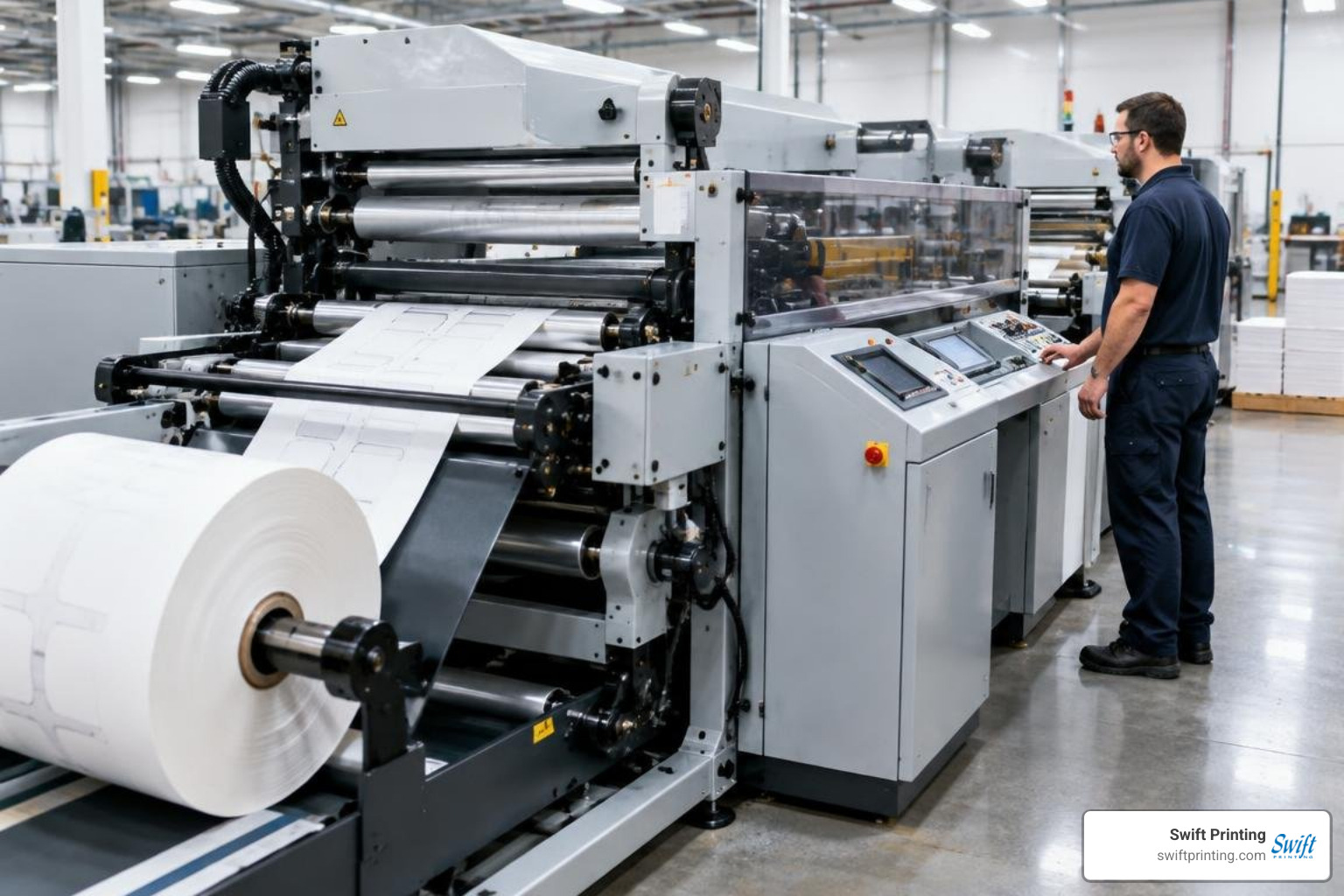
Modern rotary systems provide substantial technical advantages over legacy flatbed setups:
- Exceptional Speed: Production throughput reaching up to 15,000 sheets per hour.
- Pinpoint Registration: Optical and mechanical pin-register systems achieve register accuracy down to 15 µm (microns)—ensuring intricate cut contours align flawlessly with printed graphic borders.
- Rapid Changeovers: Preset job recall and streamlined mounting reduce makeready times to under 10 minutes for commercial runs and under 20 minutes for folding carton stock.
- Substrate Versatility: Smooth handling across diverse paper stocks, from delicate in-mould films up to 0.6 mm (24pt) rigid board.
- Inline Blanking: Integrated systems separate die-cut pieces from scrap paper skeletons in real time, delivering cleanly stacked, ready-to-fold blanks and reducing manual labor.
These precision mechanics cut scrap rates dramatically while maintaining absolute uniformity across every unit.
Production Timelines and Cost Considerations for Custom Print Projects
Custom die-cut projects involve specialized manufacturing phases that extend beyond standard cut-and-fold print jobs. A typical custom project follows a structured schedule:
- Structural Prototyping and CAD Sampling: Generating unprinted, digital plot-cut samples on the specified stock to verify panel geometry, fold mechanics, and pocket closures.
- Tooling Fabrication: Custom steel-rule or rotary magnetic dies are precision-machined to match the vector dieline files.
- Press Run & Embellishment: Sheets are printed using high-definition offset or digital presses, followed by lamination, foil blocking, or spot UV applications.
- Die-Cutting & Inline Blanking: High-speed cutting, scoring, and perforating are executed.
- Final Folding, Assembly & Quality Inspection: Complex configurations may involve automated folder-gluers or hand assembly for intricate tabs and inserts.
Depending on structural complexity, project lead times typically range from 7 working days for digital short runs to 3.5 weeks for high-volume, multi-stage embellished collateral.
How Much Does a Die Cut Brochure Cost Compared to Standard Formats?
Budgeting for custom die-cut projects involves two core components: fixed setup costs (tooling, makeready, digital CAD sampling) and variable unit costs (paper stock, press time, coatings, hand finishing).
Initial setup costs make custom tooling an investment, but unit economics drop substantially as print volumes scale. Ordering 2,500 to 10,000 units spreads tooling expenses across the run, making the per-piece investment only slightly higher than standard collateral while delivering vastly superior marketing ROI. Partnering with a dedicated Grand Rapids commercial printing provider allows you to explore multiple paper stocks and run configurations to optimize your budget in USD.
Frequently Asked Questions About Custom Die-Cut Collateral
How do panel size adjustments work for multi-panel folded brochures?
When planning multi-panel folded pieces, the outer two panels generally share identical standard dimensions to form the exterior covers. Each subsequent interior panel that folds inside must be stepped down in width—typically reduced by 1/16" for standard text sheets or 3/32" for thicker 8pt to 12pt cover boards. This compensation accommodates the physical thickness of the paper at the score lines and prevents the finished piece from bowing outward.
What is the typical turnaround time for custom shaped brochures?
Production turnaround typically ranges from 7 to 20 business days (1 to 3.5 weeks). The exact timeline depends on whether custom steel tooling needs to be milled, whether multi-stage embellishments (like foil stamping or soft-touch lamination) are specified, and whether the assembly involves automated machine gluing or hand folding. Providing print-ready vector dielines and expediting physical proof approvals keeps projects moving quickly.
What vector file requirements are needed for custom die lines?
Dielines must be supplied as vector paths created in professional design software (such as Adobe Illustrator). All cut lines, score channels, and perforations should reside on a dedicated, locked layer named "Dieline" using a distinctive spot color set to "Overprint Stroke." Solid lines designate cuts, dashed lines denote score/crease lines, and dotted lines mark perforations. Artwork bleeds should extend at least 1/8th of an inch (0.125 in) past all cut lines.
Elevate Your Brand with Precision Print Finishing
A thoughtfully crafted brochure bridges the gap between high-level brand strategy and memorable tactile execution. By pairing distinctive shapes with premium stocks, precise geometric folds, and elegant embellishments, your organization creates collateral that prospects keep, read, and respect.
At Swift Printing, we operate as a dedicated high-end print shop serving West Michigan, Ada, Rockford, Belmont, Kalamazoo, Lansing, and organizations nationwide. We work alongside marketing directors, creative agencies, and corporate executives to ensure every structural fold and die-cut contour aligns with your goals.
Ready to bring your custom print concept to life? Contact our team to request a custom print quote or discover our full range of commercial print solutions today.