How to Design Personalized Memo Pads That Fit Your Work
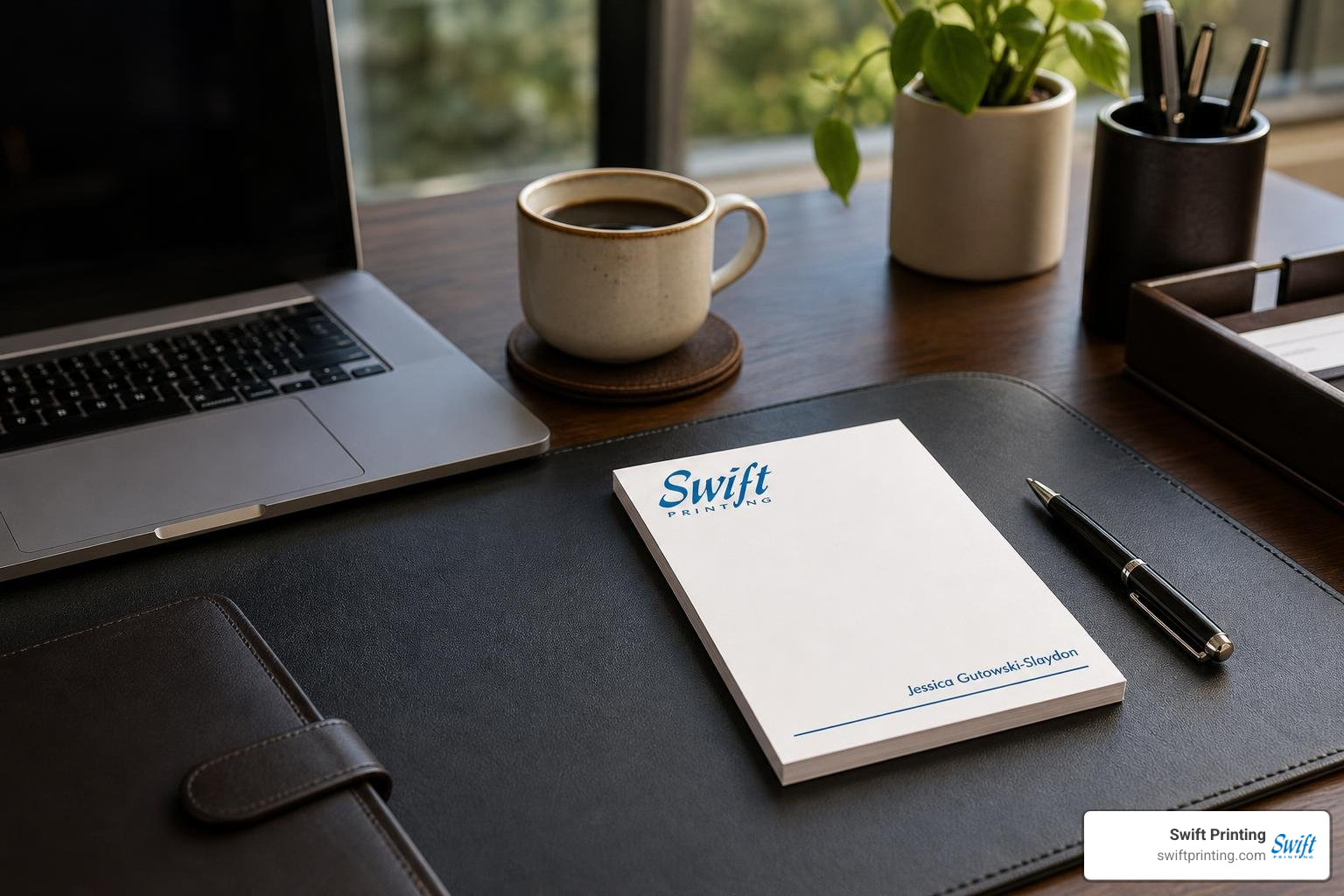
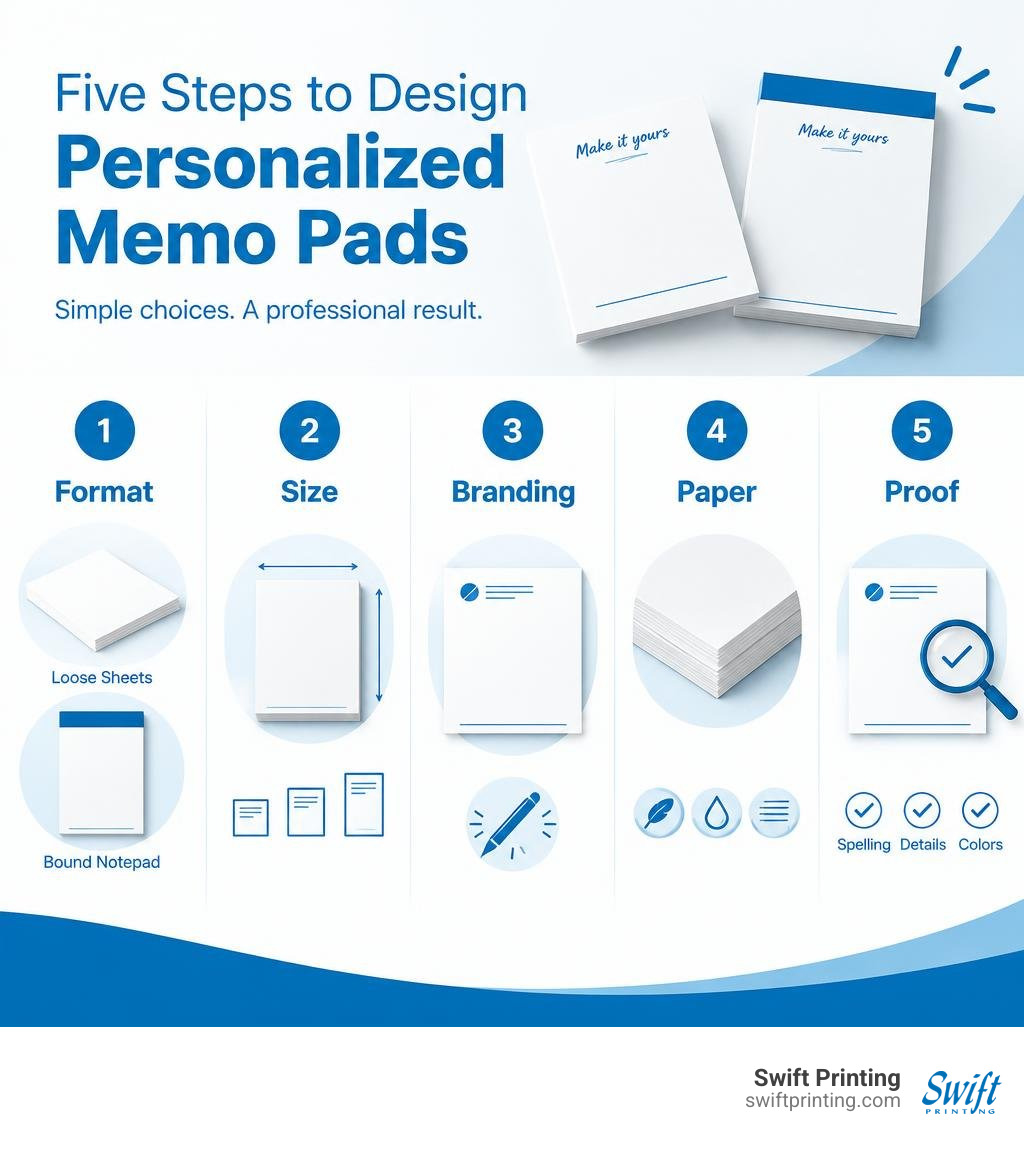
To design personalized memo pads, first decide how they will be used: loose sheets work well in a desk tray, while top-glued pads keep pages together on the move. Choose a size and sheet count, then add a name or logo without crowding the writing space. Select paper that feels good with your usual pens, and check a proof for spelling, contact details, and color before printing.
I’m Jessica Gutowski-Slaydon, president and third-generation leader at Swift Printing in Grand Rapids, where I help organizations make practical choices about paper, printing, and finishing for projects such as personalized memo pads. At Swift, we set a high standard for boutique business printing through careful production, clear communication, and dependable service.
Selecting the Right Format: Loose Memo Sheets vs. Bound Notepads
When designing custom desk stationery for law firms, medical practices, consultancies, or municipal departments, the very first decision involves how the pages will be stored and handled throughout the workday. The two primary formats are loose desk memo sheets and padded tear-off notepads. Both options offer distinct functional benefits depending on your workflow and physical office setup.
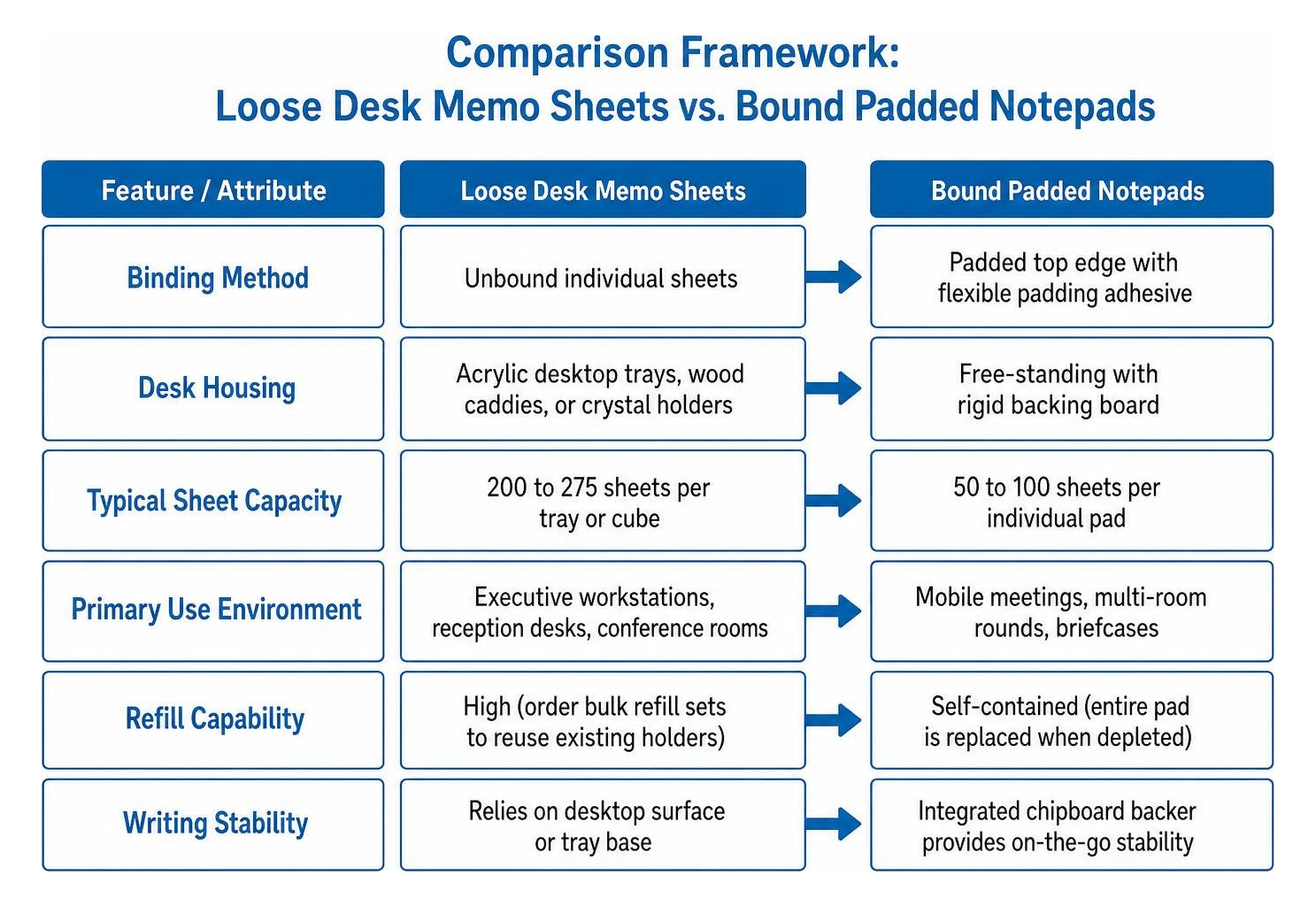
| Feature / Attribute | Loose Desk Memo Sheets | Bound Padded Notepads |
|---|---|---|
| Binding Method | Unbound individual sheets | Padded top edge with flexible padding adhesive |
| Desk Housing | Acrylic desktop trays, wood caddies, or crystal holders | Free-standing with rigid backing board |
| Typical Sheet Capacity | 200 to 275 sheets per tray or cube | 50 to 100 sheets per individual pad |
| Primary Use Environment | Executive workstations, reception desks, conference rooms | Mobile meetings, multi-room rounds, briefcases |
| Refill Capability | High (order bulk refill sets to reuse existing holders) | Self-contained (entire pad is replaced when depleted) |
| Writing Stability | Relies on desktop surface or tray base | Integrated chipboard backer provides on-the-go stability |
Understanding how your team handles daily notes will clarify which format best supports your routines. For additional inspiration regarding practical applications across different industries, explore our guide to Custom Notepads.
Designing Loose Personalized Memo Pads for Executive Desks
Loose memo sheets—often referred to as memo squares or desk cubes—are designed to sit inside dedicated holders on an executive desk or reception counter. Because they are not bound with adhesive, grabbing a single sheet to record a quick phone message or draft an informal directive requires just one hand.
For high-volume executive suites, a standard desk tray typically holds between 260 and 275 loose sheets. This capacity ensures that busy partners and directors do not have to replenish their stationery constantly. When the stack runs low, you simply unbox a matching refill pack and place it directly into the existing acrylic or leather caddy.
To maintain clean aesthetics on the desk:
- Match the paper dimensions precisely to the interior tray dimensions (such as 4.4" x 6" or 5.5" x 5.5") so sheets do not buckle or slide loosely.
- Position the personalization along the top or bottom margin to keep the central area completely unobstructed for notes.
- Keep reserve refill packs in a climate-controlled supply cabinet to prevent paper curl before loading them into desk caddies.
Configuring Bound Notepads for Professional Settings
For professionals who move between client consultations, courtrooms, or boardrooms, bound notepads offer built-in portability. These pads utilize a specialized padding compound along the top edge that holds every page firmly in place until cleanly torn away.
A standard bound notepad is built with a heavy chipboard backing that provides structural rigidity. This allows you to write comfortably while holding the pad in your lap or walking through an office corridor. Organizations frequently order these in coordinated multi-pad bundles so individual attorneys, physicians, or department directors have fresh pads across several conference spaces. Discover more configurations by viewing our dedicated Notepads & Pads selections.
How to Design Personalized Memo Pads for Corporate and Professional Use

A well-crafted memo pad balances practical writing space with refined brand identity. When drafting correspondence for external clients or internal colleagues, your stationery serves as a tangible reflection of your organization's professionalism. Leveraging our full suite of Custom Printing Services ensures your visual identity is reproduced with absolute precision.
Essential Layout Elements: Headers, Monograms, and Logos
Creating an effective layout requires careful management of margins, typography hierarchy, and graphical elements:
- Executive Headers & Monograms: For senior partners, physicians, and executives, a classic three-letter monogram or clean name header centered at the top conveys understated elegance. Pairing a traditional serif font with a modern sans-serif subline for professional credentials (such as J.D. or M.D.) establishes immediate authority.
- Corporate Logos & Seals: When preparing notepads for corporate suites or government offices, place the official insignia or vector logo in the top-left corner, balancing it with official contact information in the top-right corner.
- Writing Guides: Depending on your team's workflow, choose between unlined sheets for open-ended ideation and sketching, or subtle lined rules with 7mm to 8mm line spacing for organized lists. If you incorporate lines, print them in a muted gray or subtle brand tint so ink notes stand out legibly over the grid.
Choosing the Right Dimensions and Sheet Counts
Selecting the proper pad dimensions depends entirely on the functional purpose of the stationery:
- 4.5" x 8.5" (List & Docket Format): Ideal for legal task management, daily dockets, and structured checklists. This elongated aspect ratio provides ample vertical lines for detailed tasks.
- 5" x 7" & 5.5" x 8.5" (Executive Desk Format): The standard choice for executive correspondence, formal desk notes, and cross-departmental memorandums.
- 4" x 6" & 4.4" x 6" (Compact Message Format): Perfectly scaled for phone messages, quick reminders, and compact desktop trays.
- 3" x 5.5" (Pocket & Scratch Format): Compact and convenient for mobile clipboards, lab coats, and quick field notes.
Sheet counts per pad should align with expected turnover. Standard bound pads for conference rooms perform best at 50 to 100 sheets per pad, maintaining a slim profile that rests flat on conference tables.
Sourcing Premium Materials and Finishing for Boutique Stationery
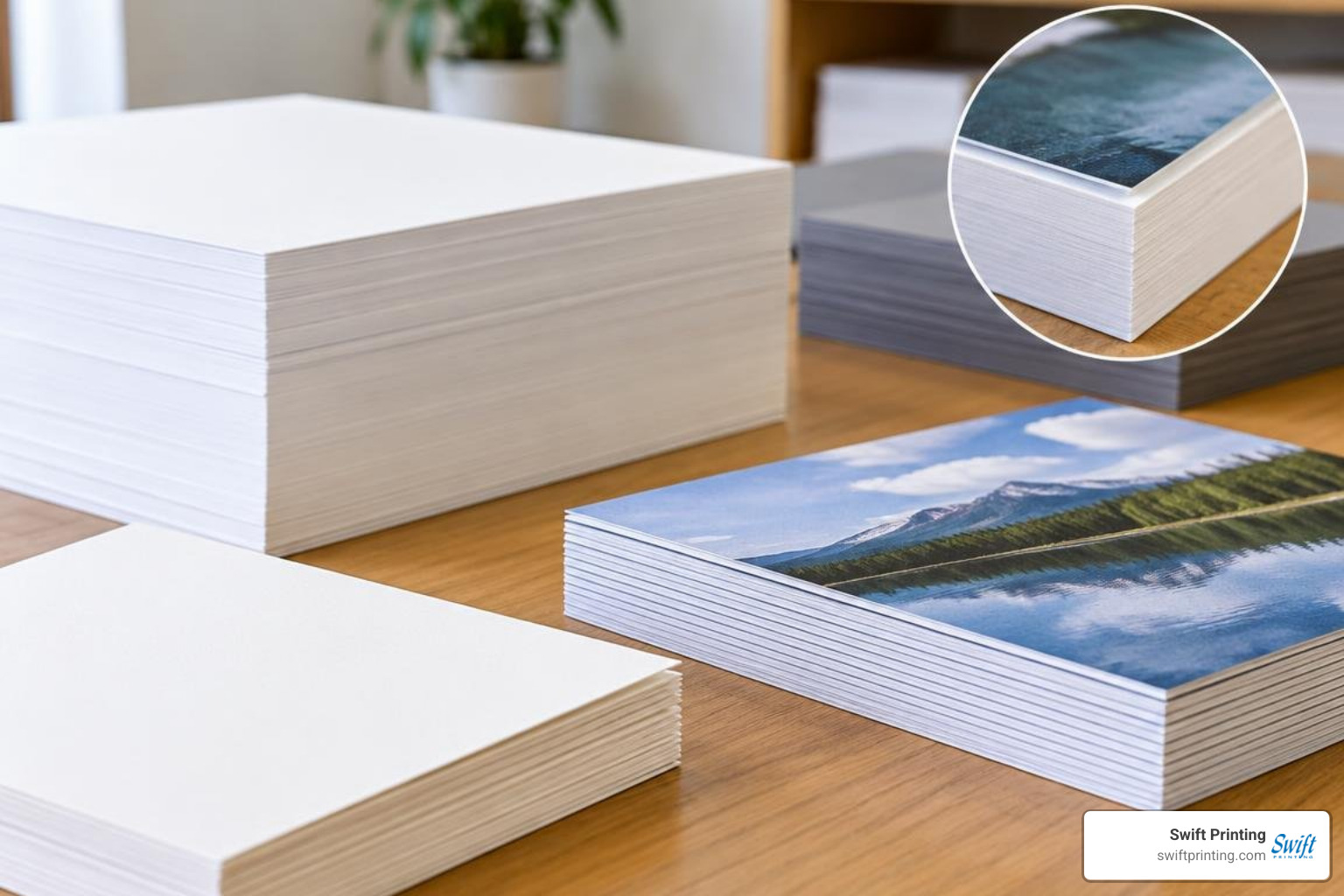
The tactile experience of writing on boutique stationery relies heavily on paper selection and binding execution. Premium paper stocks prevent ink bleed-through, feathering, and curling, ensuring every handwritten note conveys exceptional quality.
Paper Stock Specifications and Sustainable Fibers
For luxury professional stationery, standard lightweight copy paper is insufficient. We recommend choosing a substantial 70 lb text or 28 lb bond stock with high opacity and an ultra-smooth finish:
- Ink Compatibility: Heavyweight 70 lb text paper features dense fiber formation that resists ink bleed and feathering, making it fully compatible with rollerball pens, gel pens, and wet fountain pen nibs.
- Environmental Sustainability: Opt for FSC-certified paper stocks containing 50% post-consumer recycled fibers. This provides an environmentally conscious foundation without sacrificing brightness or writing smoothness.
- Visual Clarity: A high paper brightness rating ensures crisp contrast between your custom printed branding and handwritten text. To discover how specialized finishes elevate stationery, review our comprehensive Print Finishing Options.
Structural Backing and Binding Durability
A boutique notepad must withstand daily handling without losing its structural integrity:
- Heavy Cardboard & Chipboard Backing: A 30 pt to 50 pt rigid chipboard backer prevents the pad from bending when carried inside leather folios, laptop bags, or briefcases.
- Flexible Edge Gumming: Professional padding adhesives remain flexible over time. This compound holds every sheet securely during transit while allowing individual sheets to pull away cleanly without tearing or leaving messy residue along the header edge.
Streamlining Production and Proofing for Business Stationery
Creating custom corporate stationery requires structured preparation to avoid delays and ensure typographical accuracy before the job reaches the printing press.
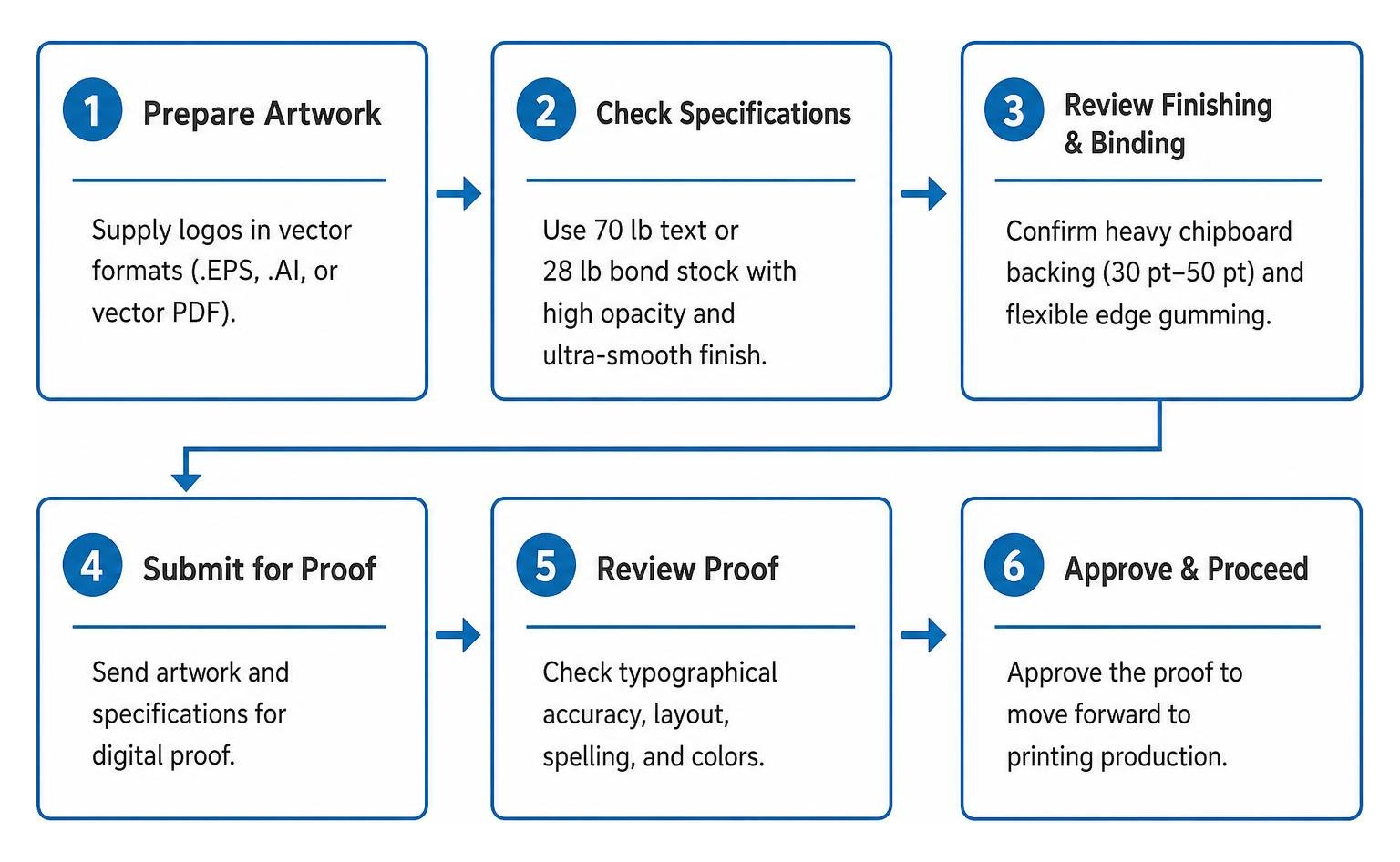
Preparing Artwork for Personalized Memo Pads
To guarantee razor-sharp lines and accurate color representation, follow these prepress best practices:
- Vector Graphics: Supply corporate crests, monograms, and logos in native vector formats (such as .EPS, .AI, or vector PDF) to eliminate pixelation and blurriness.
- Color Profiles: Convert all artwork to CMYK color profiles, or specify exact Pantone Matching System (PMS) spot colors if your firm adheres to strict brand standards.
- Margins & Bleed: Maintain a minimum 0.25-inch margin from all trimmed edges for essential text to avoid accidental clipping during guillotine trimming. If your design features decorative background patterns that extend to the sheet edge, provide a 0.125-inch bleed.
- Meticulous Proofreading: Always verify titles, office suite numbers, direct telephone extensions, and email addresses. For helpful guidelines on file setup, consult our expert Printing Tips & Guides.
Production Turnarounds and Quality Inspection
Boutique commercial printing balances handcrafted attention to detail with efficient production timelines:
- Digital Flat Printing vs. Offset Printing: Digital flat printing delivers brilliant, rich color with fast turnaround for short runs and personalized name variations across multi-attorney offices. Offset printing is optimal for high-volume enterprise orders requiring exact PMS ink formulations.
- Production Timelines: Custom stationery production typically requires approximately 4 business days to print, pad, trim, and cure the padding adhesive before careful packaging and delivery.
- Quality Control: Every batch undergoes comprehensive inspection to confirm edge alignment, pad thickness consistency, and adhesive elasticity.
Frequently Asked Questions About Custom Memo Stationery
What is the functional difference between loose memo sheets and padded notepads?
Loose memo sheets are unbound individual pages designed to sit inside a desktop caddy or crystal tray. They allow single-handed removal for quick desk notes. Padded notepads feature sheets bound at the top edge with padding adhesive and reinforced with a heavy chipboard backer, making them ideal for mobile use, travel, and meetings outside the office.
What paper weight is recommended for luxury personalized memo pads?
We recommend a premium 70 lb text (28 lb bond) uncoated paper stock. This weight provides superior opacity to eliminate show-through and features a smooth, refined surface that accommodates fountain pens, rollerballs, and ballpoint pens without feathering or bleeding.
Can custom memo pads match existing corporate identity suites?
Yes. Custom memo pads can be designed to match your existing corporate stationery, including letterheads, executive presentation folders, and Custom Stationery suites. Ink formulas, typography hierarchies, and paper brightness can be calibrated across all printed collateral to maintain absolute visual harmony.
Conclusion
Personalized memo pads bridge everyday office utility with distinguished brand presentation. Whether you require loose memo sheets inside elegant desktop trays for executive workstations or sturdy bound notepads for mobile client meetings, choosing premium paper stocks, robust chipboard backings, and balanced layouts elevates your professional correspondence.
At Swift Printing, we take pride in serving Grand Rapids, Ada, Belmont, Rockford, Kalamazoo, Lansing, and across West Michigan with dependable craftsmanship and boutique commercial printing expertise. When you are ready to expand your corporate stationery or streamline external communications, explore our guide on direct mail and corporate communication formatting or reach out to our team to start your next custom print project.