How to Lay Out Addresses on a Formal Letter

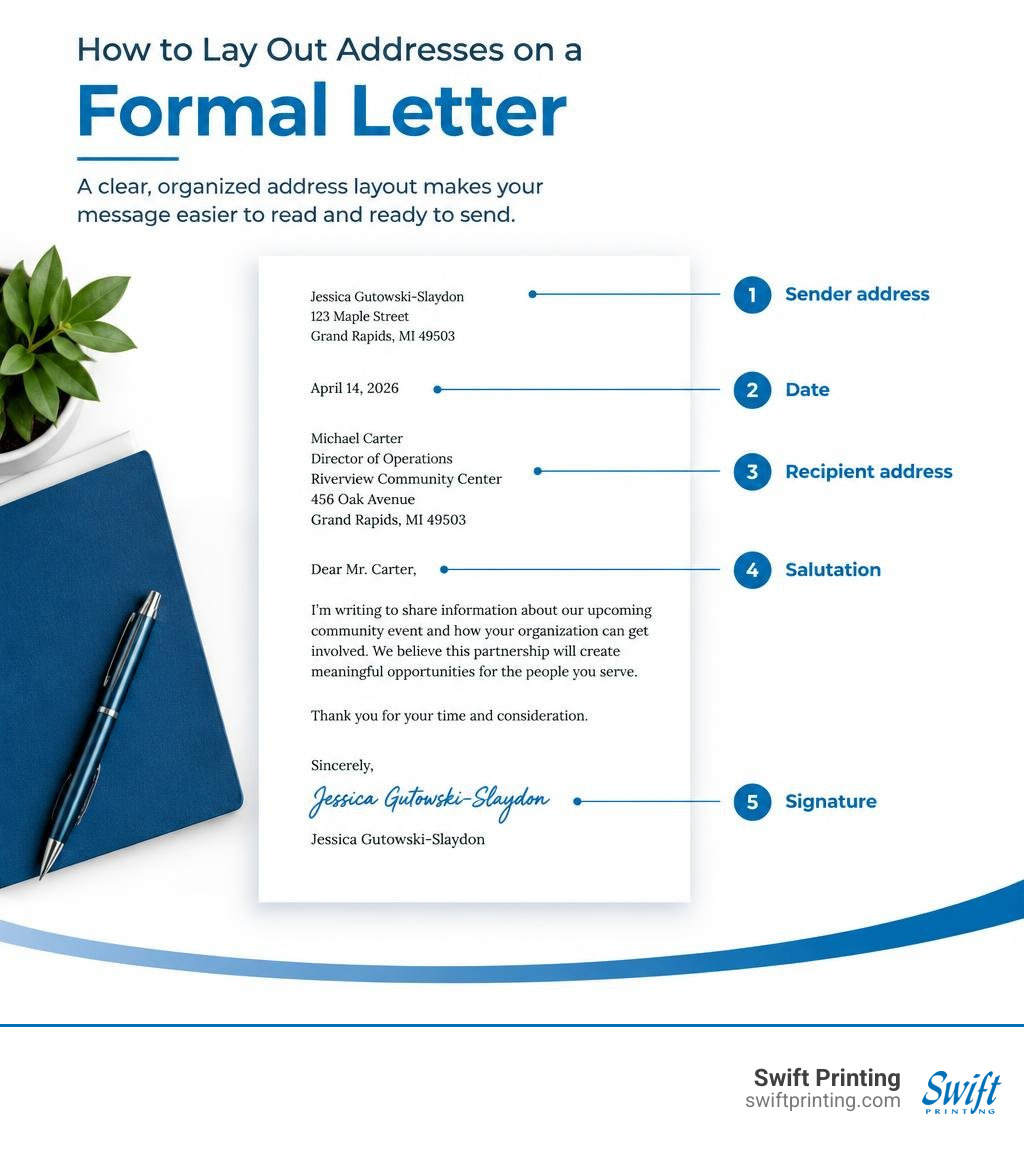
For a formal letter address layout in the US, use full-block format: place your return address at the top left, write the full date below it, then add the recipient’s name, title, organization, and mailing address on the left. If your letterhead already shows your address, do not repeat it. Leave a blank line between each section, and check that the recipient’s address matches the envelope.
I’m Jessica Gutowski-Slaydon, president of Swift Printing in Grand Rapids. My work with professional and government clients on letterhead, envelopes, and direct mail has taught me that a clear formal letter address layout makes a printed message easier to read and ready to send.
Essential Elements of a Formal Letter Address Layout
When you compose high-stakes correspondence—whether for a law practice, medical clinic, consulting firm, or public agency—the physical presentation establishes credibility before the reader reviews a single sentence. A structured document relies on standardized margins (typically 1 to 1.25 inches on all sides), clear visual hierarchy, and readable typography such as 12-point Times New Roman or Arial.
Every formal piece contains specific core components: the sender's return block, the date line, the inside recipient address, an optional attention or subject line, the formal greeting, the body text, and a signature block. Reviewing the fundamental structural parts of a business letter helps keep each element in its proper order.
| Layout Style | Margin & Text Alignment | Date & Closing Position | Paragraph Indentation |
|---|---|---|---|
| Full Block | Left-justified throughout | Left-aligned | No indentation (single space within, double between) |
| Modified Block | Left-justified body & addresses | Tabbed/centered horizontally | No indentation |
| Semi-Block | Left-justified addresses | Tabbed/centered horizontally | First line indented 0.5 inches |
Sender Information and Pre-Printed Letterhead Standards
If you print your correspondence on blank executive stationery, position your contact details at the very top. When writing without letterhead, place only your street address, city, state, ZIP code, direct telephone number, and email address in the sender block—leave your personal name off this top block, because it will appear at the bottom in your signature block.
When utilizing custom corporate letterhead, your organization's logo and contact information already occupy the header area. In this scenario, omit the top text return address entirely and begin the document directly with the date line positioned approximately two inches from the top edge of the sheet.
Date Formatting and Placement Rules
In professional American correspondence, spell out the date completely rather than using numeric shorthand: write November 18, 2026, instead of 11/18/26. This eliminates ambiguity for legal filings, contractual notices, and institutional archives.
Place the date line one blank line beneath your sender block (or two inches from the top margin if using pre-printed letterhead). If you correspond with international organizations or government bodies following European conventions, you may format the date as 18 November 2026, placing the day before the month without an intervening comma.
Inside Recipient Address Architecture
The inside address provides the delivery record within the document itself. Structure this block hierarchically from the most specific detail to the broadest geographic designation. Begin with the addressee's personal courtesy title and full name, followed by their official job title, department, organization name, building name, and street address including any suite or floor number.
Adhering to proper address formatting ensures your document maintains consistency across all executive records and meets postal clarity expectations.
How to Set Up a Formal Letter Step by Step
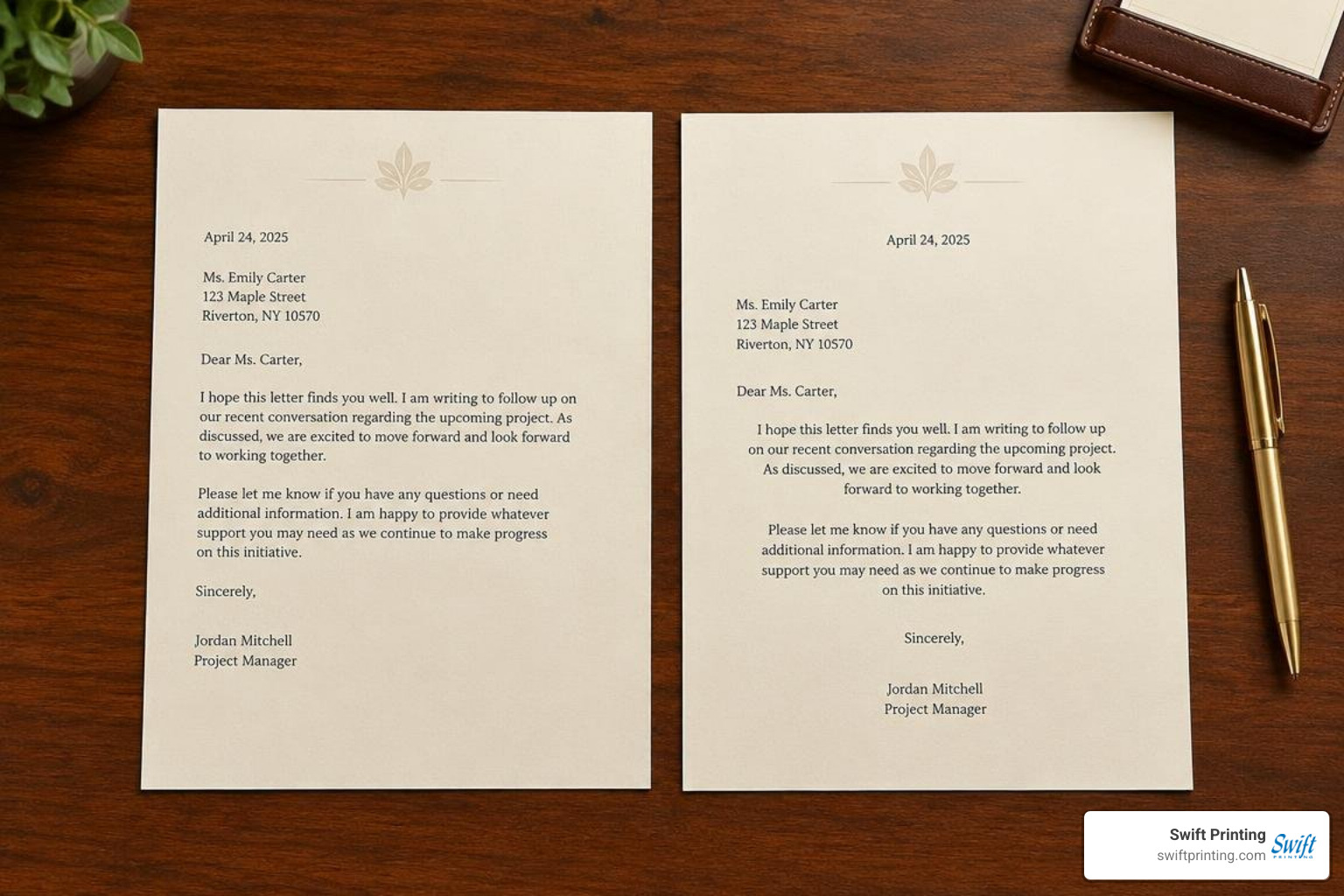
Creating a balanced, professional document requires aligning your spatial structure with established business standards. Modern executive communication favors the full-block style for its crisp, organized lines and simple readability.
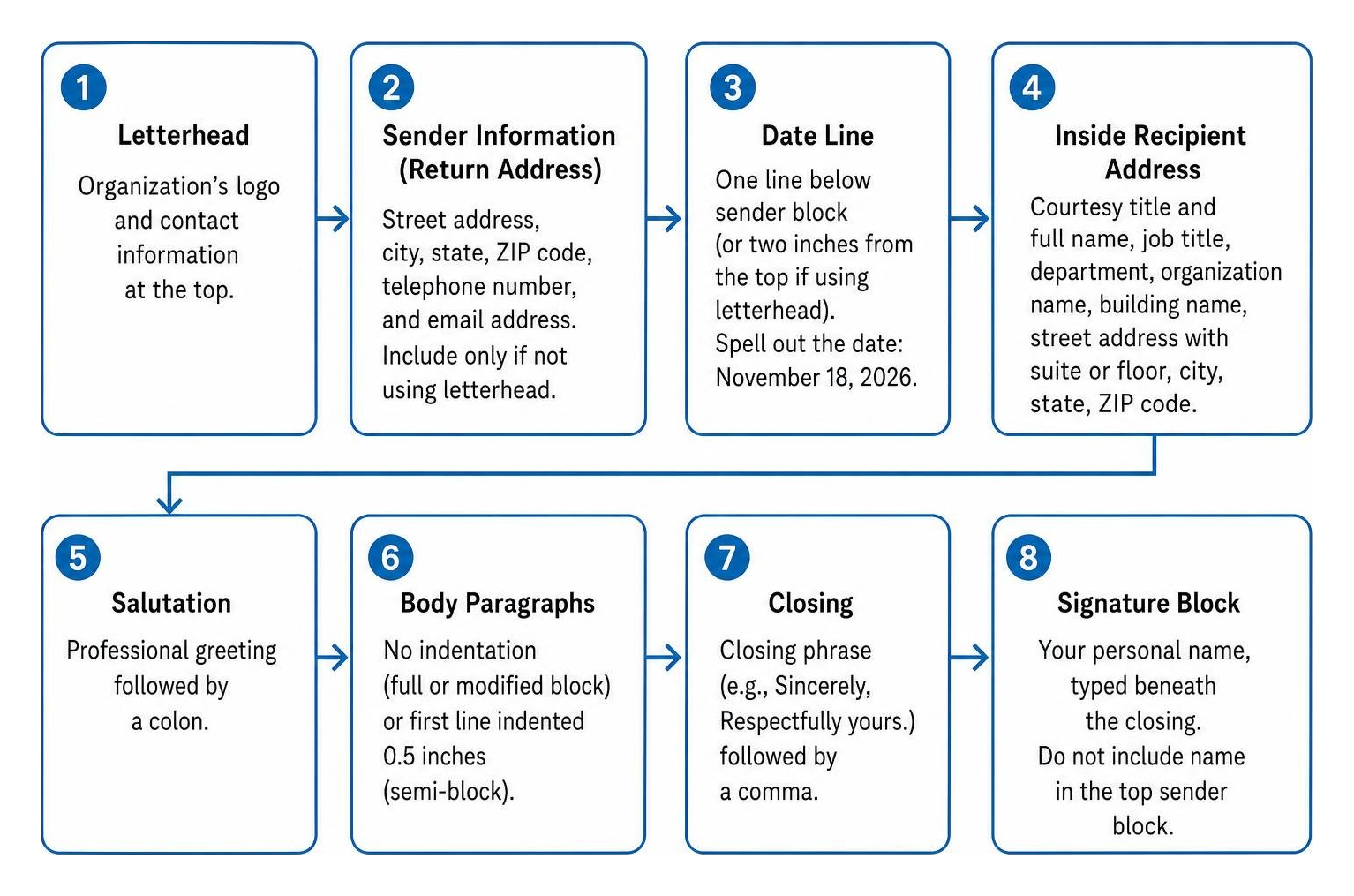
Step-by-Step Formal Letter Address Layout for Executive Mail
- Set Page Margins and Typography: Establish 1-inch margins on all sides and select a clean, professional 12-point font.
- Input Return Information: If you are not using letterhead, type your street address, city, state, ZIP code, and contact information, left-aligned at the top.
- Insert the Date Line: Skip one line and type the full date (Month Day, Year).
- Construct the Inside Address Block: Skip one line and enter the recipient's courtesy title, full name, professional title, company, and complete street address. Following authoritative style guide standards on addresses ensures institutional accuracy across state abbreviations and street suffixes.
- Add an Attention Line (Optional): If directing the letter to a specific individual within a broad department, add Attn: [Name or Department] directly below the company name.
- Formulate the Salutation: Leave one blank space and write a formal greeting ending with a colon (Dear Dr. Aris:).
- Draft the Body Paragraphs: Single-space within paragraphs and separate each distinct point with a single blank line.
- Add the Complimentary Close and Signature Space: Insert a closing (Sincerely,), leave four blank lines for a physical wet-ink signature, and type your full name, title, and organization.
Special Handling Scenarios in Your Formal Letter Address Layout
Special correspondence often requires subtle adjustments:
- Unknown Recipient Name: When you cannot identify an individual addressee after thorough research, address the letter directly to the functional title or department (Dear Hiring Committee: or Dear Director of Procurement:).
- Gender-Neutral and Professional Honorifics: When a recipient's courtesy preference is uncertain, default to Ms. for women in business, use their earned professional title (Dr., Judge, Professor), or write out the recipient's full name in the salutation (Dear Chris Morgan:).
- Cross-Border Delivery: When sending mail across international borders, place the country name in all-capital letters on the final line beneath the city and postal code, drawing on established Canadian guidelines on correspondence addresses or relevant postal rules.
Envelope Addressing and Presentation Standards

The layout of your mailing envelope must mirror the precision inside the letter. Standard business correspondence relies primarily on a standard #10 envelope (4⅛ × 9½ inches).
Place your return address in the upper-left corner, positioned ¼ inch from the top and left edges. Position the recipient delivery address block in the center-right quadrant of the envelope face to allow adequate white space for automated postal equipment. You can refine your production techniques by mastering the fundamentals of writing an address on an envelope alongside the exact spatial format to write address on envelope.
Ensuring Postal Compliance and Optical Character Recognition
Automated sorting machines use optical character recognition (OCR) to read, verify, and route mail pieces. For commercial envelopes, left-align all delivery text lines, use clean block lettering, and avoid punctuation marks such as commas or periods on the envelope face. Always utilize standard two-letter state abbreviations and verify the correct postal code format with a valid 5-digit ZIP or ZIP+4 code.
Selecting Premium Envelopes and Window Alignment
For recurring statements, invoices, and notices, window envelopes save time and eliminate addressing mismatches. Fold your document in horizontal thirds (a standard letter fold) so the inside recipient address block aligns perfectly through the clear poly window without exposing personal body text.
High-end professional firms frequently choose heavy-weight wove or laid paper stock (such as 24 lb or 28 lb bond) to convey tactile quality. Applying targeted envelope printing tips and referencing our comprehensive envelopes 101 guide will help you select the ideal paper textures, flap styles, and window placements for your executive mailings.
Frequently Asked Questions About Formal Letter Addressing
Where does the sender address go when using corporate letterhead?
When writing on pre-printed corporate letterhead, omit the typed return address block entirely. Because your organization's name, physical address, and contact information already appear in the printed header or footer, place your date line at the top left (roughly two inches from the top edge) and proceed immediately to the recipient's inside address.
When should I use 'Yours sincerely' versus 'Sincerely' or 'Yours faithfully'?
In American business correspondence, Sincerely, Respectfully, or Best regards are standard for almost all formal letters. If you follow British correspondence conventions, use Yours sincerely when you have addressed the recipient by name (Dear Mr. Davis), and reserve Yours faithfully strictly for letters begun with Dear Sir or Madam.
How do I format an inside address if the recipient's name is unknown?
Place the company or department name on the first line of the inside address block, followed by the street address, suite number, city, state, and ZIP code. You may insert an optional attention line (Attn: Human Resources Department) directly below the organization name, paired with a functional salutation (Dear Search Committee:).
Conclusion
Polishing your correspondence with an exacting address layout elevates your organization's reputation and guarantees that vital communications arrive without delay. Swift Printing is a high end print shop setting the standard for printing in the boutique business, partnering with West Michigan practices, regional offices, and nationwide enterprises to produce immaculate corporate letterhead, custom stationery, and precision-matched envelopes. When you are preparing large-scale client communications, review our guide on formatting a spreadsheet for a mailing to ensure your address database translates smoothly into print.