Top Things to Put on Your Commercial Printing Envelopes So People Actually Open the Mail (Honestly)

In a world of overflowing inboxes and nonstop notifications, physical mail still has power—but only if it’s done right. The envelope is your first impression, your handshake, your moment to earn trust before the message is ever read.
The goal isn’t trickery. It’s not clickbait. It’s not deception.
The goal is clarity, credibility, and relevance.
Here are the top, honest things to put on your business’ envelopes to increase open rates while protecting your brand’s integrity.
1. Your Real Name (or a Real Person’s Name)
People open mail from people, not “departments.”
Instead of:
Marketing Communications Office
Try:
Jessica Gutowski-Slaydon
Walt Gutowski III
Your Account Team at Swift Printing
This works because it signals accountability. Someone is standing behind this message. It feels human, not automated.
Pro tip: Script fonts are tempting here, but a clean serif or sans-serif often reads more professional and trustworthy.
2. A Clear, Branded Return Address
A missing or generic return address raises red flags instantly.
Your envelope should clearly show:
Your company name
Your physical address (yes, physical matters)
Consistent branding with your website and other materials
This reassures the recipient that:
You’re a real business
You’re not hiding
You’re established
Trust starts before the envelope is opened.
3. Subtle Brand Recognition (Not a Billboard)
Your logo should be present—but not screaming.
Think:
Upper-left corner placement
One-color logo or muted brand color
Clean spacing
Avoid:
Oversized logos
Busy patterns
Shiny gimmicks that feel promotional
If it looks like an ad, it gets tossed.
If it looks like important correspondence, it gets opened.
4. Honest Teaser Copy (One Short Line)
If you include teaser text, it must be true.
Good examples:
“Information about your upcoming renewal”
“Details inside regarding your account”
“An update from your local printing partner”
“Invitation enclosed”
Avoid vague hype like:
“Urgent notice”
“Immediate action required” (unless it truly is)
“You may be entitled to…”
People are smarter than that—and once trust is broken, it’s hard to earn back.
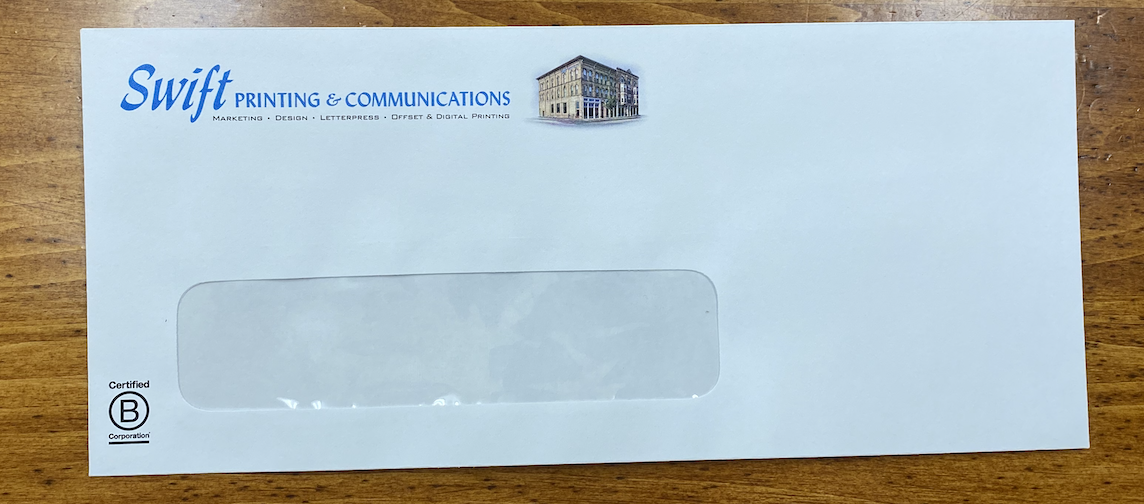
5. Window Envelopes (When Appropriate)
Window envelopes work well when:
The mail is transactional
The recipient already expects communication
The sender is clearly identifiable
Seeing their name printed cleanly inside builds legitimacy and reduces friction. It signals, “This was meant for you.”
Just make sure:
The alignment is perfect
The paper stock behind the window feels substantial
The design doesn’t feel like bulk mail
Details matter here.
6. High-Quality Paper Stock (Yes, People Notice)
The weight of the envelope communicates value instantly.
Thin envelopes say:
“This was cheap.”
Thicker, well-made envelopes say:
“This matters.”
A quality stock:
Feels intentional
Protects the contents
Signals professionalism
This doesn’t mean over-the-top luxury—it means thoughtful choices.
7. Real Postage (When It Makes Sense)
There’s a noticeable difference between:
Stamps or metered postage
Bulk mail indicia
Stamped or metered mail often feels:
More personal
More important
Less disposable
Bulk mail has its place, but if the message is relationship-driven, real postage can increase open rates significantly.
Pro Tip: I think it really depends on the generation receiving the mail too. I think GenX to Boomers really look at this. I think Millennials to Alpha are not even looking at how it’s sent.

8. Clean, Intentional Design (Less Is More)
Whitespace is your friend.
A cluttered envelope:
Feels like marketing
Feels overwhelming
Feels skippable
A clean envelope:
Feels calm
Feels official
Feels worth opening
Ask yourself:
“Would I open this if it landed in my mailbox?”
If the answer is no, revise.
Envelope Everything, our 101 guide to envelopes.
9. Local Signals (When Relevant)
People respond to familiarity.
Subtle cues like:
“Proudly serving West Michigan”
A recognizable local address
Community-focused language
…create connection and credibility. It reminds the recipient you’re part of their world, not just another faceless company.
10. Consistency With What’s Inside
This might be the most important point.
Your envelope should accurately reflect the tone and value of what’s inside.
If the envelope feels premium but the contents feel rushed—trust erodes.
If the envelope feels thoughtful and the contents deliver—trust builds.
Mail is a relationship tool, not a trick.
The Art and Science of Direct Mail Marketing: Combining Creativity and Analytics
The Big Takeaway
The best envelopes don’t shout.
They don’t deceive.
They don’t manipulate.
They simply say:
“This is relevant, respectful, and worth your time.”
When you approach envelope design with honesty and intention, you don’t just get higher open rates—you build long-term credibility.
And in business, that’s the kind of return that lasts.