Choosing an Inkjet Addressing Service for Your Mailer
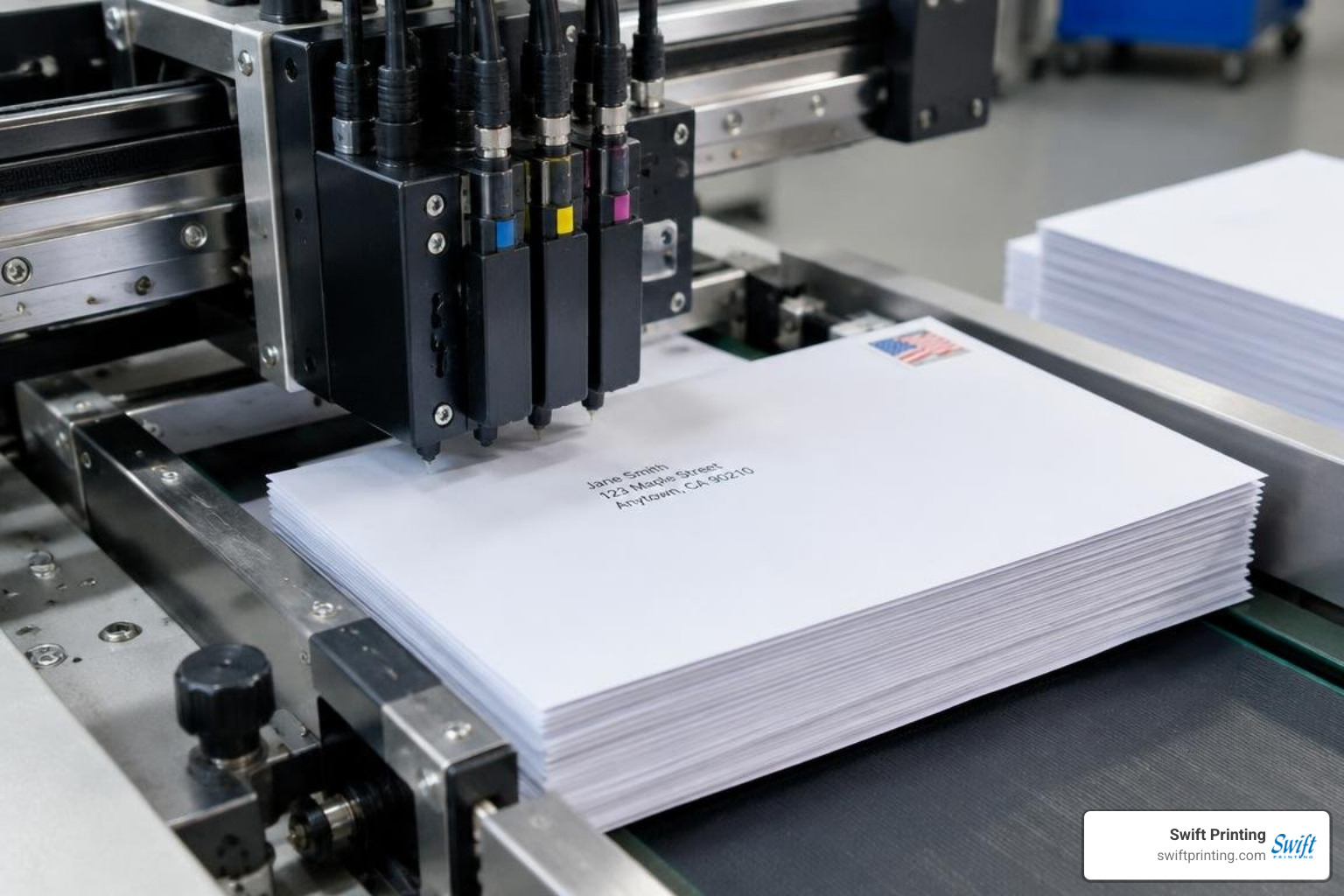
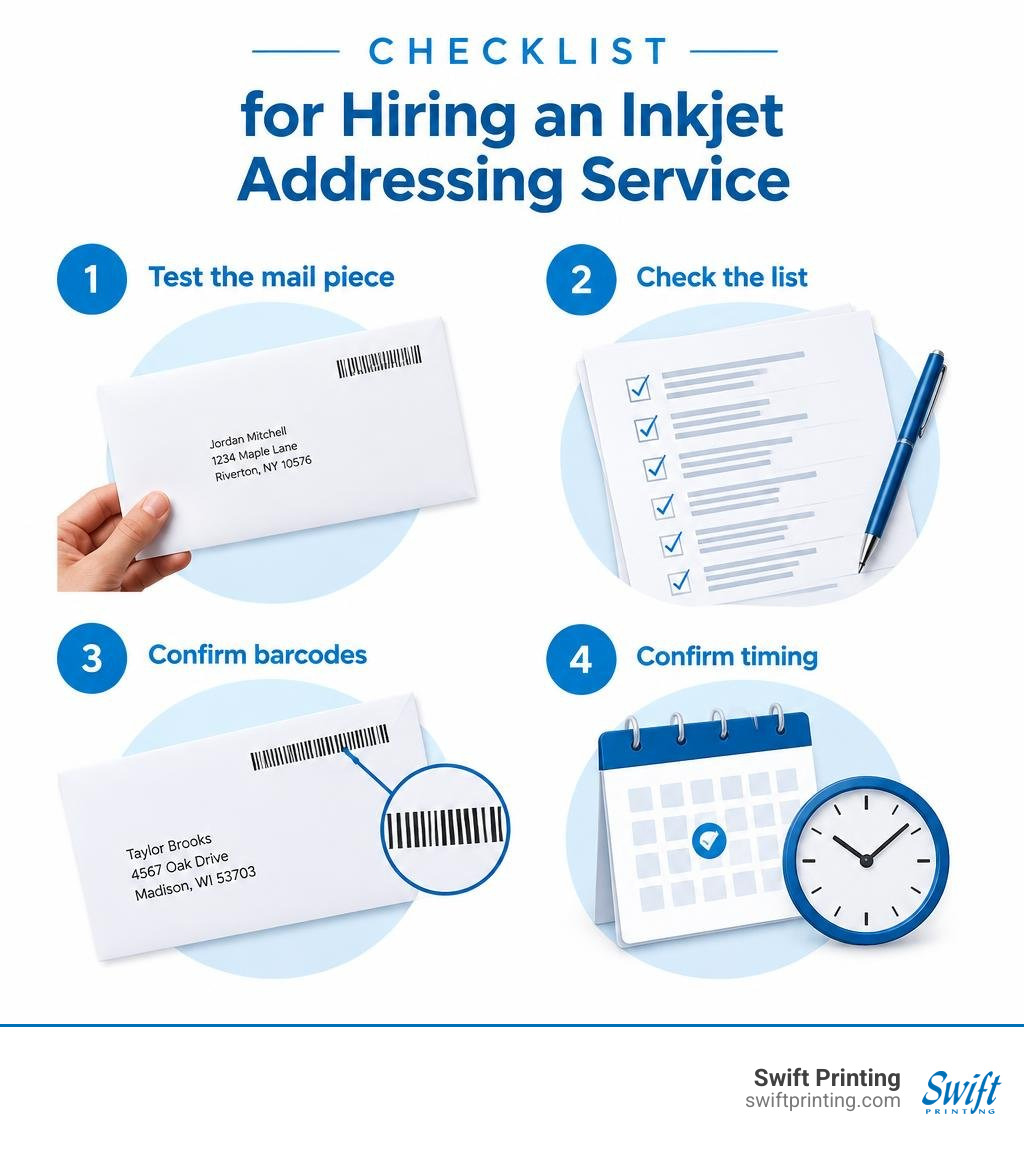
An inkjet addressing service prints recipient addresses directly on mail pieces, without adhesive labels. When evaluating commercial print partners, ask whether their equipment can print cleanly on your chosen paper stock, verify your address list against official postal databases, apply the required automation barcodes, and meet your exact distribution schedule. Always request a physical sample printed on your actual mail piece before authorizing a full production run.
A well-planned mailer should look as polished and professional as the message inside it. Swift Printing is a high-end print shop setting the standard for boutique printing, with an unwavering focus on craftsmanship, clear communication, and dependable service for professional organizations.
I’m Jessica Gutowski-Slaydon, president of Swift Printing. In my daily work with direct mail campaigns, variable-data printing, and high-volume project planning, I guide corporate leaders, medical administrators, and legal teams through the technical steps required to select an inkjet addressing service for their critical outreach efforts.
Why Professional Organizations Rely on an Inkjet Addressing Service
When a client receives a piece of physical mail from a law firm, a specialized medical clinic, an executive consultancy, or a public agency, the presentation sets the tone before an envelope is ever opened. Physical mail commands tactile attention, which is one reason why direct mail still works for modern businesses looking to build lasting relationships with key stakeholders. A thoughtfully addressed envelope conveys authority, discretion, and meticulous care.
Direct imprinting using commercial inkjet equipment applies crisp, high-resolution text and machine-readable barcodes straight onto the envelope or self-mailer. Adhesive labels can peel at the edges, catch on high-speed postal sorting machinery, or look like an afterthought. High-volume industrial systems can process between 20,000 and 40,000 pieces per hour, ensuring that even large-scale distributions maintain flawless visual alignment, deep contrast, and clean lines across every single unit.
Flawless Presentation Versus Adhesive Labels
Adhesive labels introduce physical friction and visual disruption into the mailing workflow. Labels can wrinkle during application, skew on the mail piece, or leave gummy residue that attracts dust and debris during transit. Direct inkjet imprinting eliminates the separate manufacturing and manual handling required by sticker stock, delivering a refined aesthetic that protects brand credibility and commands immediate respect.
| Addressing Feature | Direct Inkjet Addressing | Adhesive Paper Labels |
|---|---|---|
| Visual Finish | Seamless, integrated directly on paper substrate | Bulky, raised profile with visible borders |
| Alignment Stability | Controlled by optical registration sensors | Subject to crooked manual or mechanical placement |
| Typography Control | Matches document TrueType brand fonts | Often restricted to basic label sheet formats |
| Postal Processing | Smooth feed through automated sorting scanners | Risk of corner peeling and equipment jams |
| Variable Messaging | Dynamic text, teasers, and codes in one pass | Limited space strictly for delivery lines |
Variable Data Personalization for High-Impact Mailers
Boutique direct mail relies on relevant, tailored content that resonates with distinct recipient groups. Modern inkjet printheads support full variable-data workflows, enabling you to adjust dynamic recipient names, formal salutations, and even individual account codes on the fly without interrupting production throughput.
Adding personal touches with direct mail allows nonprofit foundations, educational institutions, and corporate advisory teams to customize donor recognition tiers, reference past engagement milestones, or include personalized appointment tracking URLs. TrueType font integration ensures that the recipient's name and address match the exact typography, stroke weight, and aesthetic character of your organization's formal brand guidelines.
Technical Considerations: Substrates, Barcodes, and Postal Standards
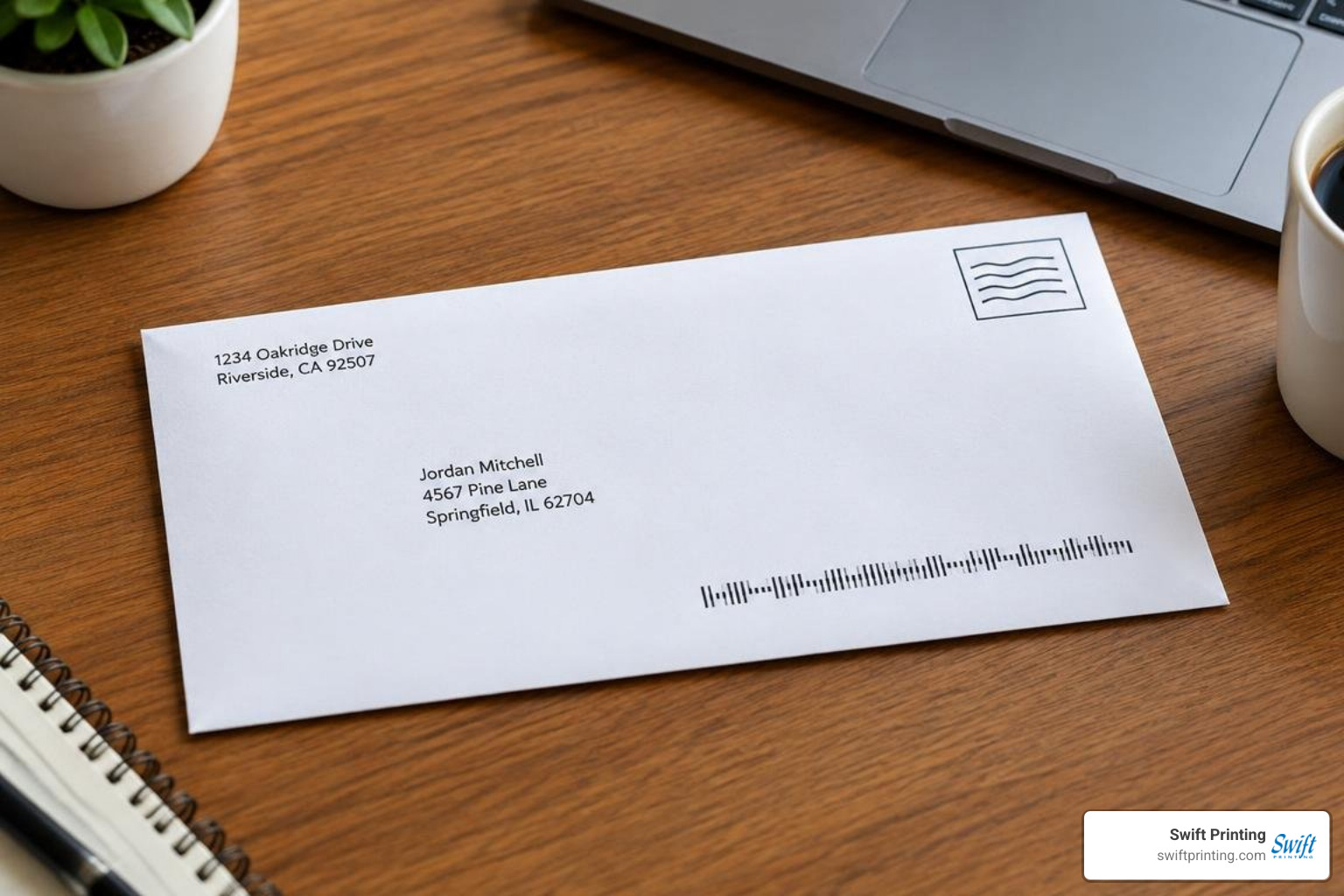
Precision addressing requires strict adherence to automated postal guidelines. The standard delivery block must maintain a dedicated clear zone to accommodate optical character readers, sorting cameras, and barcode tracking systems. Understanding USPS mailer best practices for postal compliance guarantees that your design meets all processing requirements without compromising your artistic vision or executive layout.
The United States Postal Service utilizes the Intelligent Mail Barcode (IMb), a 65-bar machine-readable code that encodes the mailer identifier, service class, routing ZIP code, and unique piece sequence. A baseline print resolution of 600 DPI ensures that the distinct tracker, ascender, descender, and full bars within the 65-bar matrix remain crisp and legible at high sorting velocities.
How Inkjet Addressing Works on Different Substrates
Paper stocks interact differently with various ink formulations. Understanding these interactions ensures high legibility and prevents smudging across different paper weights:
- Uncoated Paper & Matte Stocks: Highly porous materials absorb water-based aqueous inks instantly, yielding dark, sharp letterforms with zero drying lag.
- Aqueous (AQ) Coated Finishes: Provide basic moisture protection while remaining receptive to specialized commercial addressing inks engineered for fast bonding.
- High-Gloss and UV-Coated Stocks: Full UV coatings repel water-based inks, which can cause letters to bead up. For glossy mail pieces, leaving an uncoated 3.5-inch by 1.5-inch knockout window on the address panel allows aqueous inks to bond cleanly. Alternatively, fast-drying solvent-based systems provide durable adhesion on coated cards, poly-wrap, and synthetic films.
Selecting the right ink chemistry based on material porosity is critical for quality assurance, as detailed in technical resources covering industrial thermal inkjet addressing solutions.
High-Speed Precision and Quality Assurance
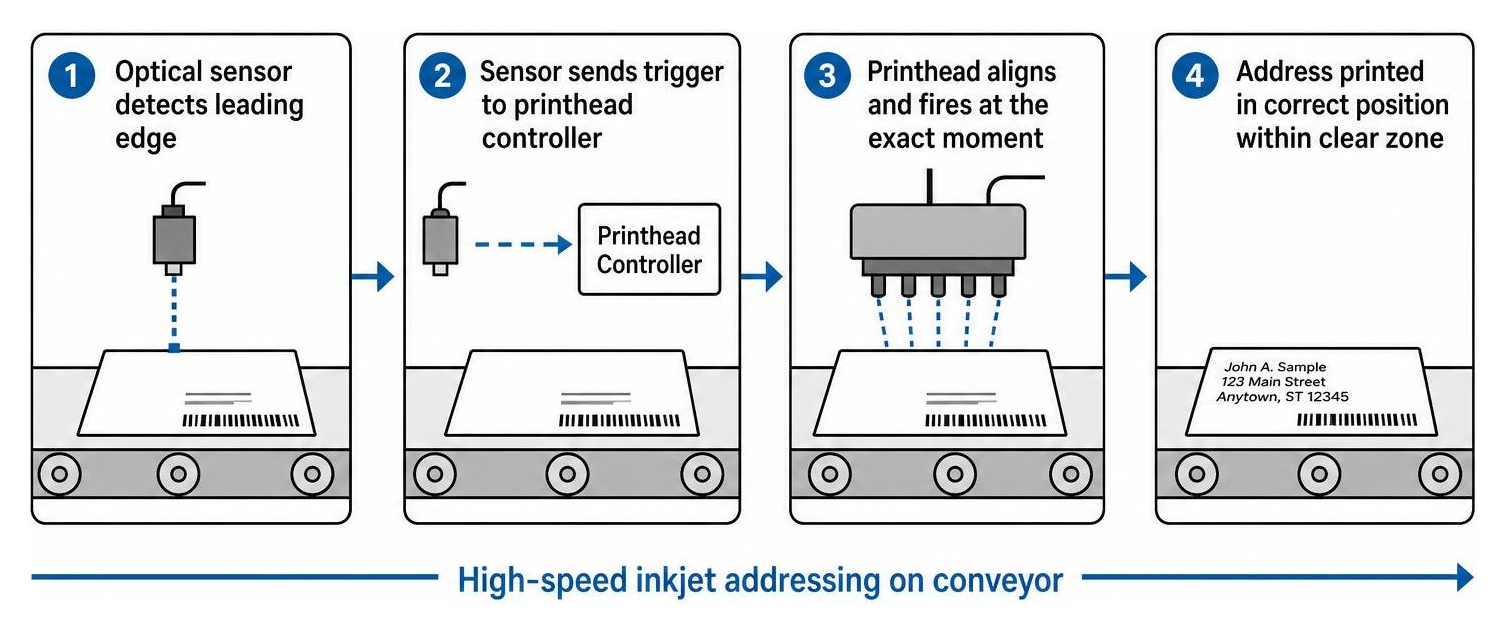
Commercial print operations use sophisticated Drop-on-Demand (DOD) and Thermal Inkjet (TIJ) systems. These platforms utilize optical positioning sensors mounted above the conveyor bed. The sensors detect the physical leading edge of every incoming postcard or envelope, instructing the printheads to fire at the exact microsecond required. This optical registration prevents address drift, keeping every delivery block perfectly centered within required postal margins.
Preparing Addressed Mail for a Successful Campaign
Careful list preparation ensures every piece arrives at its intended destination. Verifying address files before production avoids misdirected mailings and maintains data integrity. Proper file setup is straightforward when following proper address formatting for commercial mailers to structure spreadsheets cleanly.

Preparing and Checking Your Address Data
Data hygiene transforms raw spreadsheets into reliable delivery pathways. Industry best practices, such as established university bulk mail addressing standards, outline systematic approaches to address standardization:
- Address Standardization: Format street suffixes, directional indicators, and secondary unit numbers according to official postal database conventions.
- Coding Accuracy Support System (CASS): Validates individual addresses against current carrier delivery routes and appends precise ZIP+4 extensions.
- Delivery Point Validation (DPV): Confirms whether a specific address exists as an active, deliverable physical drop location.
- National Change of Address (NCOA): Cross-references recipient records against official relocation filings to update moves that occurred within the past 18 to 48 months.
- De-duplication: Filters out redundant database entries across identical households or names, preventing duplicate deliveries.
Getting Addressed Mail Ready for Mailing
Once the inkjet system prints addresses, postal barcodes, and indicia blocks, the physical mail pieces must be assembled according to strict preparation standards.
When managing comprehensive mailing services, the addressed items are placed into postal trays or sacks organized by carrier routes and regional distribution centers. Using high-capacity addressing systems capable of processing up to 30,000 pieces per hour allows mid-sized and large campaigns to move seamlessly from initial list hygiene to full carrier induction on tight timelines without sacrificing quality.
Selecting the Right Partner for Your Direct Mail Campaigns
High-stakes mailings—such as time-sensitive legal notifications, patient appointment notices, municipal communications, and executive donor campaigns—require dependable execution. When selecting an addressing partner for your targeted direct mail production, look for a team that balances high-speed equipment with attentive craftsmanship.
What to Look for When Choosing an Inkjet Addressing Service
- Substrate Versatility: The capability to print cleanly on varied textures, including heavy cotton envelopes, coated catalog covers, vellum sheets, and textured greeting cards.
- Variable Data Expertise: Seamless integration of multi-field personalization, including recipient names, customized teaser copy, individualized salutations, and variable imagery.
- Strict List Security: Secure data protocols for managing customer lists, medical patient records, and confidential business rosters in full compliance with privacy standards.
- Direct Communication: A collaborative team that provides clear proofs, physical test impressions, and proactive scheduling updates throughout the entire production run.
Frequently Asked Questions About Inkjet Addressing
What elements can be printed in a single inkjet addressing pass?
Modern multi-head inkjet systems can print the recipient delivery address, return address, corporate logos, postal permit indicia, and promotional teaser messaging in a single pass across the conveyor bed, ensuring uniform ink density and registration.
Can inkjet addressing print on glossy or coated cardstocks?
Yes. While uncoated paper readily absorbs aqueous inks, glossy pieces can be addressed using fast-drying solvent inks or by designing an uncoated knockout panel (typically 3.5 × 1.5 inches) where the address block appears.
How does inkjet addressing support USPS postal automation compliance?
Inkjet addressing systems apply the 65-bar Intelligent Mail Barcode (IMb) directly underneath or alongside the address block at high optical resolution, ensuring proper contrast, clear zones, and placement for automated postal sorting scanners.
Conclusion
Every piece of physical mail represents your organization's standard of quality. By pairing clean data hygiene with high-resolution inkjet addressing, your envelopes and mailers achieve the polished presentation needed to earn immediate trust from executives, clients, and community members. When you are ready to prepare a thoughtful, high-impact campaign, partner with Swift Printing for your next project to ensure exceptional results from initial design to final postal delivery.