Write Clean Envelope Addresses That Mail Carriers Can Read
The Four Essential Envelope Placement Zones
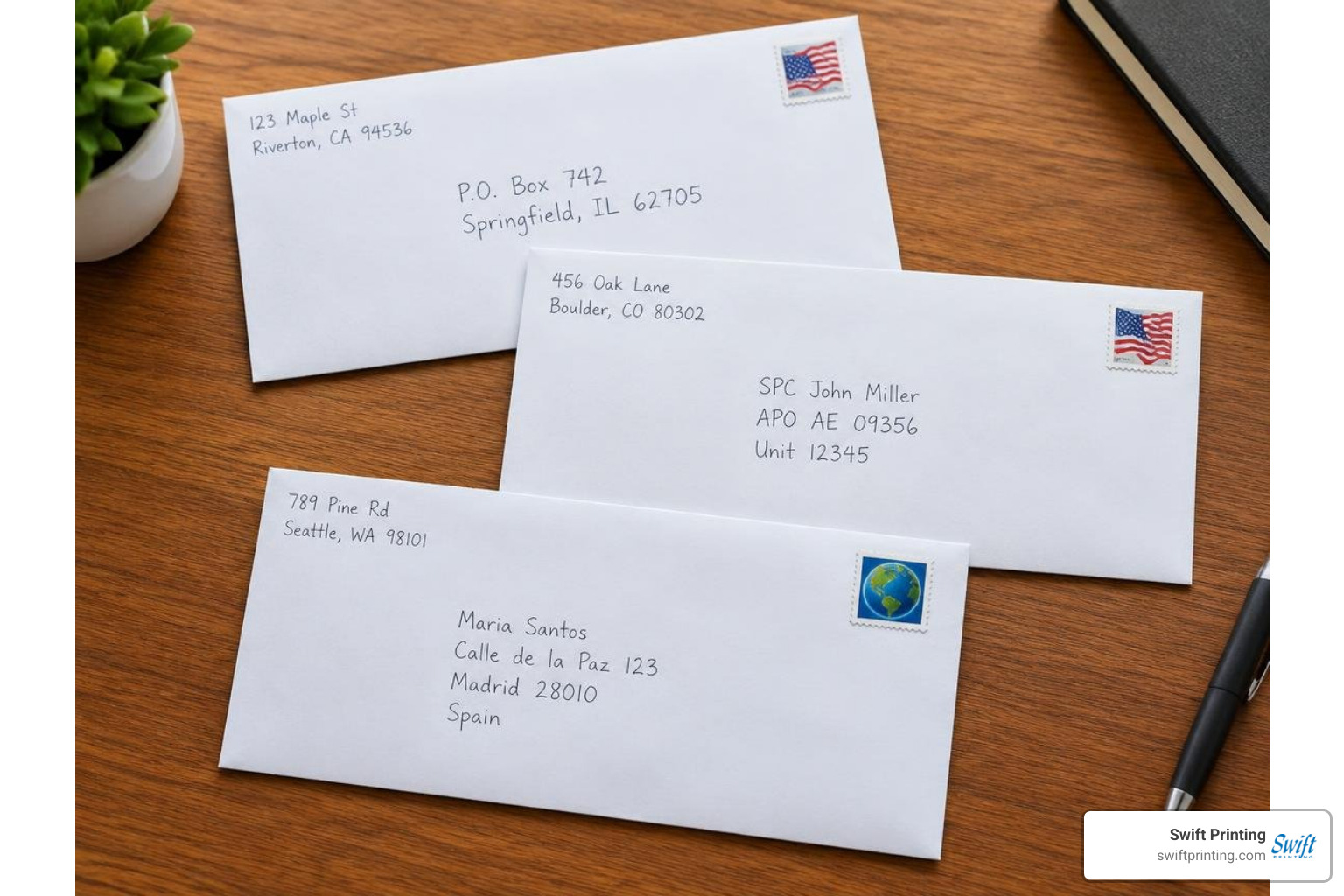
To format an address on an envelope correctly, place the recipient's name on the first line, the street address or PO Box on the second line, and the city, two-letter state abbreviation, and ZIP+4 code on the final line. Keep the delivery address block left-aligned in the center-right area of the envelope, use uppercase lettering, and leave the bottom 5/8 inch clear for postal barcodes.
Every single business day, the United States Postal Service processes 425.3 million mail pieces using high-speed optical sorting machines. These automated systems move at astonishing speeds, reading addresses and sorting envelopes in fractions of a second using advanced Optical Character Recognition (OCR).
When an address contains unusual formatting, low-contrast ink, or misplaced information, the scanning cameras cannot decipher the text. The piece gets kicked out of the automated stream for manual review, causing unnecessary transit delays or getting returned to sender.
Whether you are mailing executive client communications, legal notices, medical billing, or high-touch marketing campaigns, understanding the precise layout standards protects your timelines and ensures your mail arrives crisp and on schedule.
To set up your envelope correctly, think of the front face as a grid divided into four distinct zones. Each zone serves an automated purpose during postal processing.
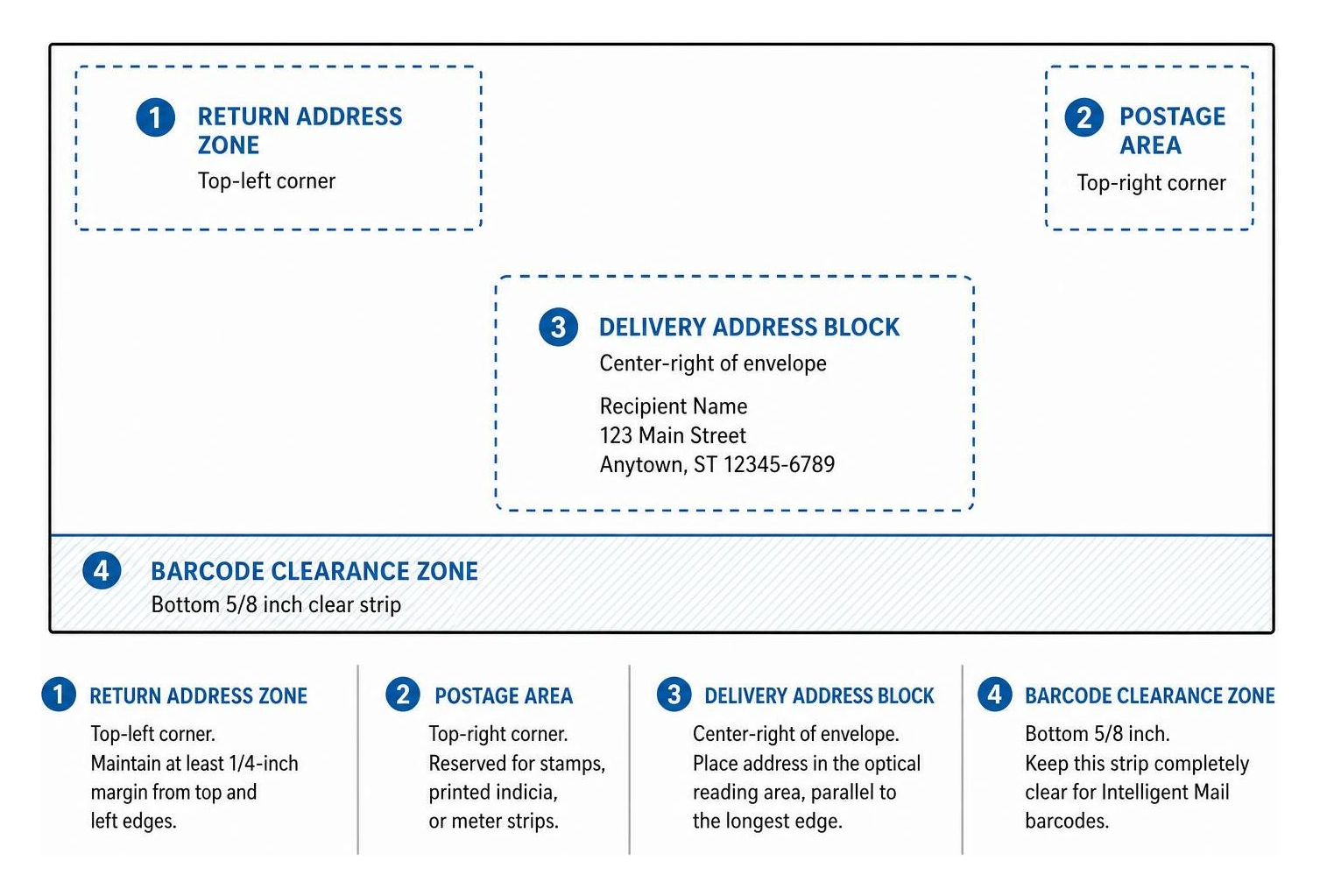
- The Return Address Zone (Top-Left Corner): Placed in the upper-left quadrant, maintaining at least a 1/4-inch margin from the top and left edges. This tells the postal service where to return the piece if it cannot be delivered.
- The Postage Area (Top-Right Corner): Reserved entirely for stamps, printed postal indicia, or meter strips. Keep this area clear of notes or return addresses.
- The Delivery Address Block (Center-Right): Positioned in the optical reading area near the middle of the envelope, oriented parallel to the longest edge.
- The Barcode Clearance Zone (Bottom 5/8 Inch): A dedicated 0.625-inch clear strip running along the entire bottom edge. Automated sorters print Intelligent Mail barcodes here, so keep this space completely blank.
The baseline standard for American business correspondence is the No. 10 envelope, measuring 9.5 by 4.125 inches. Mastering these zones ensures your letter glides effortlessly through sorting facilities. For deeper structural insights into paper stocks and flap styles, explore our foundational guide to envelopes 101 alongside the official USPS guidance on addressing your mail.
Step-by-Step Format to Write Address on Envelope
When preparing the recipient block, automated sorters read from the bottom line upward. Following a standardized structure eliminates ambiguity:
- Left-align every line: Keep the left edge straight and uniform. Never center individual lines or stagger them diagonally.
- Use uppercase lettering: While neat mixed case is acceptable, uppercase block lettering is optimal for OCR readability.
- Omit non-essential punctuation: Skip periods after abbreviations and commas between cities and states. Punctuation marks can be misread by optical lenses as stray ink.
- Apply standard abbreviations: Use official two-letter state abbreviations and standard street suffixes (such as AVE, ST, BLVD, RD, and STE).
- Include the ZIP+4 code: Adding the four-digit extension pinpoints the exact delivery route and speeds transit.
Review our practical envelope printing tips for advice on ink densities and equipment setup.
Standard Residential Format to Write Address on Envelope
A residential address follows a clear three-to-four-line progression:
Line 1: Full recipient name (and optional formal title)
Line 2: Street address with directional indicators (N, S, E, W) and secondary units
Line 3: City, two-letter state abbreviation, and ZIP+4 code (separated from the state by two spaces)
| Incorrect Format | Correct USPS-Compliant Format |
|---|---|
| John Miller, Jr. 1420 North Broadway, #4B Denver, Colorado 80202 |
JOHN MILLER JR 1420 N BROADWAY APT 4B DENVER CO 80202-1234 |
| Dr. Sarah Jenkins Apt 12, 742 Evergreen Terrace Springfield, IL, 62704 |
DR SARAH JENKINS 742 EVERGREEN TER APT 12 SPRINGFIELD IL 62704-2041 |
Corporate and ATTN Line Format to Write Address on Envelope
Corporate mailings require clear routing lines so internal office staff can quickly direct mail to the correct person or department.
- Attention Line (ATTN): Identifies the specific individual responsible for receiving the document. Place this line above the company name or as the primary line.
- Care Of (C/O): Used when sending mail to an individual residing or working at an organization or private residence where they are not the primary occupant.
- Department Routing: Clearly designate accounting, human resources, or legal departments directly below the company name.
For large-scale business operations, pairing clean database records with dependable mailing services guarantees that high-priority communications arrive at the right desk without delay.
Handling Secondary Units: Apartments, Suites, and Floors
Secondary unit designators must be formatted correctly to prevent returned mail:
- Always place apartment, suite, floor, or building designations at the end of the main street address line (e.g.,
120 OTTAWA AVE NW STE 300). - Use standard postal abbreviations:
APT(Apartment),STE(Suite),FL(Floor),BLDG(Building),DEPT(Department),RM(Room), orOFC(Office). - Avoid using pound symbols (
#), slashes, or hyphens before the number. Automated scanners can interpret the#symbol as a stray pen mark. - If the street address and unit number exceed 30 characters, move the unit designation to its own line placed directly above the street delivery line. Never place secondary unit numbers below the street line.
Formatting Special Mail: PO Boxes, Military, and International Destinations
Special delivery situations require distinct adjustments to standard address structures.
PO Box and Rural Route Addressing Rules
Post Office Boxes provide secure, centralized delivery:
- Replace the physical street address line entirely with the PO Box number (e.g.,
PO BOX 458). - Do not combine a physical street address and a PO Box number on the same line. If both must appear on the envelope, place the intended delivery point on the line directly above the city, state, and ZIP Code.
- For rural delivery routes, format the line as
RR 2 BOX 152.
Detailed layout regulations can be referenced in the official USPS 602 Quick Service Guide.
Military APO, FPO, and DPO Requirements
Deployments and overseas military bases rely on the Military Postal Service Agency:
- Recipient Line: Include the service member's full name, rank/title, and unit or PSC (Postal Service Center) number.
- City Field: Replace the domestic city name with
APO(Army Post Office),FPO(Fleet Post Office), orDPO(Diplomatic Post Office). - State Field: Use the appropriate armed forces two-letter code:
AA(Armed Forces Americas),AE(Armed Forces Europe, Middle East, Africa, Canada), orAP(Armed Forces Pacific). - Country: Never write the foreign host country name on military mail. Doing so causes it to enter foreign postal streams incorrectly. Always conclude with the military ZIP+4 code.
International Destination Envelope Layout
International correspondence must accommodate foreign delivery layouts while maintaining USPS exit sorting criteria:
- Write the recipient's name, street address, and internal routing details using the conventions of the destination country.
- Place the foreign city, province/state, and postal code on the second-to-last line.
- Print the destination country name in English, in all capital letters, on the final line alone.
- Under USPS regulations, items mailed domestically cannot use a foreign return address.
Technical USPS Guidelines for Fonts, Legibility, and Barcode Clearances
Automated processing efficiency depends on strict visual contrast and clearance guidelines. Adhering to these specifications prevents manual sorting delays:
- OCR Read Area: Keep the recipient address inside the optimal read window, situated between 0.625 inches and 2.75 inches from the bottom edge of the envelope.
- Typography & Sizing: Select clear sans-serif typefaces (such as Arial, Helvetica, or Calibri) sized between 10 pt and 14 pt. Avoid ultra-thin weights, condensed type, script fonts, and ornate calligraphy.
- High Contrast Ink: Print dark black or navy blue ink against white, cream, or light pastel stock. Reverse-contrast printing (light text on dark paper) is unreadable by postal sorting cameras.
- Margins: Maintain at least a 1/8-inch buffer from all outer envelope borders.
Review our breakdown on mailers best practices to discover how clean design choices keep sorting facilities running smoothly.
Machinability Standards and Special Handling
To qualify for standard letter handling, envelopes must remain rectangular, flexible, and within established dimensional thresholds:
- Envelopes must measure between 5 inches and 11.5 inches long, and between 3.5 inches and 6.125 inches high.
- Thickness must not exceed 0.25 inches.
- Items containing rigid enclosures, metal clasps, strings, heavy buttons, or non-rectangular dimensions (such as square greeting cards) are classified as nonmachinable. These pieces require manual processing.
- For delicate stationery, wedding invitations, or high-end announcements, senders can request manual hand-canceling at the postal service counter to protect the envelope face from mechanical cancellation rollers.
For official step-by-step dispatch guidelines, consult the postal manual on how to send a letter.
Address List Maintenance and Database Accuracy
For corporate mailers, law practices, medical institutions, and consultants, address hygiene protects deliverability and marketing investment.
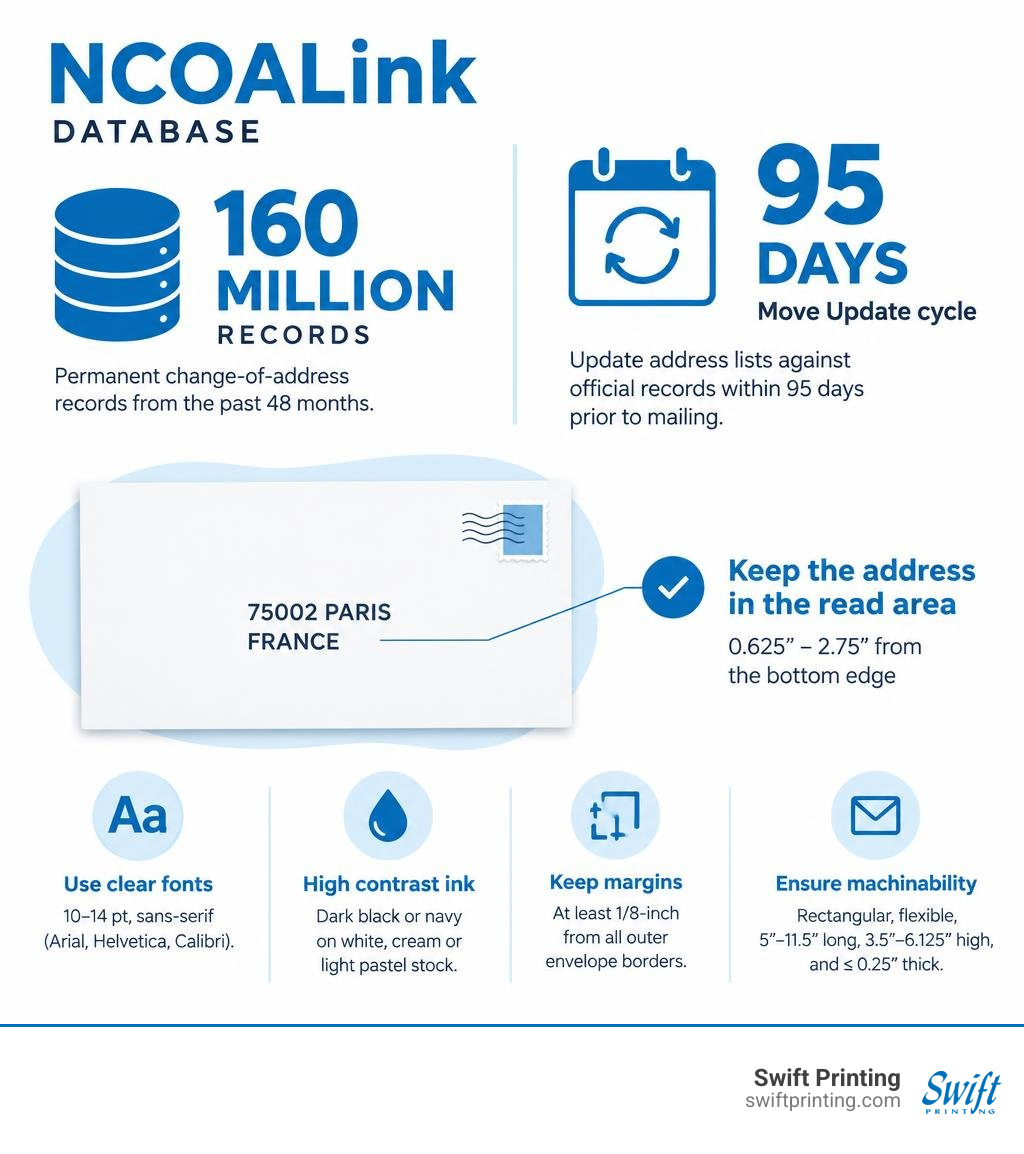
The USPS NCOALink database contains approximately 160 million permanent change-of-address records submitted over the past 48 months. Under USPS Move Update standards, commercial mailers must update address lists against official records within 95 days prior to mailing.
Using CASS-certified (Coding Accuracy Support System) software standardizes address syntax, verifies deliverability down to the individual suite, and appends accurate ZIP+4 codes. Reliable data hygiene is a core reason why direct mail still works, delivering predictable, measurable results for professional businesses.
Frequently Asked Questions About Addressing Envelopes
How should envelopes be addressed to married couples, families, or formal titles?
- Married Couples Sharing a Surname: Place both names on a single line:
MR AND MRS DANIEL MILLERorDANIEL AND EMILY MILLER. Married Couples with Different Surnames: List each name in full, either separated by "AND" on one line or stacked on two separate lines:
Whole Families: For casual correspondence, use
THE MILLER FAMILY. For formal or legal documents, list each adult on an individual line.- Professional Titles: Professional designations (such as
ESQ,MD, orCPA) should follow the surname after a comma, or use formal prefixes (THE HONORABLE KAREN WHITE).
Does the USPS require envelope addresses to be written entirely in capital letters?
The USPS does not strictly mandate all-caps text for personal, handwritten mail; neat mixed-case lettering is routinely scanned and processed. However, uppercase block lettering is the official recommendation for commercial mail and shipping labels because it eliminates character-joining ambiguities and reduces optical scanning errors.
Where should the return address go and is it mandatory?
The return address belongs in the upper-left corner on the front of the envelope. Placing return addresses on the back envelope flap is discouraged for commercial correspondence because automated scanning cameras photograph only the front face.
While ordinary First-Class residential letters without a return address will still be dispatched, any undeliverable letter lacking a return address cannot be returned and will be destroyed. Furthermore, return addresses are mandatory on certified mail, priority shipments, insured parcels, and commercial presort mailings.
Conclusion
Formatting clean, compliant envelopes ensures your correspondence arrives promptly and presents your organization with polish. Applying correct zone spacing, standard abbreviations, and verified ZIP+4 codes protects your delivery schedules and prevents unnecessary transit hiccups.
At Swift Printing, we support professional firms, healthcare practices, educational institutions, and corporate teams across West Michigan with precision envelope printing and end-to-end mailing execution. If you are preparing a large business distribution, review our step-by-step instructions on formatting a spreadsheet for a mailing, and reach out to our team whenever you need dependable print solutions handled with care.