Plan a Tri-Fold Brochure That Looks Good in Hand
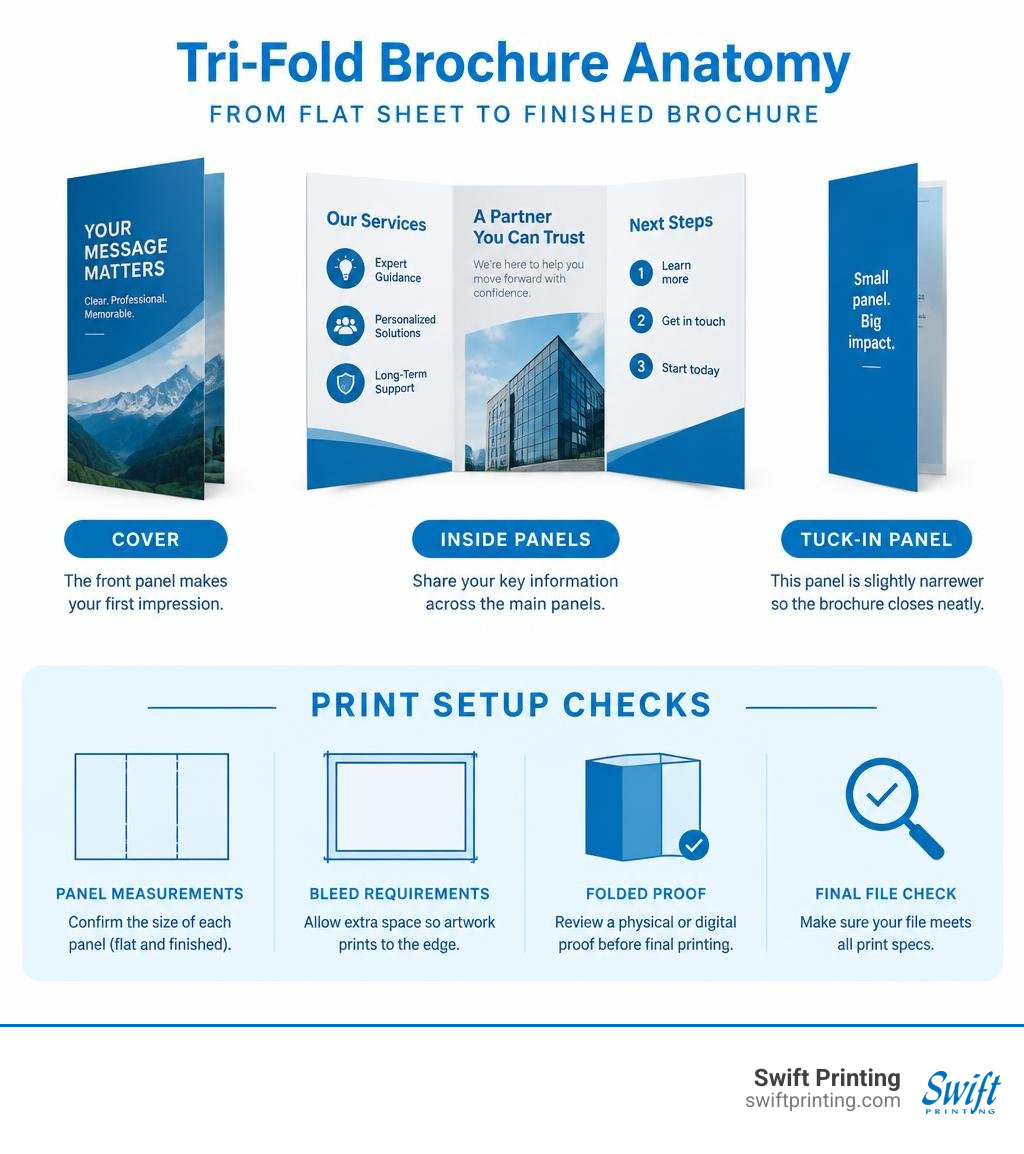
For a brochure printing tri-fold order, start with the finished job: who will receive the brochure, what they need to know, and what they should do next. A standard choice is an 8.5 x 11-inch sheet folded into three panels. Before you approve the design, ask your printer for the panel measurements, bleed requirements, and a folded proof. The panel that tucks inside usually needs to be slightly narrower so the brochure closes neatly.
A well-made tri-fold can give a law office, medical practice, business, or nonprofit a clear way to explain its services. Paper, finish, and fold quality all affect how that message feels in a client's hands. When you plan tri-fold brochure printing carefully, the finished piece becomes a polished extension of your professional brand.
I'm Jessica Gutowski-Slaydon, president of Swift Printing in Grand Rapids. I've helped customers plan brochure printing tri-fold projects, choose paper, review files, and find a production approach that fits their deadline.
Technical Standards for Tri-Fold Brochure Printing
Achieving an executive-level presentation starts with understanding flat and finished dimensions. A tri-fold brochure begins as a single flat sheet of paper divided into three distinct panels per side by two parallel folds.
The most common formats include:
- Letter Size (8.5 x 11 inches): The standard choice for corporate overviews, medical service menus, and professional capability statements. When folded, it creates a compact 3.68 x 8.5-inch finished piece that fits standard display racks and business envelopes.
- Legal Size (8.5 x 14 inches): An expanded canvas that yields roughly 4.68 x 8.5-inch panels, ideal for legal practices detailing complex service tiers or healthcare systems mapping out patient pathways.
- Tabloid Format (11 x 17 inches): A substantial format folding down to approximately 5.68 x 11 inches, often used by architectural firms, engineering consultants, and executive recruiters needing generous space for imagery and detailed text.
Mastering folded brochure geometry ensures that your final piece lies completely flat without buckling. If you plan to send your piece as a direct mail self-mailer, adhering to the Basic Design Elements for Folded Self-Mailers, Booklets, and Discs | PostalPro standards ensures smooth mailing automation and delivery.
Inside Panel vs. Outside Cover Dimensions
The most critical technical element in a tri-fold (also known as a letter fold or barrel fold) is panel size compensation. While many beginners divide an 8.5 x 11-inch document into three equal 3.66-inch sections, this causes the finished piece to bow outward.
When the brochure folds inward, the tuck-in panel must nest cleanly inside the outer cover and inner flap. To achieve this, the tuck panel is reduced by 1/16 of an inch (0.0625 inches), while the outside front cover and inside center panels receive the extra width.
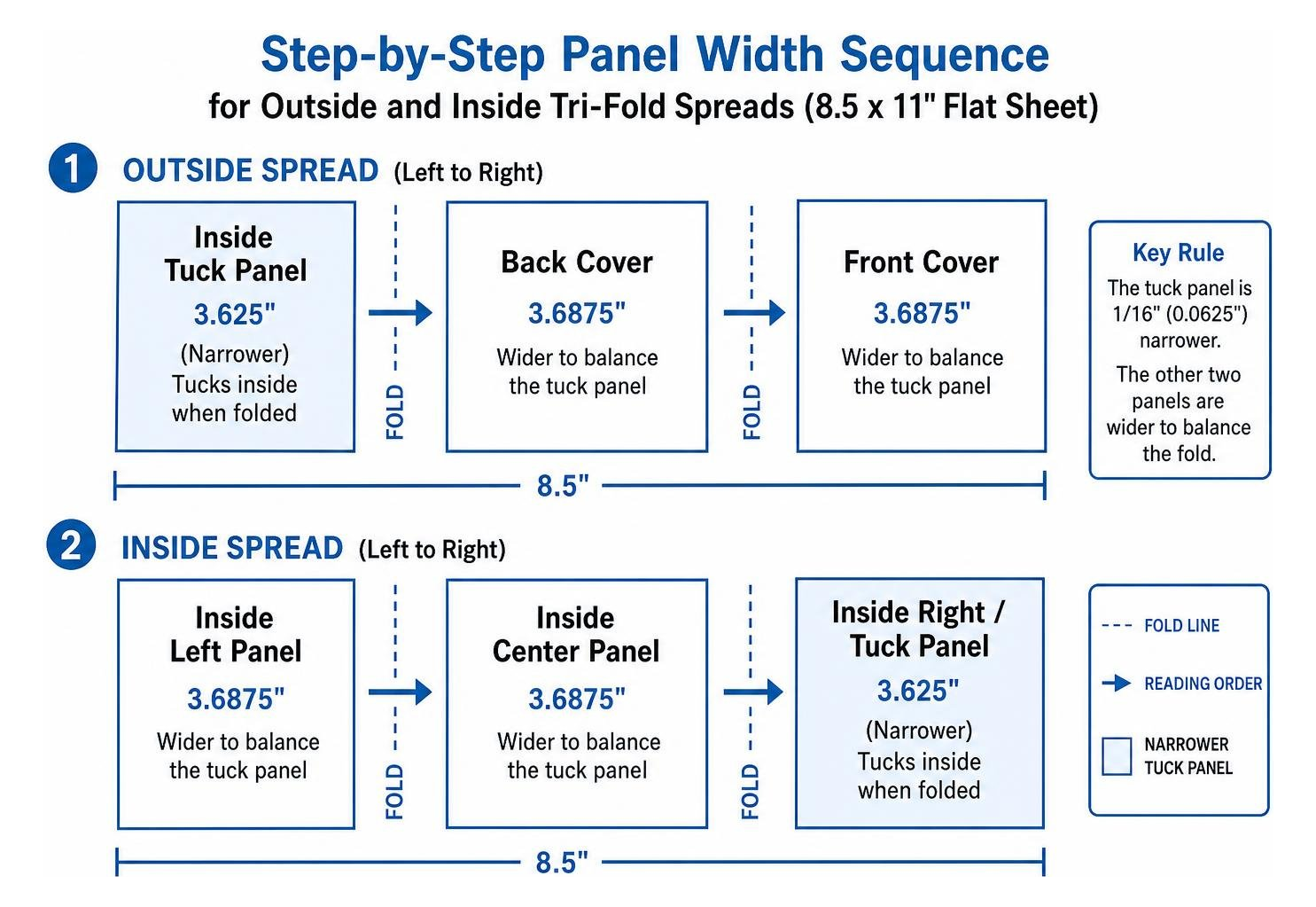
When setting up your design using layout software or adjusting a Canva tri-fold brochure design, configure your panels as follows for a standard 8.5 x 11-inch flat sheet:
- Outside Spread (Left to Right): Inside Tuck Panel (3.625 inches), Back Cover (3.6875 inches), Front Cover (3.6875 inches).
- Inside Spread (Left to Right): Inside Left Panel (3.6875 inches), Inside Center Panel (3.6875 inches), Inside Right / Tuck Panel (3.625 inches).
Accounting for this variance keeps your visual elements, color blocks, and borders aligned across every fold line.
Pre-Press File Preparation and Margins
Flawless commercial production depends on precise pre-press file setup. To ensure your files move smoothly into production, follow these core standards:
- Bleed Allowance: Always include a 0.125-inch (1/8 inch) bleed on all four outer edges of your document. If your background color or photography extends to the edge of the sheet, extending the artwork into the bleed prevents hairline white edges during trimming.
- Safe Margins: Keep vital text, legal disclaimers, and logos at least 0.125 to 0.25 inches away from both the outer trim edges and internal score lines.
- Resolution: Set all embedded images, photography, and graphic elements to 300 DPI at 100% scale. Web graphics at 72 DPI will appear blurry or pixelated in print.
- Color Mode: Build and export all print-ready assets in CMYK rather than RGB to ensure color fidelity.
Reviewing these brochure printing guidelines before finalizing your PDF eliminates delays and ensures your brand colors reproduce accurately.
Premium Paper Stocks and Specialty Finishes
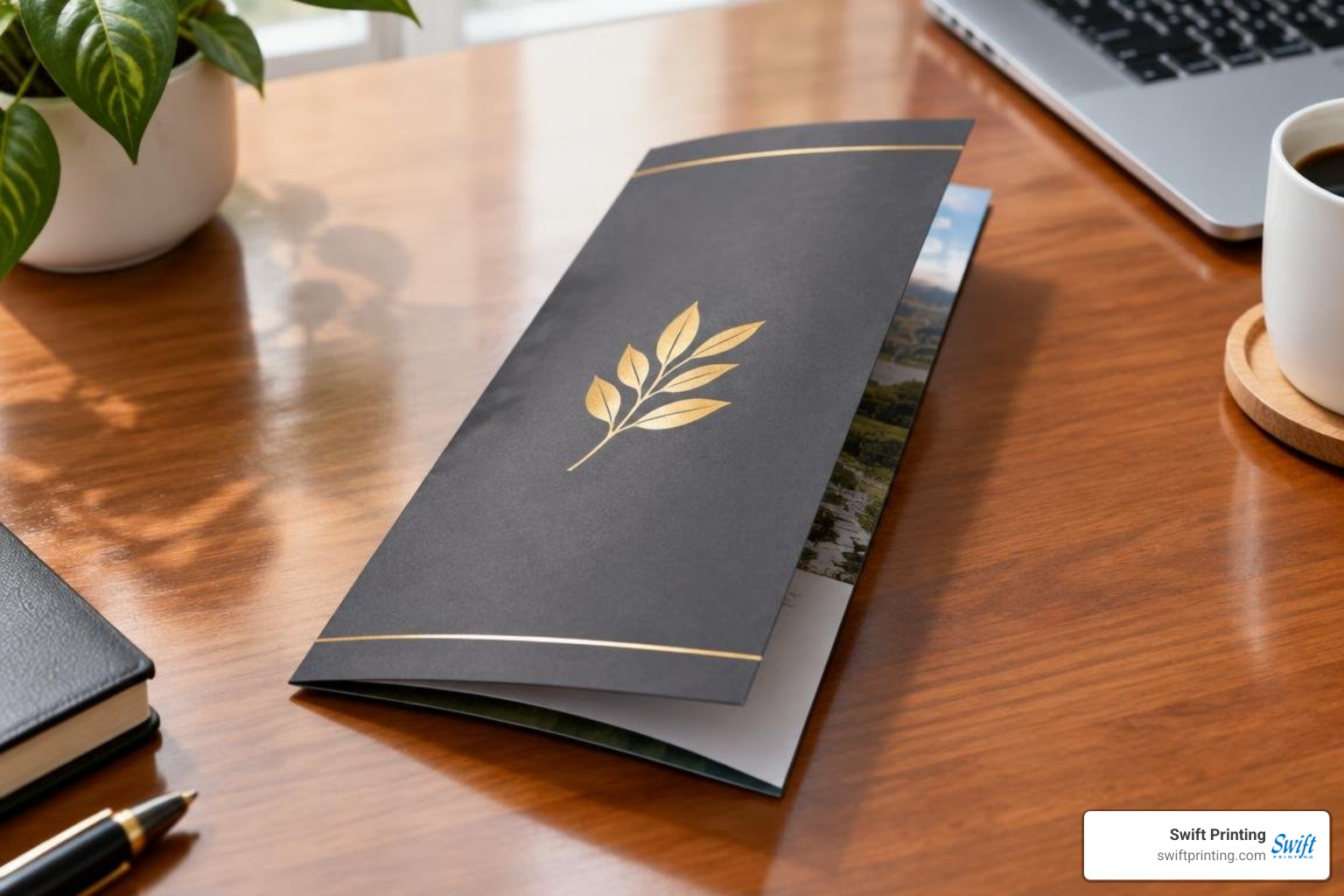
The tactile weight of your collateral communicates your organization's standards before a prospective client reads a single headline. Choosing the right paper stock elevates your brochure from a simple handout to an enduring marketing asset.
Paper options generally fall into two categories:
- Text Weight Stocks (e.g., 100 lb Gloss or Silk Text): These provide a flexible, classic feel. They fold crisply and are well-suited for high-volume informational handouts, conference bags, and direct mail campaigns.
- Cover Weight Stocks (e.g., 100 lb or 120 lb Cover / 14 pt Cardstock): A sturdier choice for law firms, wealth management advisors, and boutique medical offices. Cover stocks command attention, stand upright in display racks, and convey permanence.
For organizations looking to make an even stronger impression, adding a die cut brochure window or contoured pocket flap creates a distinctive presentation.
Choosing the Right Finish: Matte, Gloss, and Soft Touch
Protective coatings and lamination enhance durability while setting a distinct visual tone.
| Finish Type | Visual Appearance | Tactile Feel | Best For |
|---|---|---|---|
| Gloss Aqueous | High-shine, vibrant color saturation | Smooth, polished | Image-heavy medical technology, architectural portfolios |
| Satin / Matte Coating | Non-reflective, subtle elegance | Silky, understated | Legal practices, financial consulting, executive summaries |
| Soft-Touch Lamination | Ultra-matte, zero-glare | Velvet-like, premium grip | High-end boutique services, luxury healthcare, board presentations |
Scoring and Folding Precision for Heavy Stocks
Heavyweight paper stocks (especially 100 lb cover and above) require precision scoring before folding. Folding heavy paper along random fibers without scoring causes the paper fibers and dried toner to crack along the spine, leaving unsightly white gaps.
To maintain a crisp edge, we align the paper grain parallel to the fold lines and apply mechanical scoring. This compresses the internal fibers, creating a clean channel that allows the sheet to fold effortlessly without surface fractures.
Commercial Production: Digital vs. Offset Methods
Selecting the best production method ensures your collateral meets both your aesthetic criteria and operational deadlines.
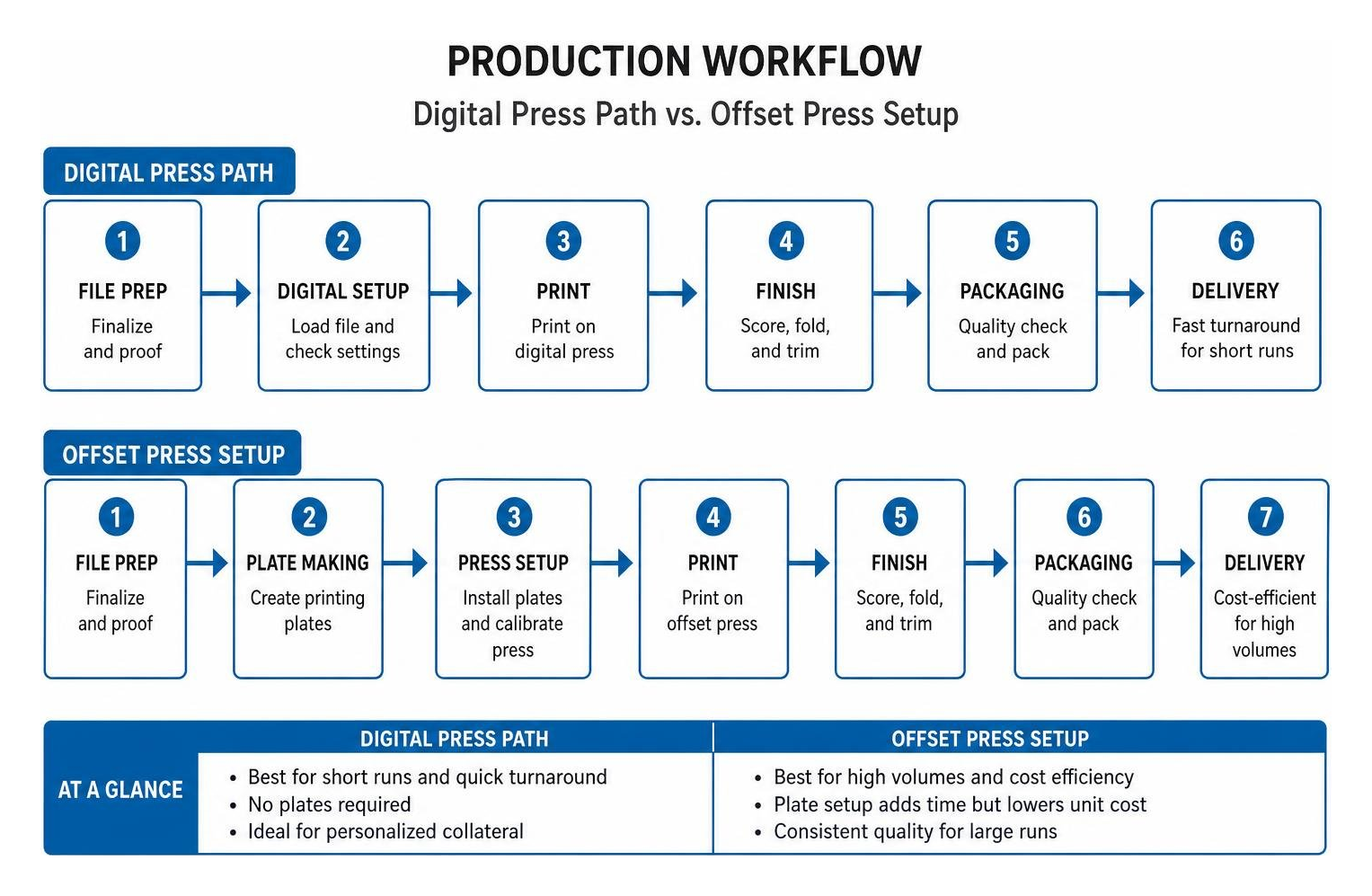
Understanding the technical nuances between digital and offset printing helps you align your schedule with your overall marketing strategy for flyers and brochures.
When to Choose Digital Tri-Fold Brochure Printing
Digital printing is ideal for targeted corporate campaigns, rapid turnaround schedules, and personalized collateral. Advanced production presses deliver vibrant color matching and razor-sharp text clarity comparable to traditional offset presses.
Digital printing allows you to:
- Execute on-demand print runs without producing excess inventory.
- Implement variable data printing (VDP) to personalize individual brochures with recipient names, targeted regional addresses, or distinct advisor headshots.
- Turn around urgent presentation collateral quickly for executive briefings or regulatory meetings across Grand Rapids, Lansing, and Kalamazoo.
High-Volume Brochure Printing Tri-Fold Advantages
For large-scale public health distributions, annual benefit enrollment packets, or multi-location corporate distributions, offset lithography provides exceptional consistency. Offset presses utilize wet ink rollers and custom printing plates, producing deep color saturation and precise Pantone spot color matching across large volumes.
When evaluating brochure printing companies, verify that their facility offers both advanced digital and high-capacity offset equipment to handle diverse project requirements.
High-Impact Design Strategies for Professional Services

A tri-fold brochure is a guided reading experience. Because the reader discovers panels sequentially, your content layout should follow this natural progression. Applying proven insights on how to design the perfect brochure ensures your collateral captures attention immediately.
Tailoring Layouts for Healthcare, Legal, and Corporate Clients
Different professional sectors require tailored layout architectures:
- Legal and Consulting Practices: Focus on clarity, credentials, and practice areas. Utilize generous white space, strong typographic hierarchy, and brief case study summaries. Dedicate the inside left flap to introducing your core value proposition, opening into a comprehensive three-panel view of your practice specializations.
- Healthcare and Specialty Medical Offices: Prioritize patient comfort and provider accessibility. Incorporate physician credentials, diagnostic technology explanations, clinic location maps, and clear instructions for scheduling a consultation.
- Government Agencies and Municipalities: Focus on structured information delivery, public service access points, and multi-lingual service directions supported by clean iconography.
End every brochure with a dedicated call-to-action block—placed prominently on the back cover and the lower right inside panel—featuring direct phone numbers, web addresses, and office locations.
Distribution Strategies and Point-of-Engagement Displays
To maximize client engagement across West Michigan offices in Rockford, Ada, Belmont, and beyond, integrate your tri-fold collateral across multiple touchpoints:
- Reception Displays: Place brochures in weighted, crystal-clear acrylic holders at reception desks and consultation suites.
- Direct Mail Inclusions: Pair your tri-fold brochures with custom presentation letters inside standard #10 business envelopes for targeted outreach.
- Corporate Presentation Folders: Insert folded collateral into branded presentation folders during new client intake sessions, board reviews, and executive conferences.
Frequently Asked Questions About Tri-Fold Brochure Printing
Why is the inside tuck panel slightly narrower than the outer panels?
The inside tuck panel is intentionally reduced by 1/16 of an inch (0.0625 inches) to allow it to roll cleanly inside the cover fold. Without this mechanical compensation, the edge of the panel would press against the inside spine, causing the brochure to buckle rather than lie flat.
What is the difference between a tri-fold and other multi-panel folds?
A tri-fold (letter fold) folds two panels inward in a rolling, spiral motion over a central base panel. In contrast, a brochure single fold (half-fold) divides a sheet once into four panels, while a Z-fold (accordion fold) alternates directions to create a zig-zag profile. The tri-fold remains the industry standard because it reveals information progressively as the reader opens each flap.
How do I prevent toner or ink from cracking along the fold lines?
Preventing spine cracking requires three steps: matching paper grain direction to fold lines, applying a protective coating or lamination, and mechanically scoring the sheet before folding. Pre-creasing heavyweight stocks relieves tension on the paper fibers, ensuring a clean fold without ink chipping.
Conclusion
A well-crafted tri-fold brochure remains one of the most effective tools for communicating complex professional services with clarity and authority. Swift Printing is a high-end print shop setting the standard for printing in the boutique business, combining attentive service with meticulous pre-press file analysis.
Whether your team is preparing clinical overview packets, legal practice summaries, or municipal agency guides across Grand Rapids and West Michigan, our team ensures every score, fold, and finish meets exacting standards. Partner with Swift Printing for flawless tri-fold collateral that reinforces your reputation and leaves a lasting impression on every client.