Cheat Sheet to Comparing Brochure Printing Companies
Core Capabilities to Evaluate Across Brochure Printing Companies
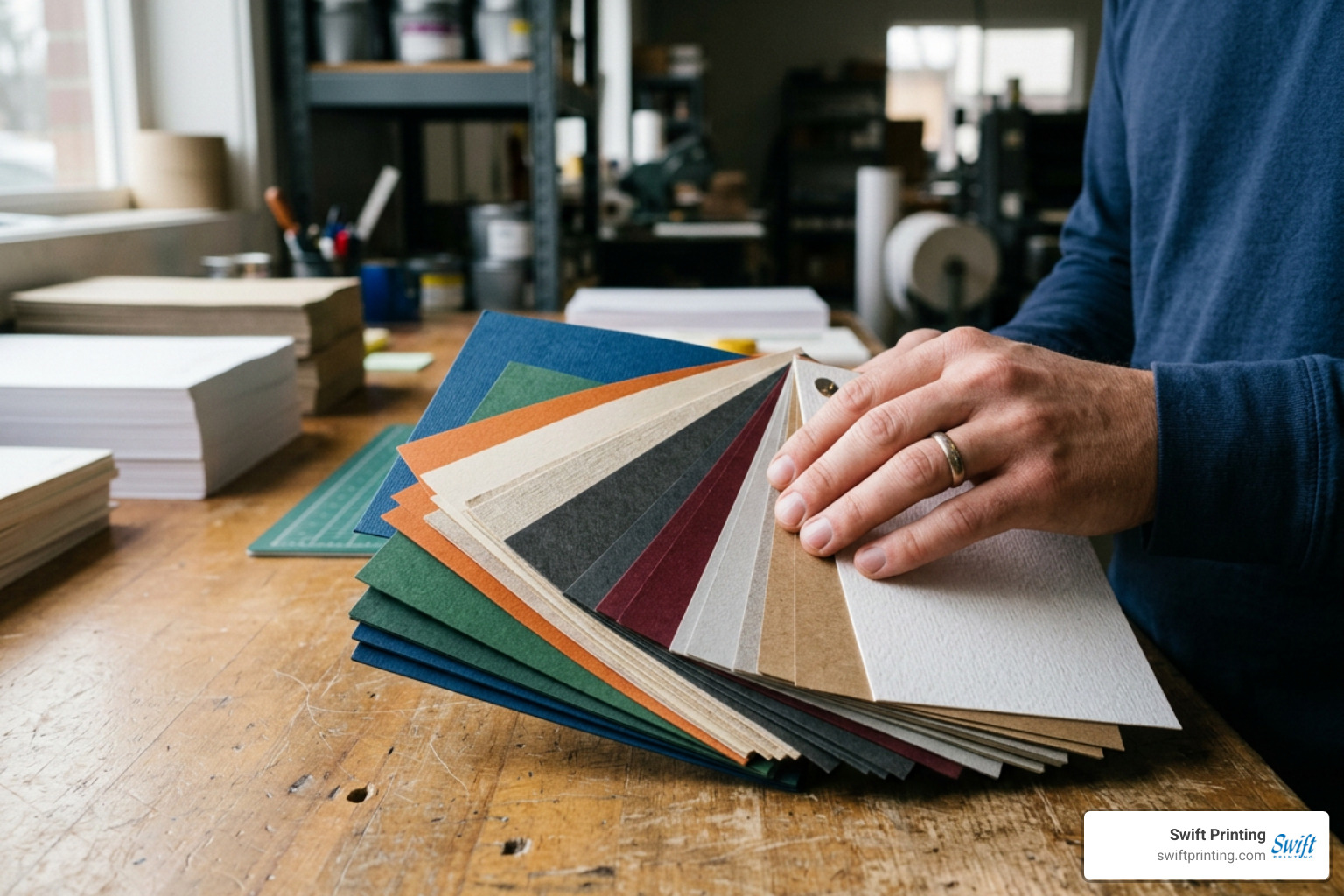
When you begin evaluating print partners, it is tempting to jump straight to the bottom-line estimate. But true print craftsmanship lives in the technical details. A dependable partner guiding your commercial printing projects should offer comprehensive guidance across paper stock selection, prepress verification, and proofing accuracy.
Paper weight and texture set the tone for your brand long before a customer opens the front cover. Standard commercial brochure weights are measured in pounds (text or cover weight) in the United States and grams per square meter (GSM) internationally.
- 70 lb to 80 lb Text (approx. 105–120 GSM): Lightweight, economical stock ideal for mass-distribution mailers, utility inserts, and event flyers.
- 100 lb Text (approx. 150 GSM): The industry standard for high-end tri-fold and z-fold marketing collateral. It provides an opaque, professional feel without cracking when folded.
- 80 lb to 100 lb Cover (approx. 215–270 GSM): A sturdy cardstock weight used for multi-page brochure covers, pocket folders, and premium product lookbooks.
Beyond weight, your paper finish alters how inks sit on the sheet. Gloss coatings maximize color vibrancy and contrast, making them perfect for photography-heavy catalogs. Matte and silk finishes eliminate glare, providing a soft, sophisticated backdrop for text-heavy corporate reports. Uncoated stocks offer a rich, tactile, organic feel that conveys warmth and authenticity.
A truly capable print shop also protects you before ink ever hits paper through thorough pre-flight checking. This technical review catches common pitfalls: low-resolution images, missing fonts, RGB-to-CMYK color shifts, and improper bleed allocations. Reliable printers back this up with contract-grade digital or physical hard-copy color proofs so you can sign off on exact margins, folds, and tonal ranges with absolute confidence.
Why Top Brochure Printing Companies Recommend Digital vs. Litho Presses
Understanding press technology helps you balance production speed against your budget. High-performing printers operate both digital toner/inkjet presses and traditional offset lithography (litho) setups.
Digital printing skips the mechanical setup of aluminum plates. It pulls digital files straight to the press, making short-run digital printing options exceptionally cost-efficient for short runs under 1,000 units. Digital also unlocks variable data printing (VDP), allowing you to personalize individual brochures with targeted recipient names, QR codes, or custom neighborhood offers.
Offset lithography uses custom plates to transfer wet inks onto rubber blankets that roll onto the paper. While the initial setup requires time and plate-making fees, its per-unit cost drops dramatically as your volume climbs. If you are producing 5,000 corporate annual reports or a high-volume regional campaign, litho delivers razor-sharp typography, exact Pantone spot color matching, and unmatched unit economics.
Specialty Binding and Embellishment Capabilities
The way your brochure is bound and embellished influences how long recipients keep it on their desks. Exploring diverse finishing techniques for business collateral transforms standard paper into an interactive experience.
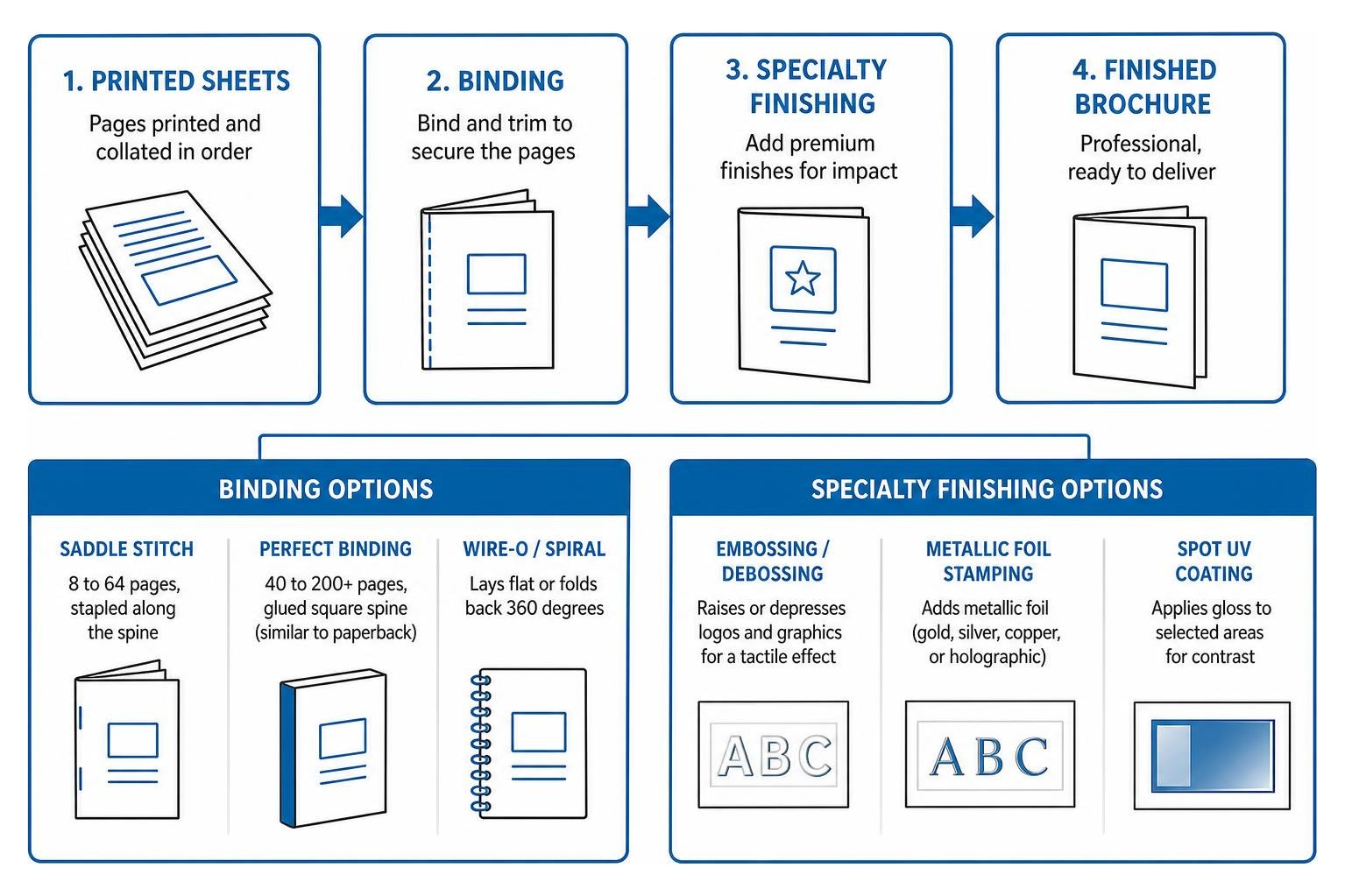
- Saddle Stitching: The classic, economical choice for 8- to 64-page booklets, binding nested folded sheets along the spine using wire staples.
- Perfect Binding: Ideal for publications with 40 to 200+ pages, gluing clean-trimmed interior pages into a flat, square spine (similar to a paperback book) for an executive presentation.
- Wire-O and Spiral Binding: Uses metal wire loops or plastic coils that allow manuals, workbooks, and presentations to lay completely flat on a table or fold back 360 degrees.
- Embossing and Debossing: Presses metal dies into the sheet to raise or depress logos and graphics, creating an irresistible tactile highlight.
- Metallic Foil Stamping: Applies metallic foil (gold, silver, copper, or holographic) with heat and pressure to make typography and badges gleam.
- Spot UV Coatings: Applies a glossy polymer layer over selected logos, photos, or patterns, contrasting sharply against a velvety soft-touch or matte background.
Total Cost of Ownership: Pricing, Turnaround, and Quality Balance
When reviewing competitive quotes, looking only at the bottom-line unit price can mislead you. Total cost of ownership encompasses setup fees, turnaround premiums, material longevity, and shipping costs.
| Brochure Format & Volume | Typical Technology | Estimated USD Range | Typical Production Turnaround |
|---|---|---|---|
| 250 Tri-Fold Brochures (100 lb Gloss Text) | Production Digital | $120 – $220 USD | 1 to 2 business days |
| 1,000 Tri-Fold Brochures (100 lb Gloss Text) | Short-Run Digital / Litho | $280 – $450 USD | 2 to 4 business days |
| 5,000 Tri-Fold Brochures (100 lb Gloss Text) | Offset Lithography | $550 – $850 USD | 4 to 6 business days |
| 500 Saddle-Stitched Booklets (16 Pages) | Digital Booklet Maker | $450 – $750 USD | 2 to 3 business days |
| 2,500 Perfect-Bound Booklets (32 Pages) | Offset + Perfect Binder | $1,800 – $2,900 USD | 6 to 9 business days |
Cutting corners on initial pricing often triggers hidden expenses later. Understanding why cheap printing costs businesses more comes down to waste: cheap commodity printers frequently bundle unrelated customer jobs on shared sheets ("gang runs"), resulting in uneven ink densities, misaligned folds, and thin, see-through stock.
Red Flags When Vetting Online Brochure Printing Companies
- No Live Pre-Press Review: If an automated website accepts your artwork without flagging low resolution, missing bleed margins, or font errors, you risk paying for thousands of flawed prints.
- Lack of Proofing Options: Avoid vendors that refuse to provide physical proofs or accurate PDF soft proofs on complex, high-dollar runs.
- Vague Stock Descriptions: If a company lists paper as simply "thick glossy paper" without explicit weight specifications (such as 100 lb Text or 14 pt Cover), you are likely receiving sub-par house stock.
- Hidden Delivery and Handling surcharges: Low upfront quotes that suddenly triple at checkout due to mandatory file upload fees, proof approval surcharges, or inflated shipping rates.
Sustainability and Local Production Standards
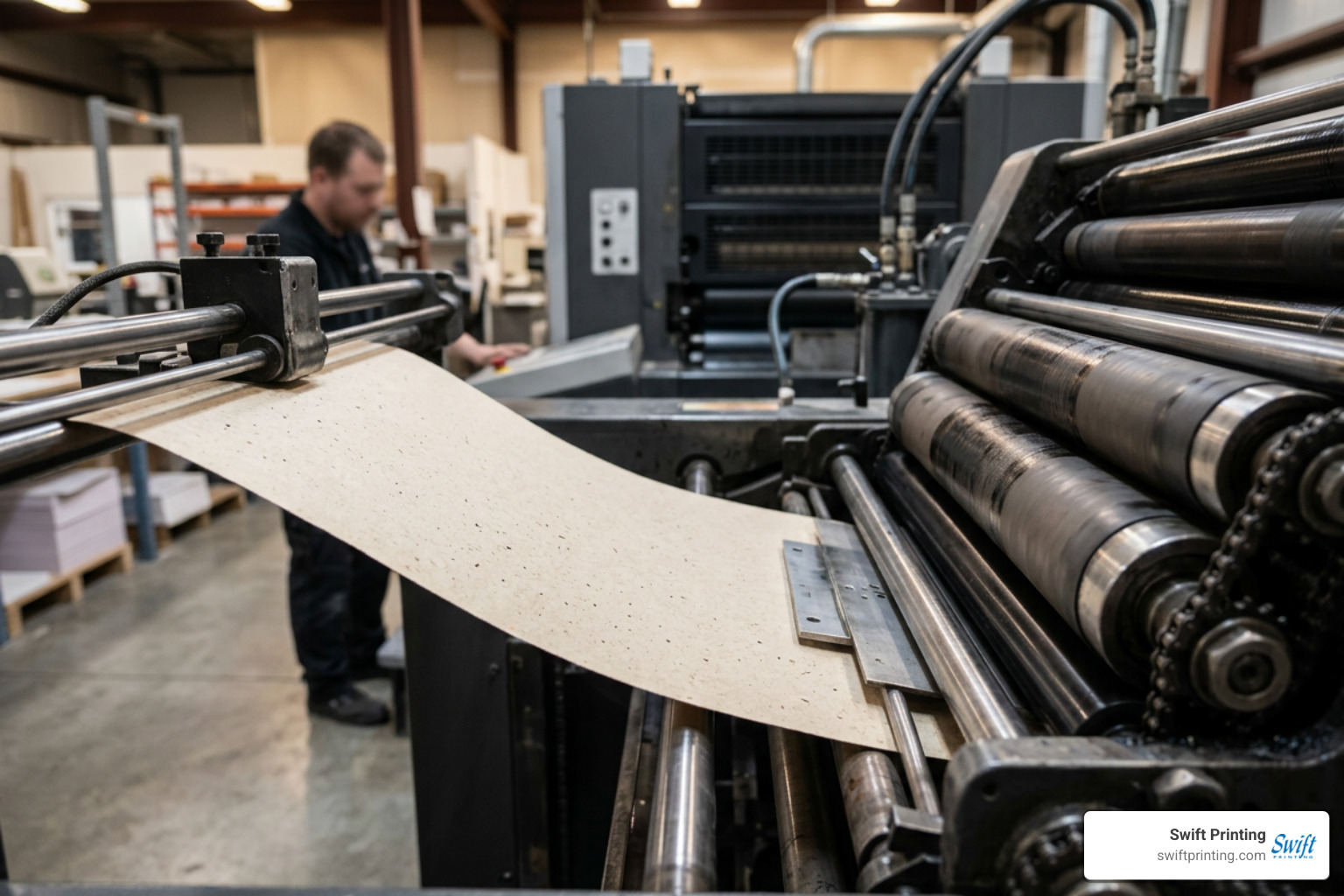
Commercial printing does not have to come at the expense of the environment. As companies place greater value on corporate responsibility, modern print shops are transforming their workflows to protect our natural resources.
When sourcing sustainable brochure printing, verify that your printer uses papers certified by organizations like the Forest Stewardship Council (FSC) or the Sustainable Forestry Initiative (SFI). These certifications guarantee that paper fibers come from responsibly managed forests, recycled materials, and controlled sources. Look for options with high post-consumer waste (PCW) content that maintain excellent opacity and bright white points.
Ink chemistry is equally important. Traditional petroleum-based inks release volatile organic compounds (VOCs) that harm air quality. Modern eco-friendly shops use vegetable- and soy-based inks, which emit minimal VOCs, preserve pressroom air quality, and de-ink far more cleanly during paper recycling processes.
Partnering with regional print teams that prioritize community-focused commercial printing cuts long-haul transport emissions, eliminates interstate freight delays, and supports local economic development.
Step-by-Step Workflow: From Artwork File to Final Delivery
A smooth print experience relies on a disciplined, step-by-step production framework:
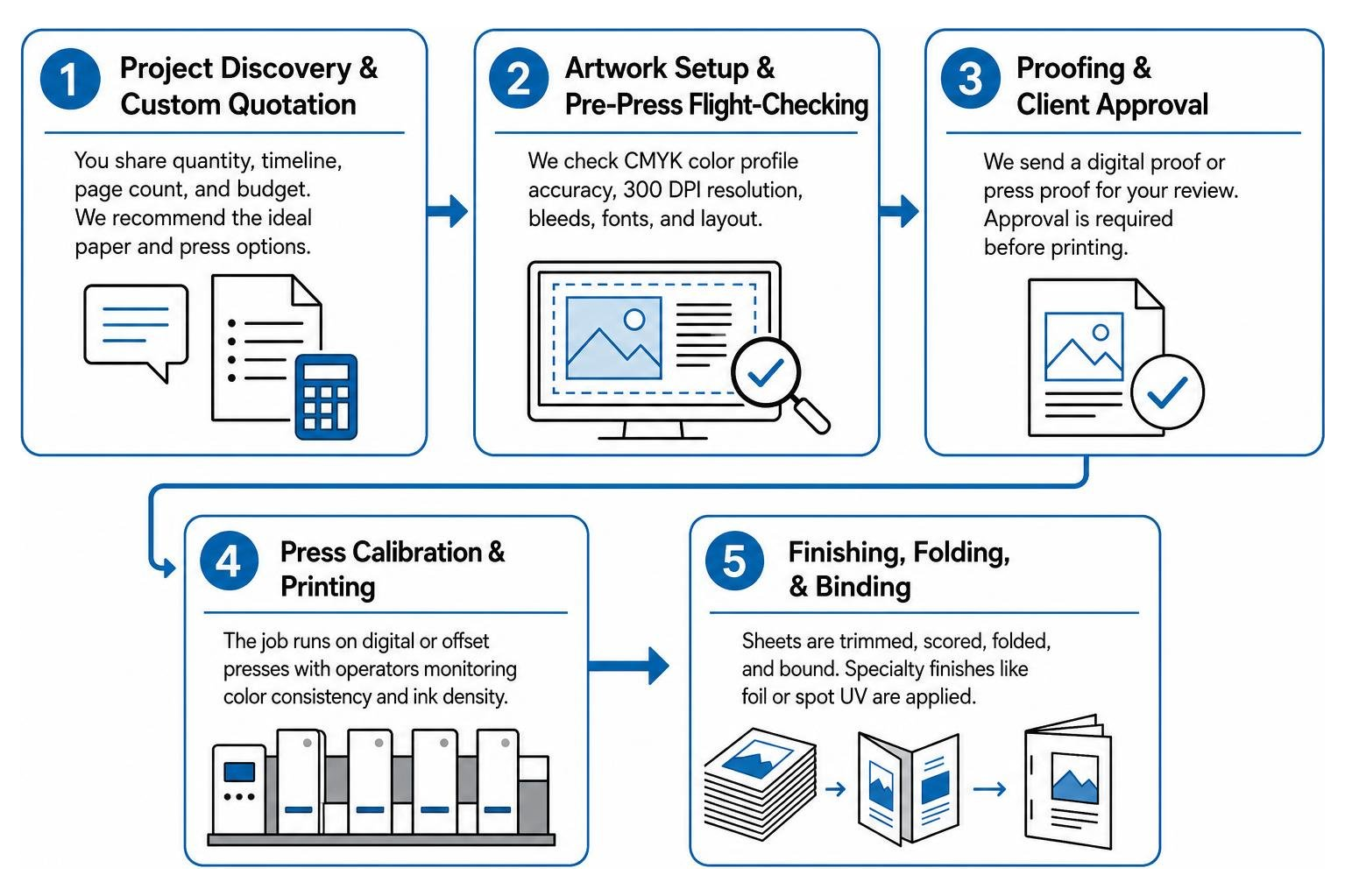
- Project Discovery & Custom Quotation: You share your desired quantity, timeline, page count, and budget. Our estimators help you select the ideal paper weights and press methods to maximize value in USD.
- Artwork Setup & Pre-Press Flight-Checking: Your designer builds the layout according to brochure design setup standards. Our pre-press specialists run detailed flight-checks to ensure CMYK color profile accuracy, 300 DPI resolution, and correct 0.125-inch bleeds.
- Proofing & Client Approval: We send a digital proof or press proof for your final review. Nothing runs on our presses until you sign off.
- Press Calibration & Printing: The approved job routes to either our precision digital presses or high-speed offset equipment, with press operators monitoring color consistency and ink density throughout the run.
- Finishing, Folding, and Binding: The printed sheets are trimmed, scored to prevent paper fiber cracking, folded on high-precision folders, and stitched or glued. Specialty embellishments like foil or spot UV are applied during this phase.
- Quality Assurance & Delivery: Our finishing department conducts a final inspection, packs the brochures in sturdy, moisture-resistant cartons, and arranges local pickup, direct-mail fulfillment, or courier delivery.
Frequently Asked Questions About Brochure Printing
What is the typical turnaround time for custom commercial brochures?
Standard digital brochure runs are typically printed, folded, and ready for shipment or pickup within 1 to 3 business days following final proof approval. Offset litho jobs with custom spot colors, specialty binding, or embellishments generally require 4 to 7 business days. If you face a tight trade show deadline, rush digital turnaround options can often produce pieces in 24 hours.
How do I choose between saddle stitch and perfect binding for my brochure?
The choice comes down to page count, spine thickness, and presentation style. Saddle stitching is the most cost-effective solution for pieces between 8 and 64 pages, allowing the brochure to open flat easily. Perfect binding requires a spine thickness of at least 0.125 inches (typically 40 to 60+ pages minimum) to securely glue the pages to the cover, creating an upscale, catalog-style appearance.
What file specifications do professional print shops require?
To ensure your finished piece matches your creative vision, prepare your files to these commercial standards:
- File Format: High-resolution, print-ready PDF (PDF/X-1a preferred).
- Color Mode: CMYK (convert all RGB photos and spot colors unless printing true Pantone inks).
- Resolution: 300 DPI at 100% final output size.
- Bleed & Safety Margins: Include a 0.125-inch (1/8") bleed on all outer edges, and keep live text at least 0.1875-inch inside the cut line to prevent accidental trimming.
Conclusion
Finding the right brochure printing partner is about more than comparing quotes—it is about finding a team that respects your vision, your budget, and your deadlines. When you balance technical press capabilities, tactile finishing options, and sustainable material sourcing, your print collateral becomes a powerful marketing asset that drives measurable results.
At Swift Printing, we take pride in bridging time-tested craftsmanship with modern, sustainable manufacturing. As a family-owned commercial printer in Grand Rapids, Michigan, and one of only two Certified B Corporation printers worldwide, we balance economic value with purposeful care for our community, our clients, and the planet. Whether you need a short run of 250 event brochures or 25,000 corporate booklets, our prepress and production specialists are here to guide you every step of the way.
Ready to bring your next print project to life? Request a custom commercial brochure quote from our Grand Rapids team today.