How to Choose a Folded Brochure That Works
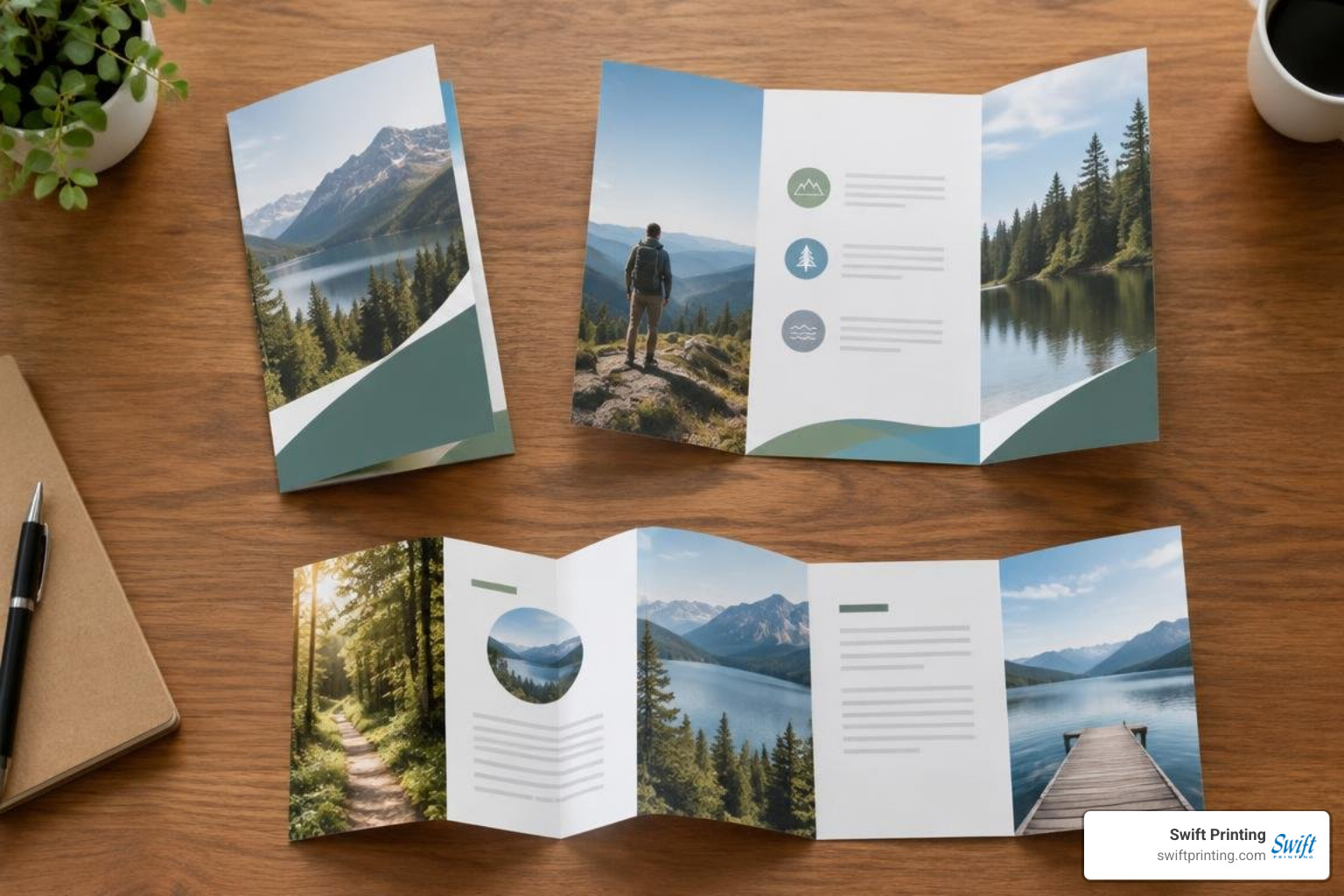
A folded brochure is a printed sheet folded into panels to guide readers through a message. Choose a half fold for a simple service overview, a tri-fold for compact information, or an accordion fold for a timeline or several offerings. If you need to include a card, invitation, or other insert, consider a pocket fold.
Start with what your reader needs to do: learn about a service, find an office, or respond to an offer. Then match the fold to that task and your content. A creative fold can make a piece more memorable, but clear writing and an easy path to the next step matter more.
I'm Jessica Gutowski-Slaydon, president of Swift Printing, where I've helped businesses, nonprofits, and public agencies plan folded brochure projects, from paper and layout choices to printing and mailing. At Swift, we bring boutique-level care to those decisions so the finished piece looks professional and works for its audience.
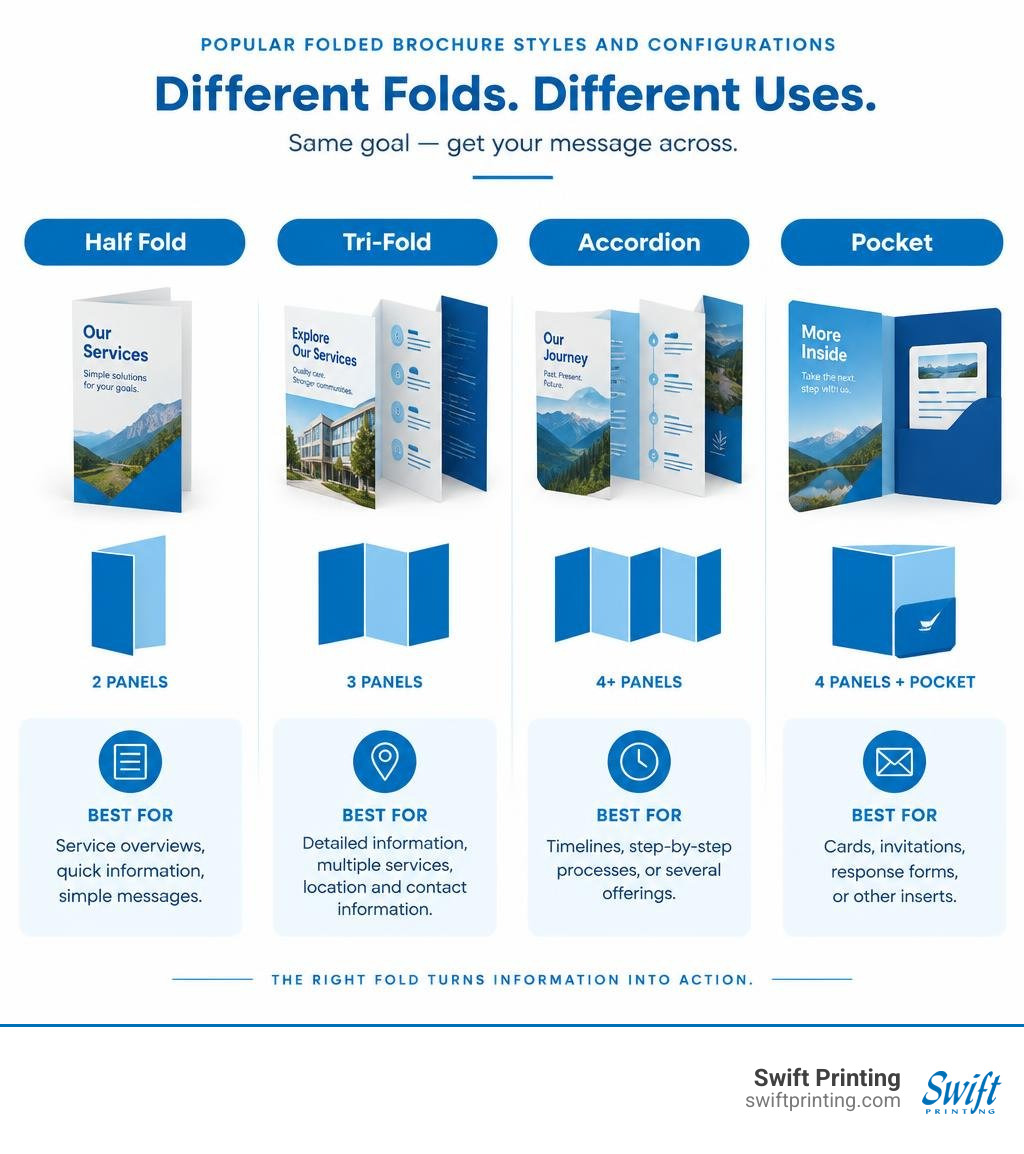
Popular Folded Brochure Styles and Configurations
The architecture of your fold dictates how a recipient physically uncovers your message. Rather than viewing a single flat surface, the reader experiences a choreographed sequence where each panel acts like a deliberate step in a presentation. When executed with precision, this physical interaction builds anticipation and keeps decision-makers engaged.
Choosing the right structure depends on how much detail you need to share, whether you are presenting complex legal services, detailed medical programs, or high-level consulting frameworks. Through expert brochure printing, any standard sheet can be engineered into an intuitive marketing piece.
| Fold Format | Panel Count | Common Flat Size | Finished Folded Size | Ideal Professional Use Case |
|---|---|---|---|---|
| Bi-Fold (Half Fold) | 4 printable panels | 8.5" x 11" (or A4) | 5.5" x 8.5" (or A5) | Executive service summaries, medical intake overviews |
| Tri-Fold (Letter Fold) | 6 printable panels | 8.5" x 11" | 3.68" x 8.5" | Standard direct mail, clinical service menus |
| Z-Fold | 6 printable panels | 8.5" x 11" | 3.66" x 8.5" | Quick-reference guides, multilingual overviews |
| Accordion (Concertina) | 8 to 10 panels | 8.5" x 14" or custom | 3.5" x 8.5" | Timelines, multi-department capabilities, step-by-step processes |
| Gate Fold | 6 panels (2 flanking doors) | 8.5" x 11" or custom | 4.25" x 8.5" | High-profile event invitations, major corporate announcements |
| Stepped Accordion | 6 to 8 visible tabbed panels | Custom | Custom multi-tier | Architectural portfolios, tiered consulting packages |
| Double Parallel | 8 printable panels | 8.5" x 14" | 3.5" x 8.5" | Comprehensive institutional guides, policy overviews |
Classic Single and Multi-Panel Folds
Classic folds remain the workhorses of corporate and institutional communications because their panel progression feels natural and intuitive.
- Bi-Fold (Half Fold): Created by folding a flat sheet once down the center, creating four distinct pages. A standard sheet folded in half delivers a spacious, book-style reading flow that works well for law firm practice overviews, executive bios, and healthcare clinic summaries.
- Tri-Fold (Letter Fold): Two parallel folds create three panels on each side (six total). The right panel folds inward first, followed by the left panel folding over it. Standard tri-fold brochures fit cleanly into standard business envelopes, making them ideal for patient education and concise service catalogs.
- Z-Fold: Created with two parallel folds in alternating directions, forming an accordion "Z" shape. Unlike the tri-fold, all panels share identical widths, allowing the reader to open the piece in one fluid motion.
- Accordion (Concertina) Fold: Features three or more zigzag folds opening out into a long, continuous banner. This format excels when presenting chronological timelines, multi-step onboarding workflows, or panoramic imagery.
- Gate Fold: The left and right panels fold inward to meet precisely in the center without overlapping. Opening the two flaps mimics opening double doors, revealing a broad central interior spread that suits major announcements and ceremonial invitations.
Advanced Folded Brochure Designs for High-Impact Presentations
When high-level stakeholders, board members, or executive clients represent your target audience, specialized fold architectures command immediate attention. These custom formats turn corporate communications into interactive presentation pieces.
- Stepped Accordion Fold: Each subsequent panel is engineered slightly wider or taller than the previous one, creating a layered set of visible tabs along the outer edge. This allows busy executives to jump straight to specific topics, such as practice areas or compliance data.
- Double Parallel Fold: The sheet is folded in half, then folded in half again in the same direction, generating an eight-page document. It cleanly packages dense regulatory information or multi-location facility directories into an organized, pocket-friendly footprint.
- Tri-Fold Pocket Mailers: By integrating a die-cut, folded pocket into the right interior panel, this configuration lets you securely hold business cards, registration slips, or executive proposals without requiring extra envelopes.
- Twist and Reveal Folds: Using intricate geometric scores, these specialty formats expand into broad dynamic posters or multi-panel displays as they are opened.
Examining historical marketing campaign archives shows that tactile presentation and deliberate panel organization have always driven print engagement. High-impact folds build on that heritage by pairing memorable physical reveals with refined branding.
Technical Considerations: Paper Stock, Scoring, and Folding Mechanics
Transforming a flat printed sheet into a multi-panel presentation requires precise mechanical preparation. If you fold heavy cardstock without proper bindery prep, the wood fibers along the spine will snap, resulting in cracked edges and flaking toner that compromise an otherwise polished design.
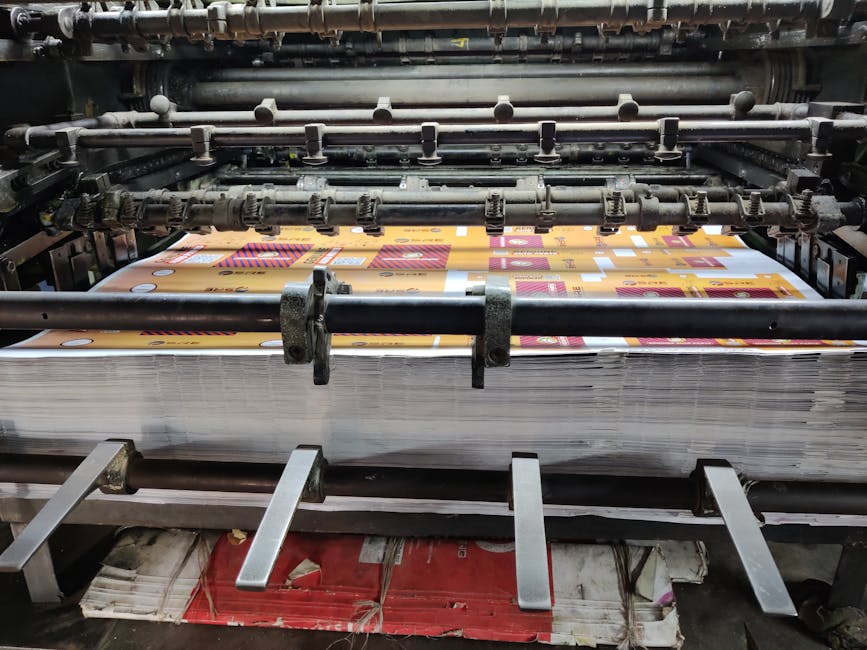
Paper weight and structure must align with your chosen panel configuration:
- Text Stock (80 lb to 100 lb Text / 120 to 150 gsm): Lightweight and highly flexible. Best for multi-panel accordion formats, map-style folds, and high-volume mailers that must remain slim when closed.
- Cover Stock (80 lb to 120 lb Cover / 215 to 325 gsm): Sturdy, rigid, and substantial in hand. Ideal for corporate overviews, gate folds, and pocket mailers.
Whenever we run cover stocks or heavy coated sheets, we apply specialized bindery options here at Swift, including mechanical rotary scoring and compression creasing. Scoring gently compresses the paper fibers along the fold line, allowing the stock to bend smoothly without cracking the surface. We also align the primary folds parallel to the paper's natural grain direction, keeping edges crisp and preventing moisture-related buckling.
Selecting the Right Print Method for Your Project
Selecting the ideal printing technology ensures sharp typography, deep color saturation, and dependable registration across every fold.
- High-Volume Offset Printing: Commercial offset printing uses customized aluminum plates and liquid inks to deliver unmatched color fidelity and razor-sharp fine lines. It is the premier choice for large corporate runs, precise Pantone spot color matching, and comprehensive direct mail programs.
- On-Demand Digital Printing: Modern digital printing uses advanced dry toner or liquid electrophotography to produce vivid, high-resolution pieces without physical plates. It is perfect for short-run executive presentations, regional marketing materials, and personalized direct mail that demands rapid turnaround.
How to Prepare Your Folded Brochure Artwork for Print
Accurate prepress setup guarantees that your digital layouts translate into a properly aligned physical piece. Setting panel widths without accounting for paper thickness is a common pitfall that can cause interior panels to buckle or push outer covers open.
- Bleed Margins: Always extend background colors, patterns, and full-bleed photography at least 0.125 inches (3 mm) beyond the final trim line to prevent unprinted white edges after cutting.
- Safety Zones: Keep all essential typography, logos, and critical charts at least 0.125 inches to 0.25 inches inside the cut and score lines.
- Panel Compensation for Folding: In an 8.5" x 11" tri-fold, panels cannot all measure an identical 3.66 inches. The tucked interior panel must be reduced to roughly 3.625 inches, while the front and back panels expand to 3.687 inches, ensuring the piece folds flat without bowing.
- Resolution Standards: Maintain image resolutions at 300 DPI (dots per inch) for continuous-tone photography and 600 to 1200 DPI for fine line art. Verify that all artwork files use the CMYK color space rather than RGB. Technical references such as this 8 page fold 8.5 x 11 brochure template offer detailed breakdowns of these dimensions.
Thoughtful prepress preparation echoes the structural clarity seen in classic exhibition and institutional print design, ensuring content unfolds logically for the reader.
Best Practices for Layout, Typography, and Visual Hierarchy
A successful brochure pairs structural engineering with clear, scannable layout design. If an executive must search through cluttered text blocks to find your core capabilities, your message loses momentum.

- Front Cover Focus: The outer front panel has one primary job: earn the next interaction. Avoid crowding it with dense paragraphs. Feature a strong brand mark, a focused value proposition, and an engaging visual that encourages the reader to open the piece.
- Controlled Panel Progression: Treat each panel as an individual section within an overarching narrative. Use the inside left panel to frame the challenge or introduce your organization, saving the wide multi-panel center spread for key capabilities, data graphics, or facility overviews.
- Typographic Hierarchy: Select legible, complementary typefaces. Set primary headlines between 18 and 24 points, section subheadings between 12 and 14 points, and body copy between 9 and 10.5 points. Keep line lengths between 40 and 60 characters for comfortable reading.
- Strategic White Space: Leave generous margins around margins and score lines. Unprinted negative space gives the eye room to rest and directs attention to your most important takeaways.
- Clear Call to Action: Dedicate the back panel or lower interior flap to next steps. Provide direct contact channels, portal web addresses, scan codes, and physical office locations.
For an in-depth look at tailoring your print layouts to executive audiences, review our guide on how to design the perfect brochure for your Grand Rapids business.
Strategic Applications Across Industries and Campaigns
High-touch collateral delivers tangible, memorable value across professional services, clinical healthcare, and public sector communications.
- Professional Services & Law Firms: A heavy-weight bi-fold or double parallel brochure helps organize complex practice groups, partner credentials, and regulatory case summaries into a clear, authoritative leave-behind for prospective corporate clients.
- Medical Practices & Specialty Clinics: A tri-fold or four-panel accordion brochure provides a patient-friendly structure for pre-procedure instructions, specialized provider bios, and departmental directories that clinical teams can easily hand to patients.
- Consulting & Financial Advisory Firms: Stepped accordion and pocket folds allow advisors to pair comprehensive market insights with removable client worksheets and proposal summaries during executive presentations.
- Civic & Public Agencies: A durable Z-fold or accordion brochure organizes program schedules, multi-point service directories, and regional facility maps into a sturdy format suitable for public distribution.
Working with trusted brochure printing companies ensures your projects benefit from precise color management, automated scoring, and dependable turnaround.
Frequently Asked Questions About Custom Print Projects
What is the most practical fold for bulk direct mail?
The standard tri-fold on an 8.5" x 11" or 8.5" x 14" sheet remains the most practical choice for high-volume mailing campaigns. It processes efficiently through automated folding equipment, fits cleanly into standard letter envelopes, and meets standard postal processing requirements without needing specialized hand assembly.
Why is paper scoring necessary before folding heavy cardstock?
Scoring uses a rounded mechanical wheel or rule to compress the paper fibers along a defined line prior to folding. On heavy cardstock and coated cover stocks, folding without scoring tears the outer surface fibers, creating jagged edges and flaking toner along the spine. Scoring preserves the integrity of both the paper and the ink for a clean, sharp finish.
How do I ensure inside panels do not buckle when folded?
Inside panels must be designed slightly narrower than the outer panels. For example, in a classic letter-fold tri-fold, reducing the tucked panel width by 0.0625 inches (1/16") leaves sufficient clearance inside the spine, allowing the brochure to close flat without bulging along the outer edges.
Conclusion
A well-planned brochure gives your audience a tactile, memorable way to experience your brand. By pairing the right fold structure with sturdy paper stocks, crisp scoring, and focused visual hierarchy, your print materials leave a lasting impression on clients and community partners across Grand Rapids and West Michigan.
At Swift Printing, we are a high-end print shop setting the standard for printing in the boutique business. We collaborate closely with marketing directors, legal administrators, healthcare executives, and public agencies to ensure every piece is scored, trimmed, and delivered with absolute precision. When you are ready to produce print collateral that reflects the quality of your organization, partner with Swift Printing for boutique-level commercial printing.