Is a Single-Fold Brochure Right for Your Project?
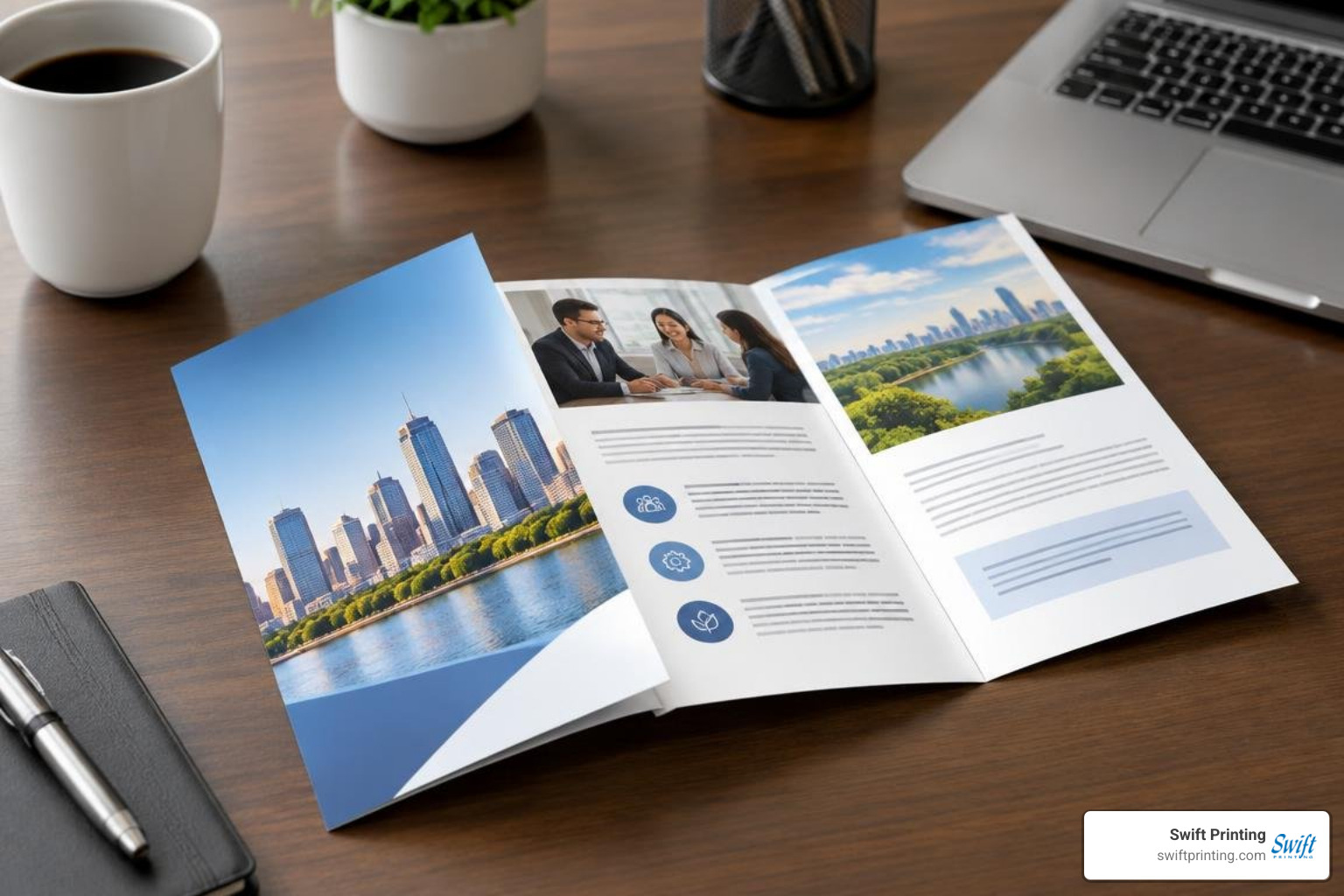
A single-fold brochure is one sheet folded in half to make four pages: a front cover, two inside pages, and a back cover. Choose it when you have one focused message and want a clean, easy-to-read handout, such as a service overview or event program. A single-fold brochure works especially well for professional services firms that need a polished, book-like format for presenting detailed information without overwhelming the reader. According to the U.S. Small Business Administration, well-organized printed materials remain a practical way to reinforce a professional brand and support in-person conversations.
For a polished result, keep important text away from the fold. If you want heavier paper, ask your printer about grain direction and scoring so the crease stays clean. At Swift Printing, those production details are part of the high-end, boutique print quality we work to deliver.
I'm Jessica Gutowski-Slaydon, president and third-generation leader of Swift Printing. Since joining the business full time in 2014, I've helped clients plan single-fold brochure projects, from choosing paper to checking the finished piece.
Understanding Single-Fold Brochure Anatomy and Page Layout
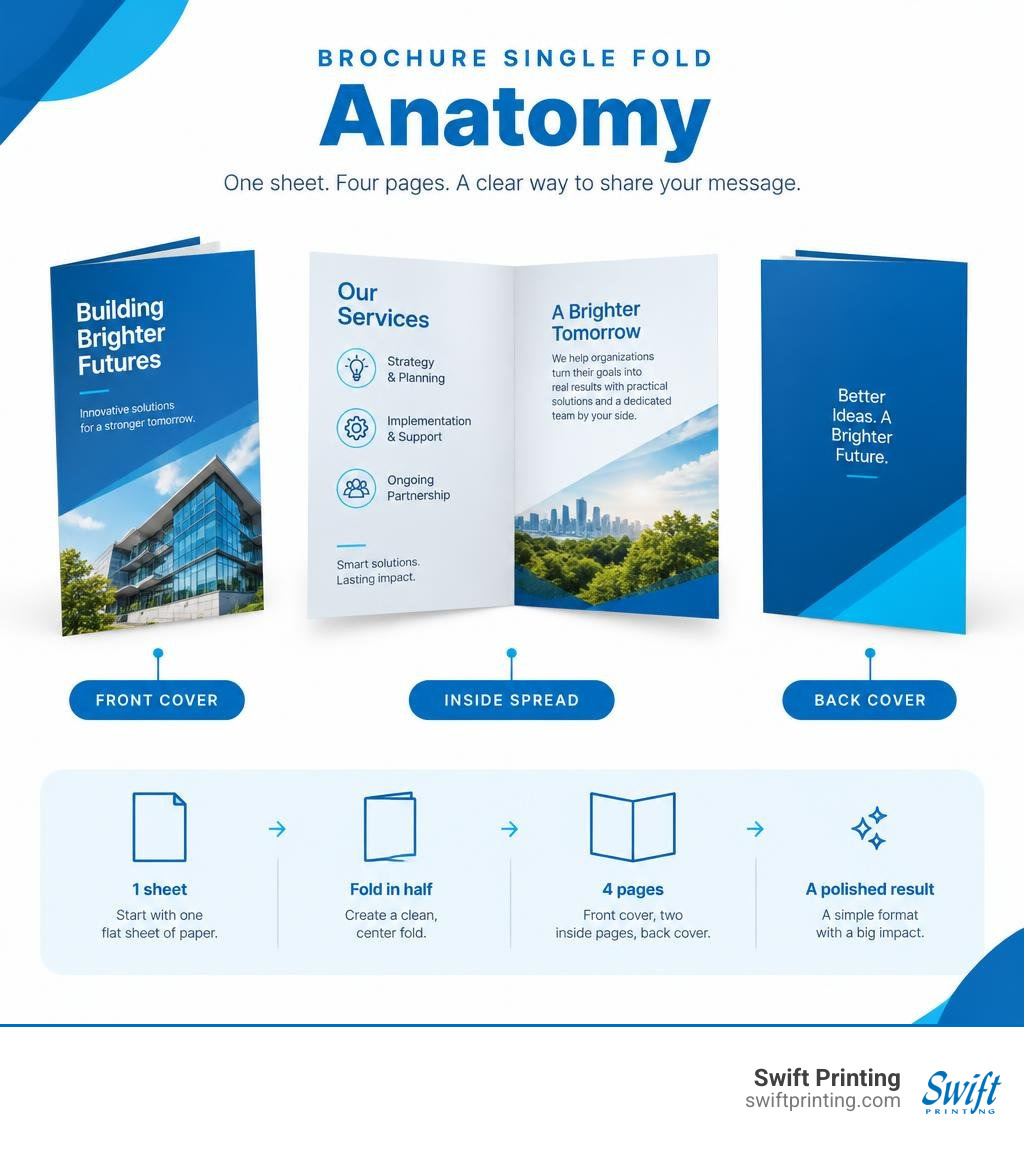
When planning corporate collateral, understanding how a reader navigates your document determines how well your message is received. A classic single-fold brochure design—often called a bi-fold or half-fold—is constructed by taking a single flat sheet of paper and folding it once down the center. This straightforward structure creates four distinct panels or pages: the front cover, the left interior panel, the right interior panel, and the back cover.
Unlike more intricate pieces that unfold like an accordion or tuck inside themselves, this layout functions like a traditional book. The intuitive flow invites the reader to open the piece naturally. Following proper print folding specifications ensures that your artwork lines up seamlessly across each surface without awkward page overlap or shifted margins.
Page Capacity and 4-Panel Structure
The beauty of the four-panel structure lies in its visual clarity. It prevents content overload by establishing a strict narrative arc:
- Front Cover (Page 1): Serves as the visual welcome mat. It should feature a compelling headline, your primary brand identity, and an engaging visual that encourages the recipient to open the piece.
- Inside Left (Page 2): Introduces your core service offering, outlining the specific challenge or context.
- Inside Right (Page 3): Presents your solution, detailed specifications, or key team credentials, pairing naturally with Page 2.
- Back Cover (Page 4): Acts as the natural home for your call-to-action, contact information, compliance details, and accreditations.
By keeping the messaging structured across these four panels, your brand delivers a cohesive story. When you invest in custom brochure printing, this four-page footprint offers ample breathing room for generous white space, readable typography, and bold imagery that conveys authority.
Designing Natural Spreads for a Single-Fold Brochure
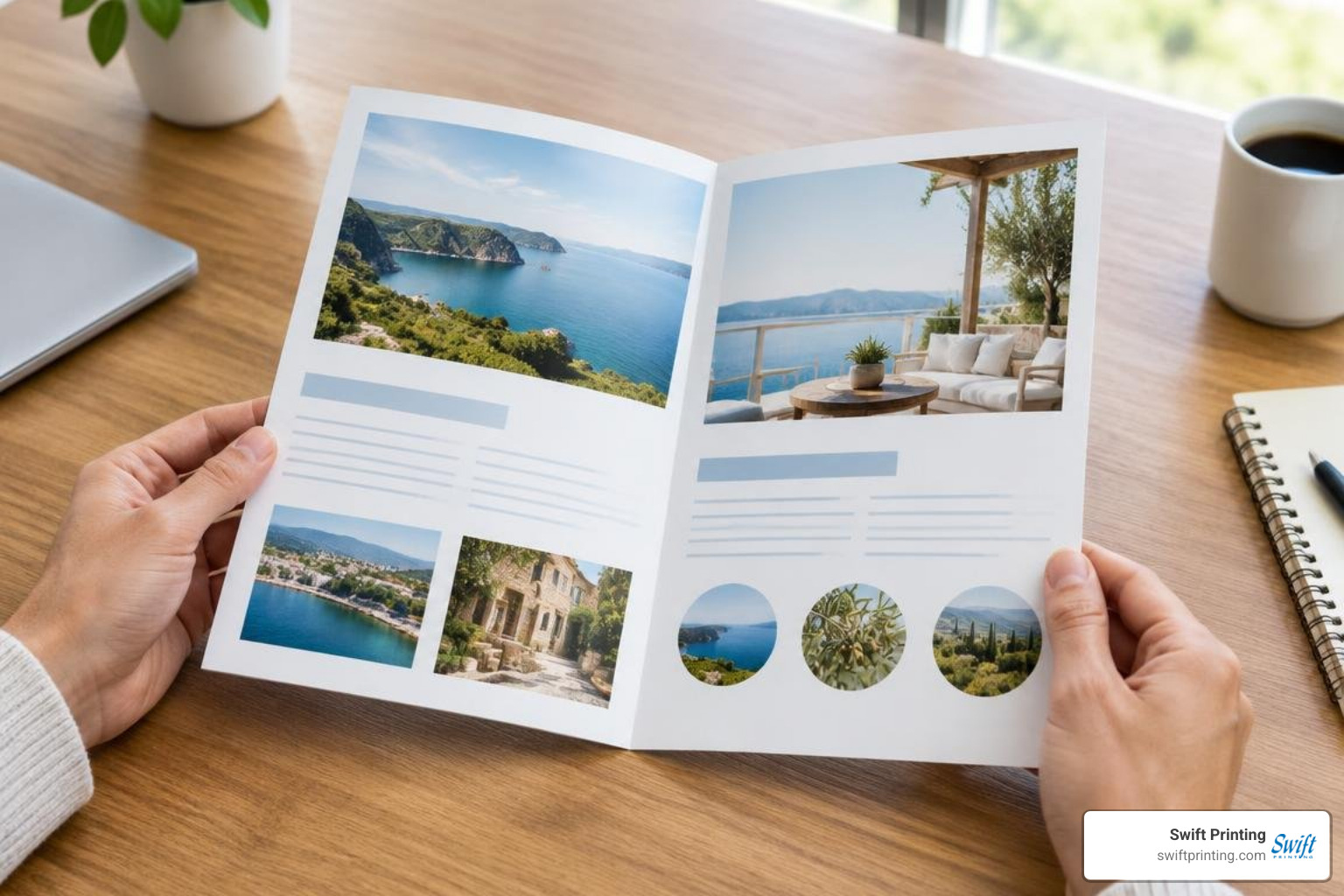
One major advantage of the half-fold layout is the uninterrupted interior spread. When opened flat, pages 2 and 3 form a single visual canvas. Unlike multi-panel accordion or roll folds where panels can tilt at slightly different angles in the hand, a single fold presents a flat, unified interior.
To design an effective natural spread:
- Align Cross-Panel Artwork: If an infographic, architectural rendering, or panoramic image spans across the center fold, verify your layout alignment so elements do not warp across the spine.
- Mind the Center Crease: Keep typography and critical icons at least 4mm to 5mm away from the central fold line. While the sheet opens flat, placing fine text directly across the spine can disrupt reading flow.
- Maintain Consistent Register: Ensure your horizontal alignment guides match across both pages so that body copy baselines and header positions remain uniform across the entire spread.
Paper Selection and Technical Production Standards
Selecting the proper paper elevates a piece from ordinary mail to an executive-level leave-behind. Because a single fold has fewer panels to create rigid structural support, the weight and tactile feel of the stock do the heavy lifting. Reviewing our guide to commercial paper stocks can help you decide between silk, gloss, or uncoated finishes.
Paper Weight, Thickness, and Grain Direction
The physical properties of paper require careful handling during folding:
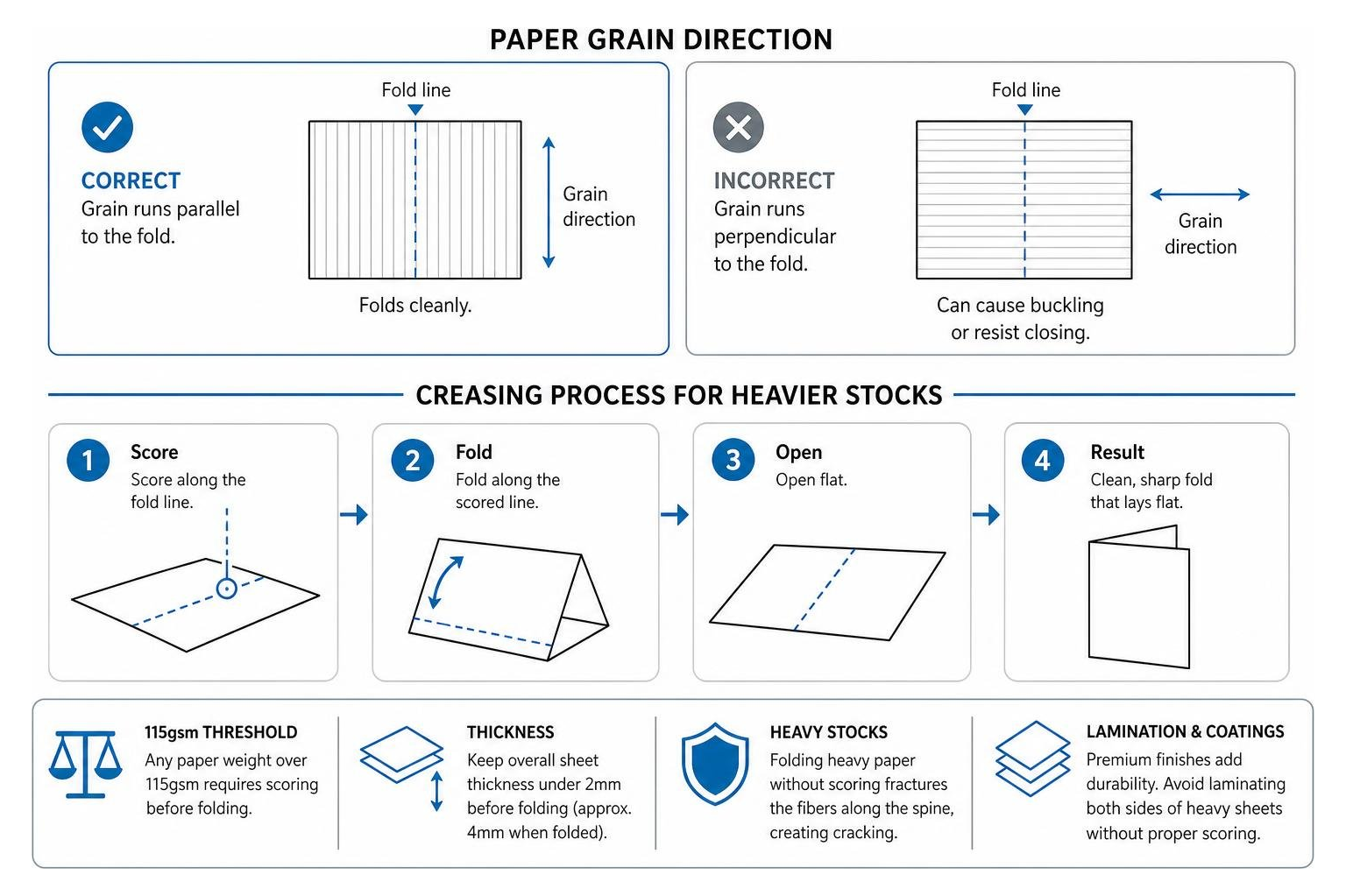
- The 115gsm Threshold: Any paper weight over 115gsm (or 70lb text weight) requires scoring before folding. Folding heavy paper without scoring fractures the paper fibers along the spine, creating unsightly cracking.
- Grain Direction: Paper fibers naturally align in one direction during manufacturing, a property explained in more detail in this overview of paper grain direction. For a crisp result, the paper grain must run parallel to the fold line. Folding against the grain stresses the paper structure and can cause the spine to buckle or resist closing cleanly.
- Thickness Thresholds: Maintain an overall sheet thickness under 2mm before folding (resulting in an assembled folded thickness of around 4mm). This ensures the brochure sits completely flat when closed on a desk or inside a presentation folder.
- Lamination and Coatings: Combining heavy stocks with premium finishing options for folded print adds durability. However, avoid laminating both sides of heavy sheets without proper scoring channels, as rigid films can cause the fold to resist laying flat.
Bleed Settings, Trimming Margins, and Creasing
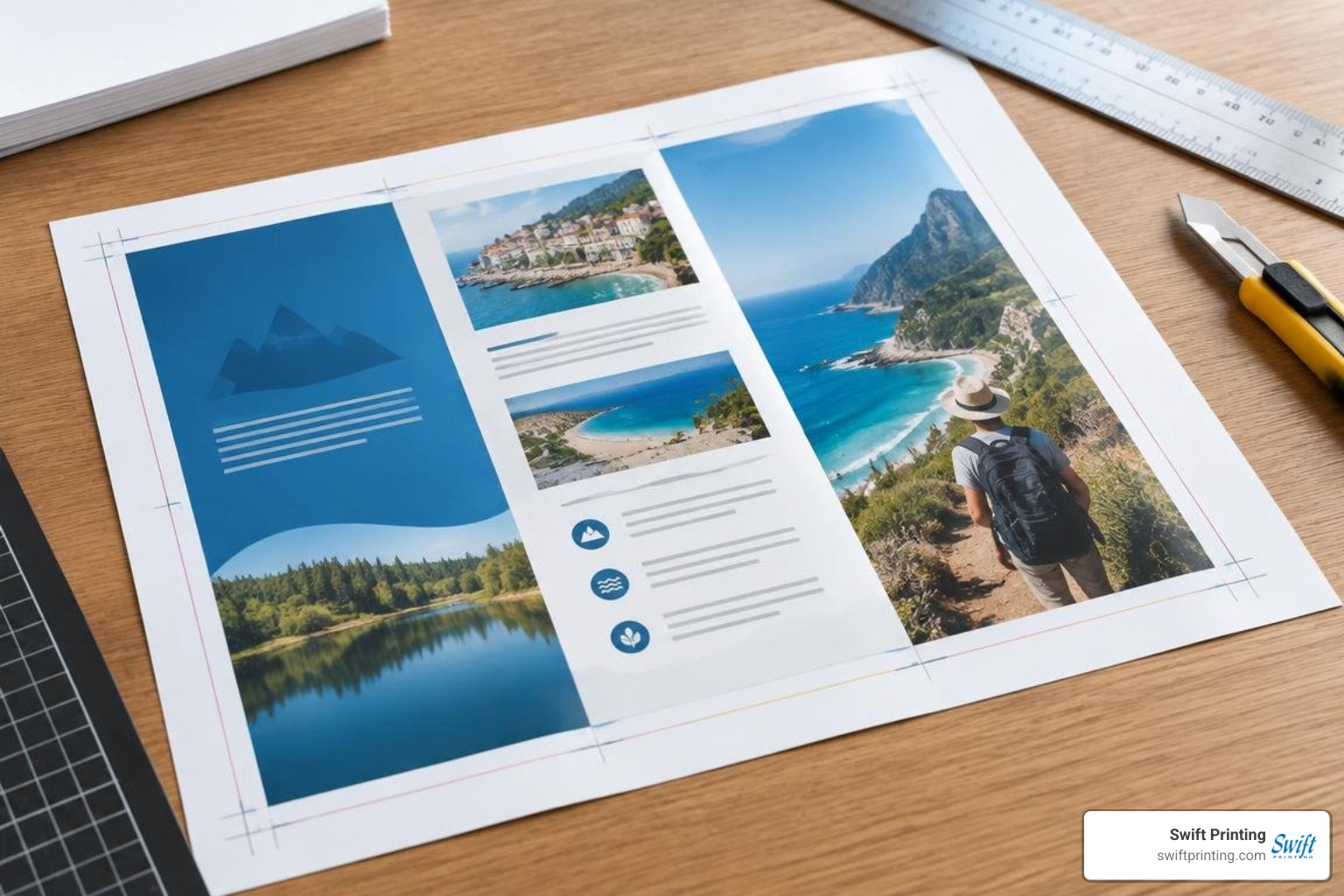
Precision in prepress file setup prevents white edges and uneven margins. Familiarizing yourself with understanding bleed and crop marks ensures your files translate cleanly to physical sheets.
When preparing files for production:
- Bleed Allowance: Standard bleeds should extend at least 1/8 inch (approximately 3mm) beyond the final cut line. If running large background colors or solid ink to the outer edges, proper bleed avoids visible paper borders after cutting.
- Post-Fold Trimming Margins: If your piece is trimmed after it has been folded, leave a 10mm safe margin around perimeter text.
- Two-Up Imposition Gaps: When printing multiple brochures on large commercial press sheets (printing 2-up), leave at least a 6mm gap between copies to allow space for cutting blades.
- Mechanical Creasing: High-end boutique printing utilizes mechanical matrix scoring to compress paper fibers prior to folding. This produces a rounded hinge along the spine that preserves surface coatings.
Printing Method Comparison: Digital and Offset Capabilities
Producing a flawless brochure depends on matching your run volume and schedule to the right commercial press technology.
Digital vs. Offset Production Capabilities
The two primary production paths offer distinct strengths for different project scopes:
| Consideration | Digital Printing | Offset Lithography |
|---|---|---|
| Ideal Project Volume | Short runs, targeted releases, personalized iterations | High-volume corporate runs, statewide distribution |
| Turnaround Speed | Same-day or next-day turnaround capabilities | Requires upfront plate creation and drying time |
| Color Calibration | Advanced dry toner and liquid electrophotography | Pantone matching system (PMS) spot color fidelity |
| Substrate Flexibility | Certified digital sheet sizes and standard weights | Broad array of custom weights, textures, and heavy boards |
| Variable Data Support | High (custom names, tailored regional phone numbers) | Static (all printed sheets share identical plate artwork) |
When you require quick turnarounds or targeted versions for specific corporate presentations, short-run digital printing offers fast output without sacrificing sharp detail. When producing tens of thousands of unified program guides or annual reports, high-volume offset printing provides exceptional ink laydown, fine line screens, and consistent Pantone spot-color reproduction.
Comparing Formats: Single-Fold Brochures vs. Multi-Panel Folds
A single fold represents the cleanest mechanical layout in commercial finishing. Here is how it compares mechanically to other folding formats:
- Single Fold (Bi-Fold): One central fold line. Can be scored and folded inline easily, offering high dimensional stability with zero panel-nesting conflicts.
- Tri-Fold (Letter Fold): Two parallel folds creating three panels per side. The inside panel must be designed approximately 1/16 to 1/8 inch narrower so it can tuck inside the outer panels without buckling.
- Gate Fold: Two outer panels fold inward to meet at a central point. Requires a precise 3mm to 15mm gap in the center so the opposing paper edges do not clash or overlap when closing.
- Roll Fold & Map Folds: Multiple panels rolling inward. These require progressively narrower panel widths and often demand specialized offline folding equipment, as web presses and standard inline folders cannot always handle complex roll folds.
Understanding these structural requirements through an experienced commercial print company helps you choose the right format for your project's technical needs.
Best Use Cases for High-End Professional Collateral
The broad canvas of a single-fold format makes it a natural fit for organizations that value clear presentation and generous layout space. When you are designing premium local brochures, the single fold provides a comfortable, book-like reading experience.
Corporate Presentations, Legal Summaries, and Medical Packets
Professional organizations rely on single-fold brochures to convey authority and organize sensitive information:
- Legal Practices: Law firms use bi-fold formats for case summaries, practice area overviews, and estate planning guides. The format slips easily into standard corporate folders and keeps complex legal pathways organized.
- Healthcare & Medical Groups: Specialty medical practices and regional hospitals utilize single-fold layouts for patient orientation guides, treatment overviews, and surgical preparation instructions. The larger panel dimensions accommodate clear diagrams and readable font sizes for older patients.
- Consulting and Accounting Firms: B2B service firms rely on the two-page interior spread to showcase organizational charts, data graphs, and multi-step methodologies across our range of commercial print products.
Luxury Product Catalogs and Event Programs
For black-tie galas, development foundations, and luxury product lines, a single fold acts as an elegant program or portfolio:
- Executive Galas and Fundraisers: A heavy 100lb cover stock folded in half provides an upright, self-standing program for dinner tables, listing event schedules and benefactor recognitions cleanly.
- Architectural and Real Estate Portfolios: Wide-format single folds allow floor plans and property photography to stretch across the interior spread without being cut by multiple vertical fold lines.
- Specialty Finishes: Adding specialty die cut brochure features, soft-touch coatings, or foil stamping turns a simple bi-fold layout into an engaging sensory experience.
Frequently Asked Questions About Single Fold Brochures
What paper weight prevents cracking on a single fold brochure?
To prevent cracking along the spine, any paper stock heavier than 115gsm (or 70lb text) must be scored before folding. Additionally, ensure the paper grain runs parallel to the fold line. This alignment allows the paper fibers to bend smoothly rather than snapping under tension.
How do single fold bleed and margin rules differ from multi-panel folds?
Single-fold pieces do not require varying panel widths because panels do not nest inside one another. However, you should maintain a 1/8-inch (3mm) external bleed, leave a 10mm safe margin if trimming after folding, and ensure a 6mm gap between copies when running multiple pieces on a single press sheet.
When should professional services choose a single fold over a tri-fold?
Choose a single fold when your content includes horizontal diagrams, wide photographs, or detailed text that benefits from an expansive, book-like interior spread. Tri-folds are better suited for quick, step-by-step marketing summaries, whereas single folds offer a more substantial, formal presentation.
Conclusion
A well-crafted single-fold brochure provides a clean, executive look that helps your business stand out. From selecting the right paper grain and scoring methods to calibrating color spreads across the spine, every step in the process shapes how your brand is perceived. At Swift Printing, we take pride in delivering the highest standard of boutique commercial printing for professional organizations across West Michigan and beyond. When you are ready to produce your next corporate piece, request a custom printing quote and let our team bring your design to life.