An Essential Guide to Comparing Cardboard Poster Options in USD
Understanding Cardboard Poster Printing: Materials, Sizes, and Pricing in USD
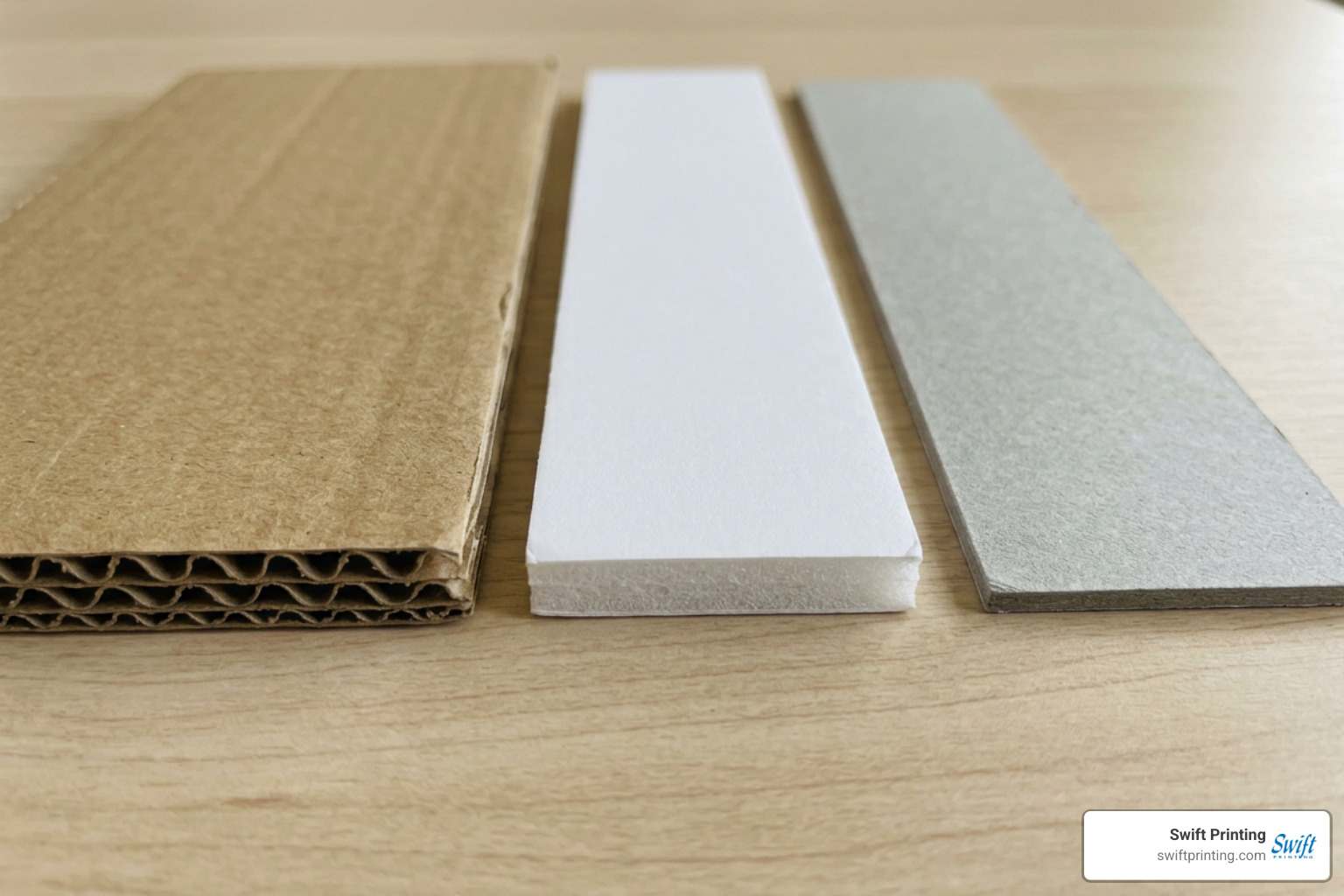
When you explore rigid display prints, understanding your substrate options is the first step toward getting a display that looks great and holds its shape. While people often use "cardboard poster" as a catch-all term, commercial print shops and retail photo centers actually work with several distinct materials.
The three primary categories include:
- Corrugated Cardboard: Built with a fluted inner layer sandwiched between two flat linerboards, corrugated board offers excellent structural rigidity and lightweight handling. It is widely used for point-of-sale retail stands, short-term promotional signs, and eco-conscious packaging displays.
- Foam Core (Foam Board): Featuring a dense polystyrene foam core faced on both sides with smooth paper, foam core provides an ultra-flat, clean edge that sits beautifully on easels without bowing.
- Heavy Poster Board & Cardstock: Thick, multi-ply paperboards offer a rigid alternative without plastic cores. To understand how sheet weight impacts durability and presentation, exploring Why Paper Matters More Than You Think will help you match paper weight to your display environment.
Standard Sizes and Costs for Cardboard Poster Printing
Standard rigid board prints are commonly priced in transparent tiers depending on overall surface area. Most consumer retail centers offer popular pre-cut dimensions such as 11x14 inches, 16x20 inches, 18x24 inches, and 24x36 inches.
Here is a quick look at average retail pricing in USD across typical display dimensions:
| Board Dimension | Common Display Purpose | Average Price Range (USD) |
|---|---|---|
| 11x14 inches | Tabletop frames, memorial tributes, small photo collages | $9.86 – $14.86 |
| 16x20 inches | Milestone birthdays, classroom awards, standard easel displays | $19.86 |
| 18x24 inches | Directional event signage, presentation graphics, retail notices | $22.86 – $26.86 |
| 24x36 inches | Trade show displays, wedding welcome signs, life-size announcements | $27.86 – $29.86+ |
In retail environments, you will frequently find themed templates spanning over 100 designs for milestone events like graduations, holiday gatherings, and business opening announcements. Custom commercial printing allows for bespoke sizing well beyond these standard cuts.
Substrate Finishes and Backer Selections
The coating applied to your board print dramatically affects both readability and longevity. Choosing between a soft matte finish and a vibrant gloss coating changes how light interacts with your graphics. Matte surfaces eliminate annoying glare under harsh office fluorescent tubes or direct sunlight, making them ideal for text-heavy presentation boards. Gloss finishes, on the other hand, maximize color saturation and depth for photographic artwork.
For boards displayed in high-traffic or high-humidity environments, protective surface treatments are crucial. You can review specialized Finishing Options for Printing to see how liquid laminates, UV-cured coatings, and film overlays shield direct-to-board prints from fading, scuffing, and edge curling.
How to Prepare Artwork Files for High-Quality Board Prints

Getting crisp results on a large-format rigid print starts long before the file hits the machine. If you scale a tiny web image to fit a 24x36-inch board, the result will look blurry and pixelated.
For handheld prints, a resolution of 300 DPI (dots per inch) is standard. However, large poster boards are generally viewed from several feet away. For a 1-meter (approx. 39-inch) wide display, an image file around 3,000 pixels wide provides roughly 75 DPI. At standard viewing distances of 3 to 5 feet, 75 to 150 DPI looks crisp and legible to the human eye.
To avoid costly setup mistakes such as missing bleeds or misplaced safety margins, be sure to consult The 10 Most Common Print File Mistakes and How to Avoid Them.
File Preparation and Prepress Checks
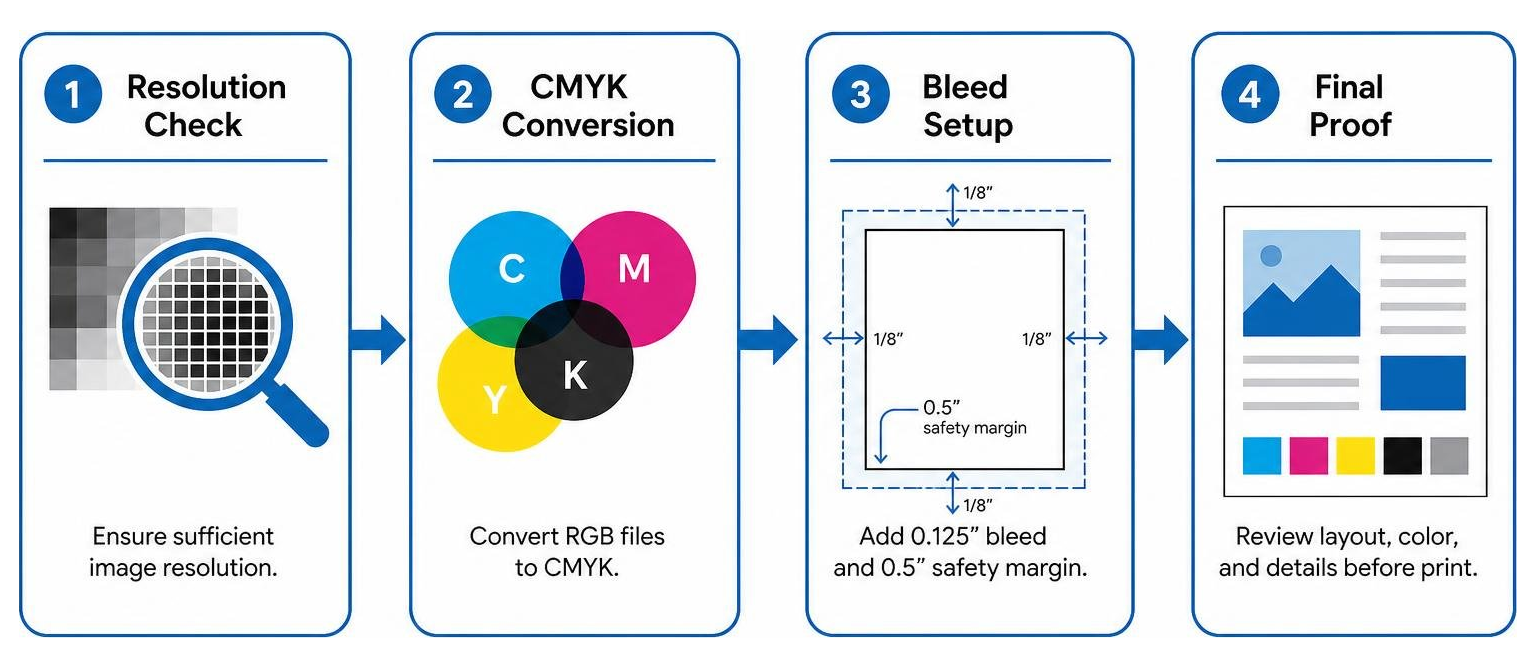
Before sending your poster file to a printer, running through a standard prepress checklist ensures seamless reproduction:
- Color Mode: Convert RGB files to CMYK so on-screen hues translate accurately to physical ink.
- Vector Assets: Keep typography, logos, and line art in vector format (PDF, EPS, or AI) so edges remain razor-sharp at any magnification.
- Bleed and Safety Margins: Include a 0.125-inch (1/8") bleed along all outer edges to prevent unprinted white borders during trimming. Keep essential text at least 0.5 inches inside the cut line.
To learn more about how our prepress team inspects files for proper trapping, resolution, and color profiles, read Behind the Print: What Happens Before Your Project Ever Hits the Press.
How to Choose: Professional Services vs. DIY Tiled Printing
When you need a large display, you have two distinct paths: ordering a seamless, direct-printed board from a professional service or assembling a tiled multi-page poster at home using standard desktop equipment.
If you represent an organization or brand looking for long-term consistency, investing in Digital Printing for Growing Brands ensures your marketing assets maintain exact brand colors, structural durability, and clean presentation.
Professional Cardboard Poster Printing vs. DIY Assembly
Professional rigid board production utilizes large-format UV flatbed printers that deposit and cure ink directly onto the substrate. This creates a durable, weather-resistant, single-piece board with clean factory-trimmed edges.
Our team at Swift Printing specializes in Commercial Printing Grand Rapids businesses rely on for trade shows, boardroom presentations, and retail installations. When your reputation is on the line, a seamless rigid board delivers a clean, authoritative appearance that taped paper simply cannot match.
Step-by-Step Guide to Tiled DIY Poster Printing at Home
For low-budget classroom aids, temporary party backdrops, or mural tracing templates, tiled printing offers an accessible alternative.
Using browser-based tools like Free Poster Maker — Make & Print a Large Poster at Home | GridPrint , you can split an oversized graphic across standard Letter or A4 pages without watermarks. For instance, generating a 1-meter poster requires about 12 standard sheets, while a 2-meter backdrop spans roughly 48 sheets.
Follow these steps to print and assemble your own tiled poster:
- Upload Your File: Load a high-resolution PNG, JPG, or SVG image into the tiling software.
- Set Target Dimensions: Enter your final width and height in inches or centimeters, selecting your base paper size (Letter or A4).
- Download the Multi-Page PDF: The tool automatically slices the image, adding overlap margins, alignment crosshairs, and page numbers.
- Print at 100% Scale: Open the PDF in your viewer and disable "Fit to Page" or "Shrink Oversized Pages." Print on heavy paper or cardstock for better rigidity.
- Trim and Overlap: Use a craft knife and metal ruler to cut along the designated crop marks on one side of each seam.
- Join the Sheets: Lay the pages face down on a flat table, match the numbered grid, align the overlap guides, and apply archival tape firmly along the back seams.
- Mount to Backer: For a rigid finish, spray-mount the assembled multi-page sheet onto a piece of corrugated cardboard or foam core.
Real-World Applications and Fulfillment Logistics
Fulfillment speed and shipping logistics play a massive role in choosing how you source your poster boards. If you find yourself in a time crunch, exploring Short Run Digital Printing Near Me can help you source locally without getting trapped by long shipping windows.
Standard fulfillment avenues include:
- Same-Day Local Pickup: Many national retail photo centers offer same-day collection across thousands of locations for standard templates, provided files are uploaded early in the day.
- Ship-to-Store: A budget-friendly option that delivers boards to a local retail branch within 5 to 10 business days.
- Direct Mail Delivery: Ships finished rigid boards right to your doorstep within 3 to 10 business days, though large boards require rigid oversized packaging to prevent corner damage.
Common Use Cases for Rigid Poster Boards
Rigid poster boards provide an instant, self-supporting display solution across a wide range of personal and commercial settings:
- Academic and Graduation Milestones: Commemorative photo collages, senior spotlight boards, and first/last day of school chalkboard signs.
- Weddings and Life Events: "Welcome to Our Beginning" easel signs, seating charts, and Celebration of Life memorial displays.
- Retail and Office Operations: "We Are Open" notices, directional parking signs, safety policies, and seasonal promotional banners.
- Presentations and Trade Shows: Pitch deck summaries, financial charts, architectural renderings, and courtroom exhibits.
Frequently Asked Questions About Cardboard Poster Printing
What image resolution is needed for large cardboard poster printing?
For standard viewing distances (3 to 6 feet), an image resolution between 100 and 150 DPI is ideal. For a 1-meter wide board, an image file that is 3,000 pixels wide delivers roughly 75 DPI, which is clear and legible for general event signage. For fine photographic work viewed up close, aim for 300 DPI at full output dimensions.
How long does poster board shipping and pickup usually take?
Same-day pickup is often available at retail photo centers if ordered during morning hours. Standard ship-to-store orders typically arrive within 5 to 10 business days, while direct-to-door ground shipping generally requires 3 to 10 business days depending on destination and board size.
What is the difference between foam board and corrugated cardboard posters?
Corrugated cardboard utilizes a fluted paper interior that makes it highly recyclable, cost-effective, and rigid along its flutes. Foam board uses a solid polystyrene core sandwiched between clay-coated papers, offering a flatter surface without visible interior ribs, though it is less eco-friendly to recycle.
Conclusion
Whether you choose a DIY tiled assembly for a weekend school project or partner with a commercial press for high-stakes corporate signage, matching your substrate and production method to your timeline and budget ensures success.
At Swift Printing, we are proud to be one of only two commercial printing companies worldwide certified as a B Corporation. We combine decades of family-owned craft with an unwavering commitment to sustainable materials, community reinvestment, and exceptional print quality. When you are ready to bring your next big visual project to life, discover our complete range of custom commercial printing solutions tailored to support your organization's goals.