How to Format Addresses for Reliable Mail Delivery
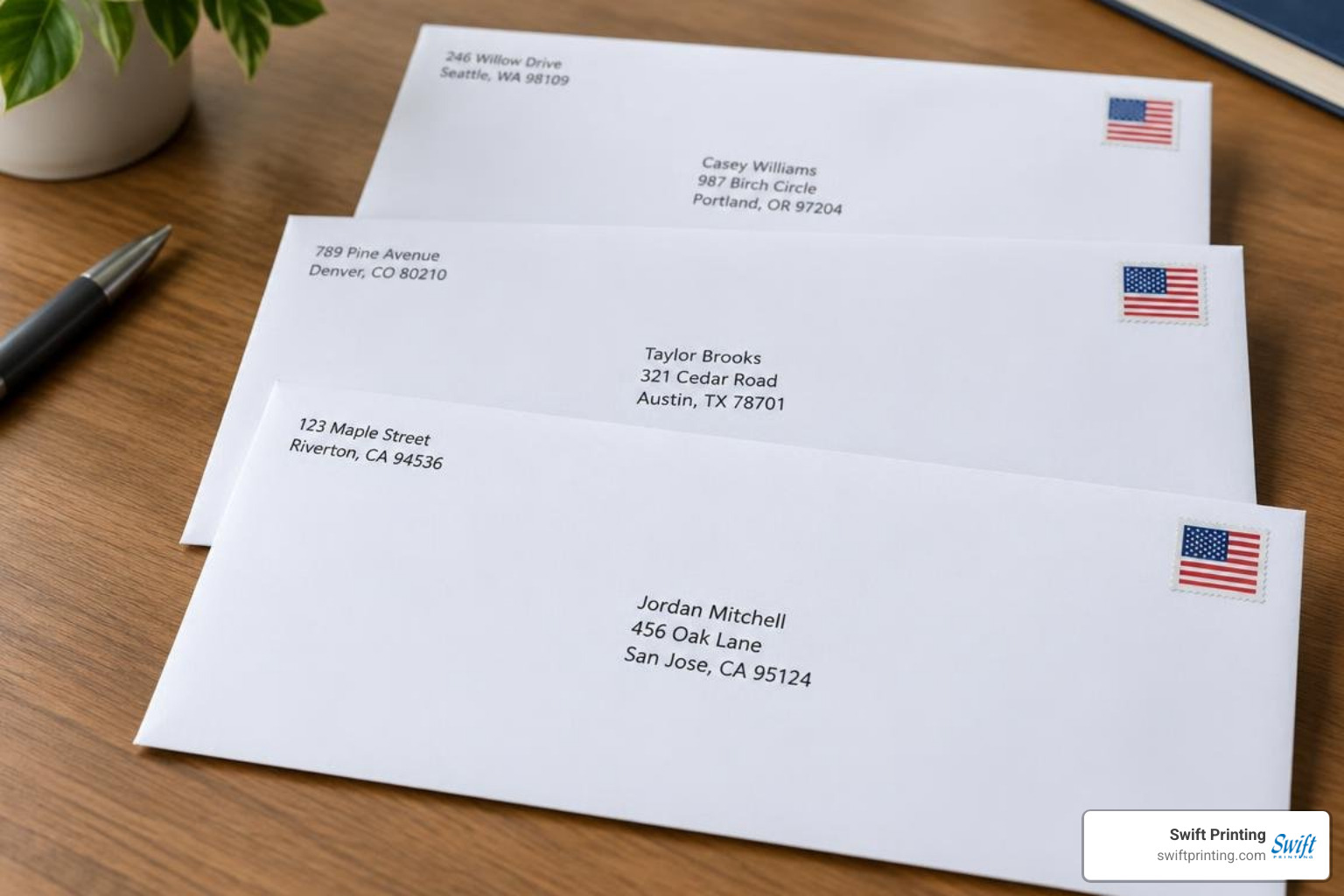
To format addresses for U.S. mail, put the recipient’s name first, then the street address and apartment or suite number, followed by the city, two-letter state abbreviation, and ZIP Code. Use a separate line for each part. For international mail, follow the destination country’s address order and put the country name on the last line.
Before printing a mailing list, check for missing unit numbers and incorrect postal codes. A clear address helps postal equipment sort the piece and helps the carrier find the right door.
I’m Jessica Gutowski-Slaydon, president of Swift Printing in Grand Rapids. My work with business and municipal mailings has taught me that taking time to format addresses correctly is one of the simplest ways to prepare a more dependable mailing.
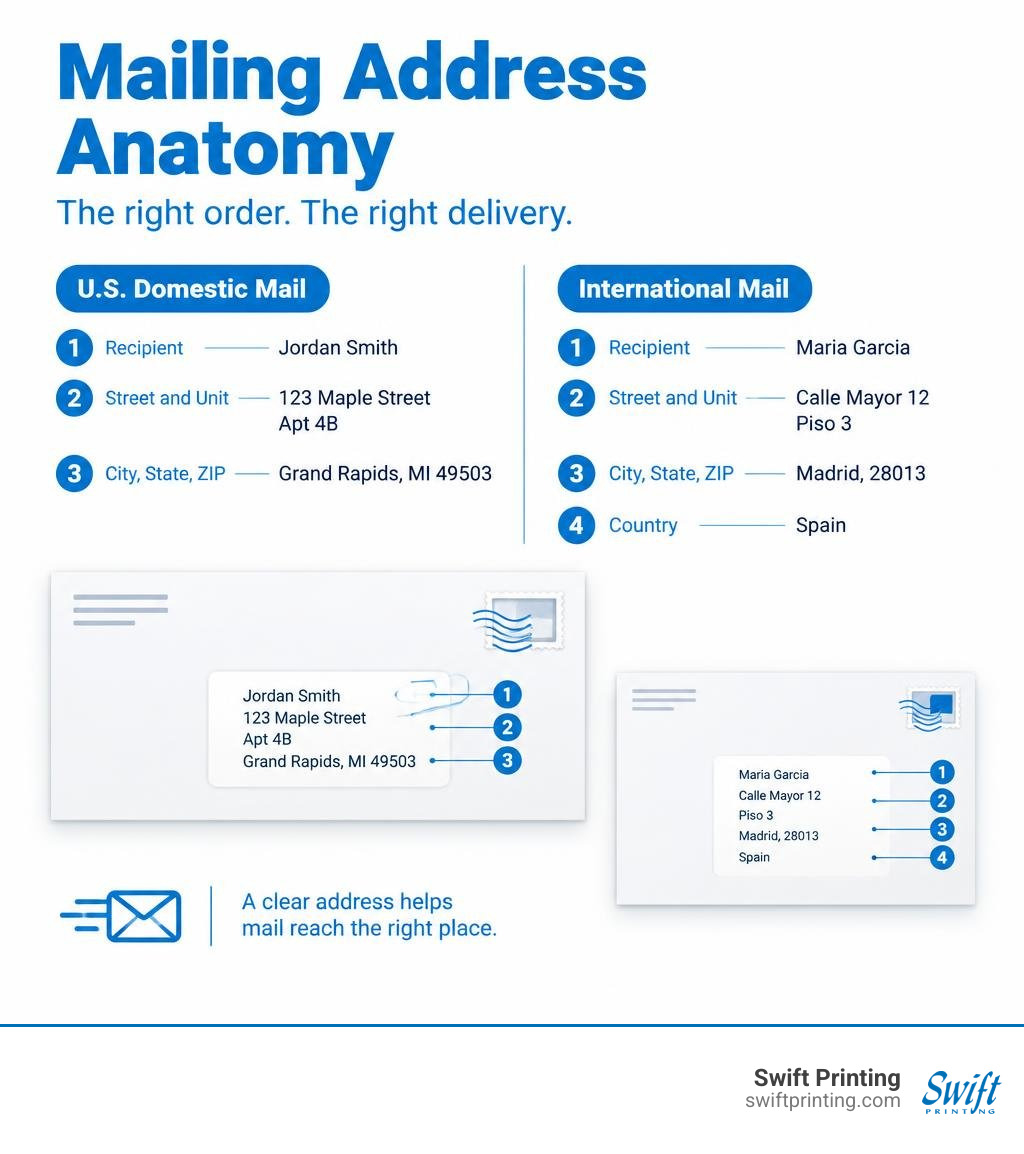
How to Format Addresses for Standard Domestic Mail
When we prepare direct mailings for law firms, medical practices, or municipal offices across Grand Rapids, Lansing, and Belmont, we always begin with how the United States Postal Service processes mail. High-speed Optical Character Recognition (OCR) systems process millions of pieces daily. These automated machines read envelopes from the bottom up, first identifying the delivery city, state, and ZIP Code before reading the specific street address above it.
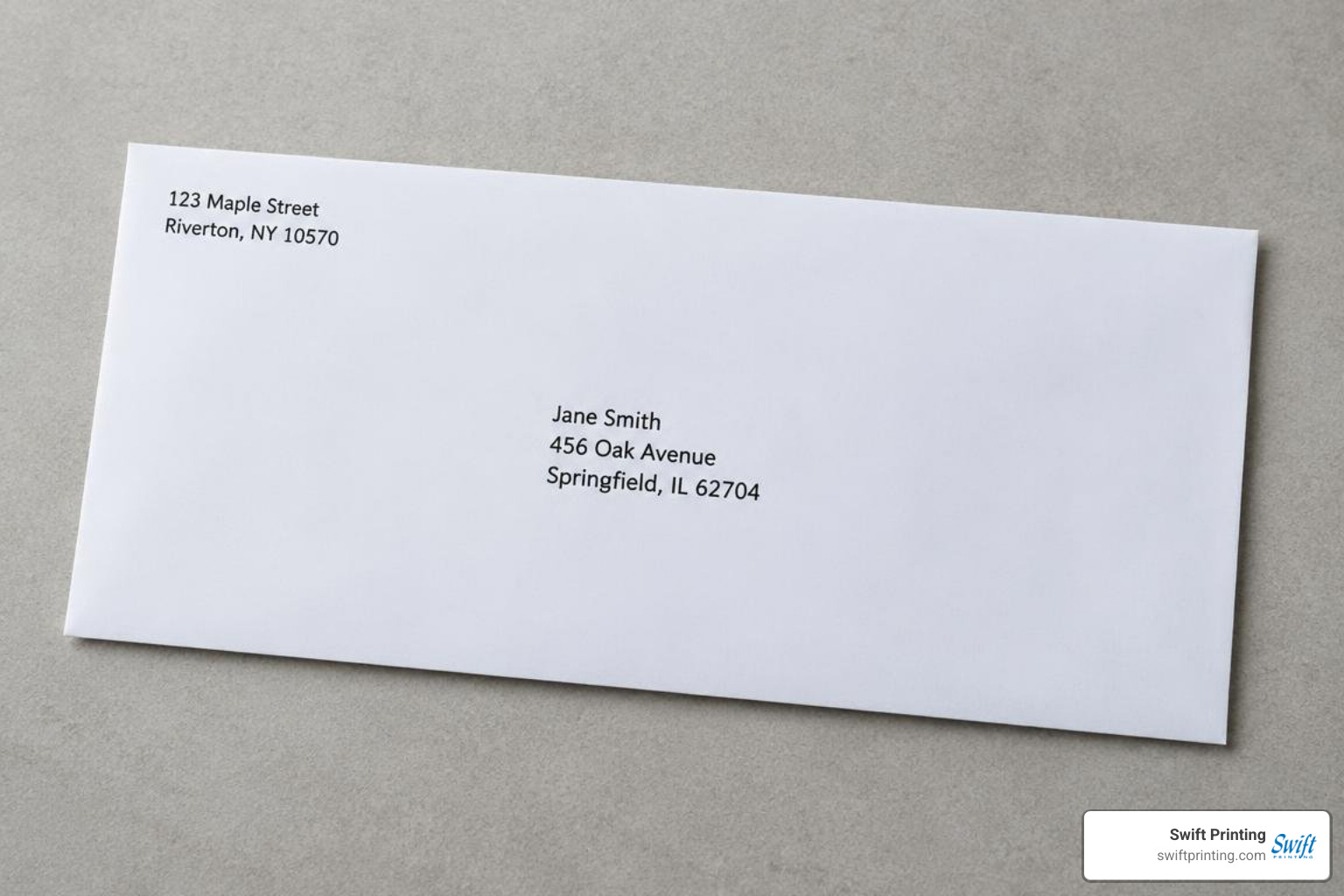
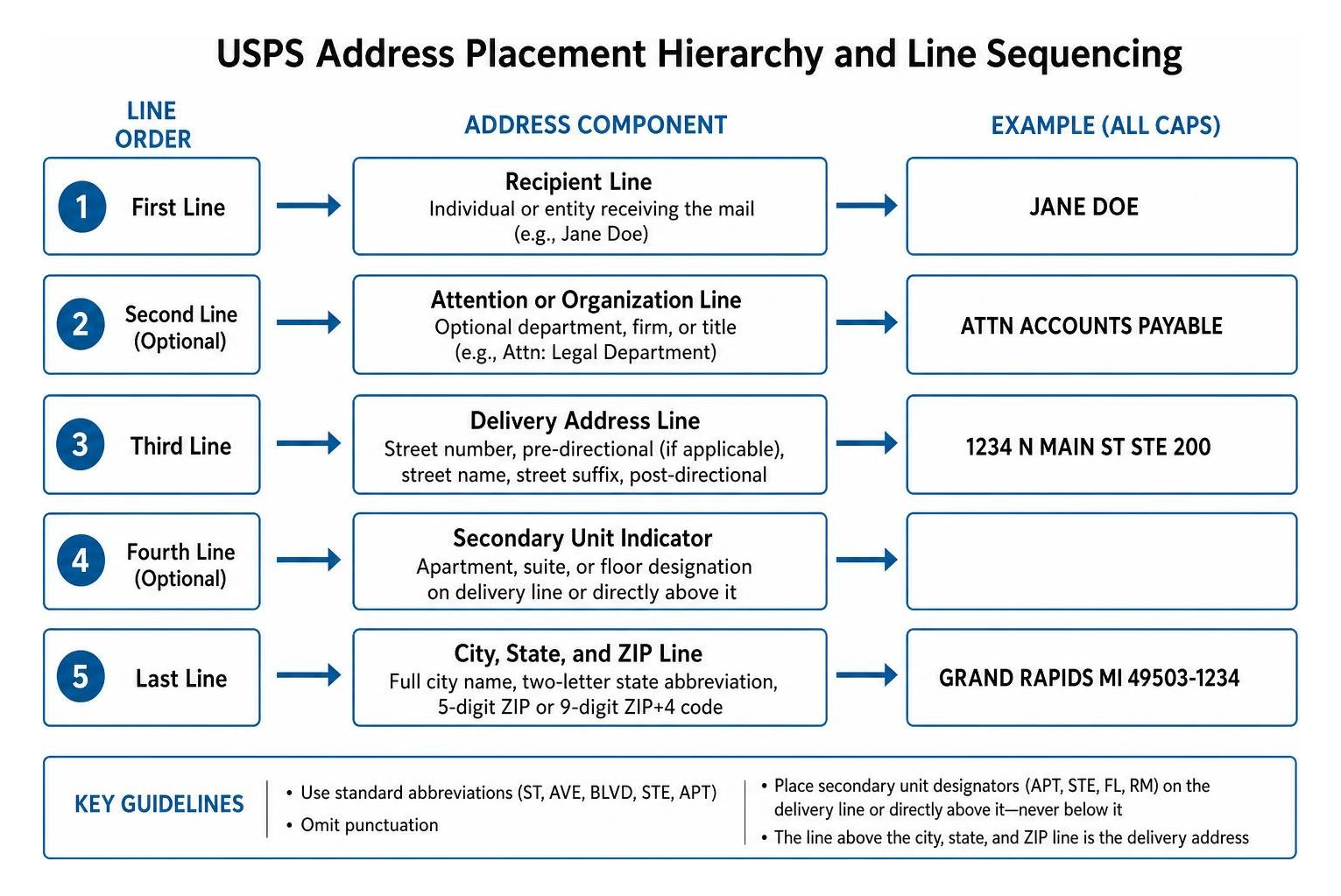
Following USPS component-by-component specifications ensures that sorting machines route each envelope accurately. Using clean layouts and following professional envelope printing tips helps prevent sorting delays and delivery errors.
Essential Components of a Domestic Mailing Address
A standard domestic address consists of distinct elements stacked in a clear hierarchy:
- Recipient Line: The individual or entity receiving the mail (e.g., Jane Doe).
- Attention or Organization Line: Optional department, firm, or title (e.g., Attn: Legal Department).
- Delivery Address Line: The physical street number, pre-directional (if applicable), street name, street suffix, and post-directional.
- Secondary Unit Indicator: Apartment, suite, or floor designation placed on the delivery line or directly above it.
- City, State, and ZIP Line: The full municipality name, official two-letter state abbreviation, and the 5-digit ZIP or 9-digit ZIP+4 code.
Using standard abbreviations (such as ST, AVE, BLVD, STE, and APT) and omitting punctuation streamlines automated sorting across regional distribution hubs.
Formatting Special Address Types: Apartments, PO Boxes, and Rural Routes
Handling multi-unit dwellings, post office boxes, and rural destinations requires specific conventions to maintain deliverability:
- Apartment and Suite Designators: Always place secondary unit designators (APT, STE, FL, RM) on the delivery address line immediately following the street name. If the line becomes too long, place the unit identifier on the line directly above the street address—never below it.
- Post Office Boxes: Write "PO BOX" followed by the assigned number. If both a street address and a PO Box exist for a recipient, postal carriers deliver to whichever address appears on the line immediately above the city, state, and ZIP line.
- Rural Routes and Highway Contracts: Use "RR" or "HC" followed by the route number and box number (e.g., RR 2 BOX 152).
Global Address Diversity and International Standards
Worldwide mail handling encompasses more than 200 distinct address formats across at least 20 different language scripts. Managing global correspondence requires familiarity with the international framework established by the Universal Postal Union (UPU).
The UPU maintains two fundamental international standards: UPU S42, which defines international address components and localized templates, and UPU S53, which regulates address data exchange. Adhering to these conventions ensures that international mail clears foreign customs and automated hubs smoothly, matching benchmarks such as official Canadian postal address standards.
| Address Component Order | Typical Region/Countries | Example Formatting Pattern |
|---|---|---|
| Smallest to Largest (Little-Endian) | United States, United Kingdom, Canada, Australia | Recipient to House Number & Street to City to State/Province to Postal Code to Country |
| Street First, House Number Last | Germany, Austria, Netherlands, Scandinavia | Recipient to Street Name + House Number to Postal Code + City to Country |
| Largest to Smallest (Big-Endian) | Japan, China, South Korea | Country to Postal Code to Prefecture/Province to City to District/Block to Recipient |
How Global Postal Systems Format Addresses Differently
Address structure varies significantly across borders:
- Component Hierarchy: North American systems use "little-endian" ordering (starting with the individual and ending with the country). East Asian systems like those in Japan and China use "big-endian" ordering, moving from largest administrative unit down to the specific building and addressee.
- House Number Placement: In the US and UK, the house number precedes the street name. In Germany and much of continental Europe, the street name appears first, followed by the building number (e.g., Goethestrasse 12).
- Subunit and Building Identifiers: UK addresses frequently rely on building names rather than street numbers, while Australian addresses use a forward slash for subunits (e.g., Unit 3, 17 Smith St is written as 3/17 Smith St).
Navigating International Postal Code Systems and Last-Mile Deliveries
Roughly 130 countries worldwide use structured postal codes, while others operate without formal postal codes:
- Alphanumeric Formats: Countries such as Canada (e.g., K1A 0B1) and the United Kingdom (e.g., SW1A 1AA) use precise alphanumeric systems that isolate specific street blocks or single large buildings.
- Numeric Systems: Most European postcodes use 4 to 5 continuous digits, while Japan uses a 7-digit hyphenated format (e.g., 〒100-0001).
- Regions Without Postal Codes: In regions relying on descriptive, landmark-based navigation, include detailed delivery instruction lines, recipient phone numbers, and local neighborhood identifiers to support last-mile courier delivery.
Technical Best Practices for Databases, Forms, and List Management
Maintaining pristine data hygiene is essential for enterprise mailing campaigns. Before any files go to print, address records should undergo automated scrubbing, deduplication, and standard normalization protocols.
Applying address normalization guidelines ensures consistent field entries across your CRM or ERP software, supporting high-volume direct mail programs.

Best Practices to Format Addresses in Spreadsheets and Databases
Structuring mailing lists properly in data tables prevents line truncation and field misalignment:
- Isolate Discrete Fields: Never combine complete addresses into a single spreadsheet cell. Maintain separate columns for Recipient Name, Company/Attention, Address Line 1 (Street Address), Address Line 2 (Unit/Suite), City, State, and ZIP Code.
- Preserve Leading Zeros: Store postal codes as text strings rather than numeric values so spreadsheets do not strip leading zeros from East Coast ZIP codes.
- Normalize Street Names and Directionals: Standardize suffixes (e.g., "Court" to "CT", "Boulevard" to "BLVD") across all records to avoid duplicate entries. For a complete spreadsheet setup, review how should I format addresses in Excel or Google sheets for a mailer.
Designing Flexible Web Forms for Multilingual and Global Users
Web forms must accommodate diverse global input styles without blocking legitimate submissions:
- Use Flexible, Generic Field Labels: Use "Address Line 1," "Address Line 2," and "Postal Code / Province" rather than rigid "Street Name" and "ZIP Code" labels.
- Avoid Over-Restrictive Validation: Do not restrict postal code fields to numbers only, as international codes often include letters and spaces.
- Support Native Character Sets: Ensure databases and forms utilize UTF-8 character encoding to handle accented characters, non-Latin scripts, and localized typography accurately.
Address Verification, Normalization, and Deliverability Best Practices
Automated address verification software matches lists against official postal authority databases to correct typos, standardize street types, and append missing ZIP+4 extensions.
Commercial mailers must also comply with the USPS Move Update standard, which requires mailing lists to be scrubbed against the NCOALink database within 95 days prior to mailing. Integrating standardized address formatting with full-service mailing services guarantees that correspondence for executive offices, healthcare providers, and local organizations arrives promptly without costly return-to-sender delays.
Frequently Asked Questions About Address Formatting
Why do postal sorting machines prefer uppercase letters and no punctuation?
Optical character recognition (OCR) systems process uppercase typography faster and with fewer scanning errors. Commas, periods, and decorative typefaces can be misread by high-speed scanners as stray marks or extra characters, potentially routing the mailpiece into manual sorting channels.
Where should an apartment or suite number be placed on a mailpiece?
The apartment or suite number belongs on the delivery address line directly following the street name (e.g., 100 OTTAWA AVE NW STE 300). If space is limited, position the suite number on the line immediately above the street address. Never place it below the street address line, as bottom-up OCR scanners may misread the unit number as the primary street number.
How often should business mailing lists be scrubbed against change-of-address registries?
To comply with USPS Move Update requirements, business mailing lists must be verified through the NCOALink registry at least once every 95 days prior to mailing. Regular verification ensures addresses stay current, reduces undeliverable mail, and maintains high delivery rates for marketing and billing lists.
Conclusion
Formatting addresses correctly is essential for ensuring that critical documents, professional marketing materials, and municipal notices reach their intended recipients without delay. Whether managing domestic mailings across West Michigan or coordinating complex international distributions, proper address hygiene protects your schedule and reinforces your professional image.
At Swift Printing, we set the standard for high-end boutique commercial printing in Grand Rapids, Rockford, Ada, and Kalamazoo. Our team pairs meticulous print craftsmanship with deep postal logistics expertise to handle every detail of your direct mail campaigns. To prepare your recipient files for flawless production, follow our comprehensive guide on formatting a spreadsheet for a mailing, and let our team ensure your next project is delivered accurately and on time.