How to Choose a Professional Mail Forwarding Service

A professional mail forwarding service receives mail at a staffed address and sends it to you when and where you need it. Some services also let you view envelopes online, request scans, and decide which items to ship or securely destroy.
To compare services, start with your actual mail: Who sends it, how quickly must you see it, and do you need the original? Then check which carriers the address accepts, how staff handle sensitive documents, and how quickly scanning, storage, and shipping are completed. For a law firm, medical office, or nonprofit, a basic plan matters less if an important notice sits unopened or a processing delay holds up delivery.
I’m Jessica Gutowski-Slaydon, president of Swift Printing in Grand Rapids, Michigan. My work in direct mail and postal preparation has taught me to evaluate a professional mail forwarding service by its address accuracy, clear handoffs, and dependable delivery.
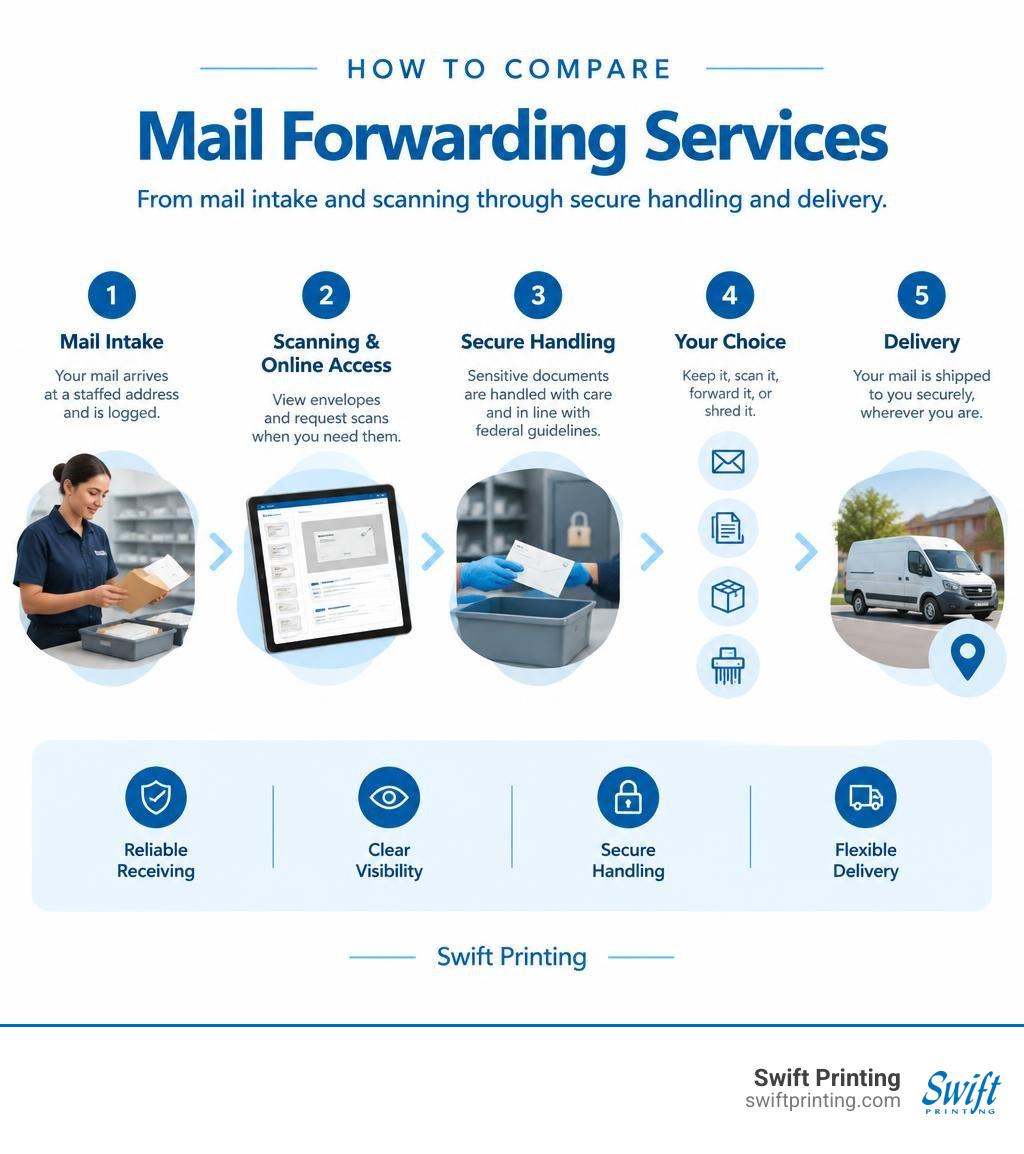
How a Professional Mail Forwarding Service Works
At its foundation, a modern forwarding service acts as an authorized receiving agent for your organization. Rather than relying on an unstaffed receptacle, you partner with a registered Commercial Mail Receiving Agency (CMRA) that processes inbound correspondence under strict federal guidelines.
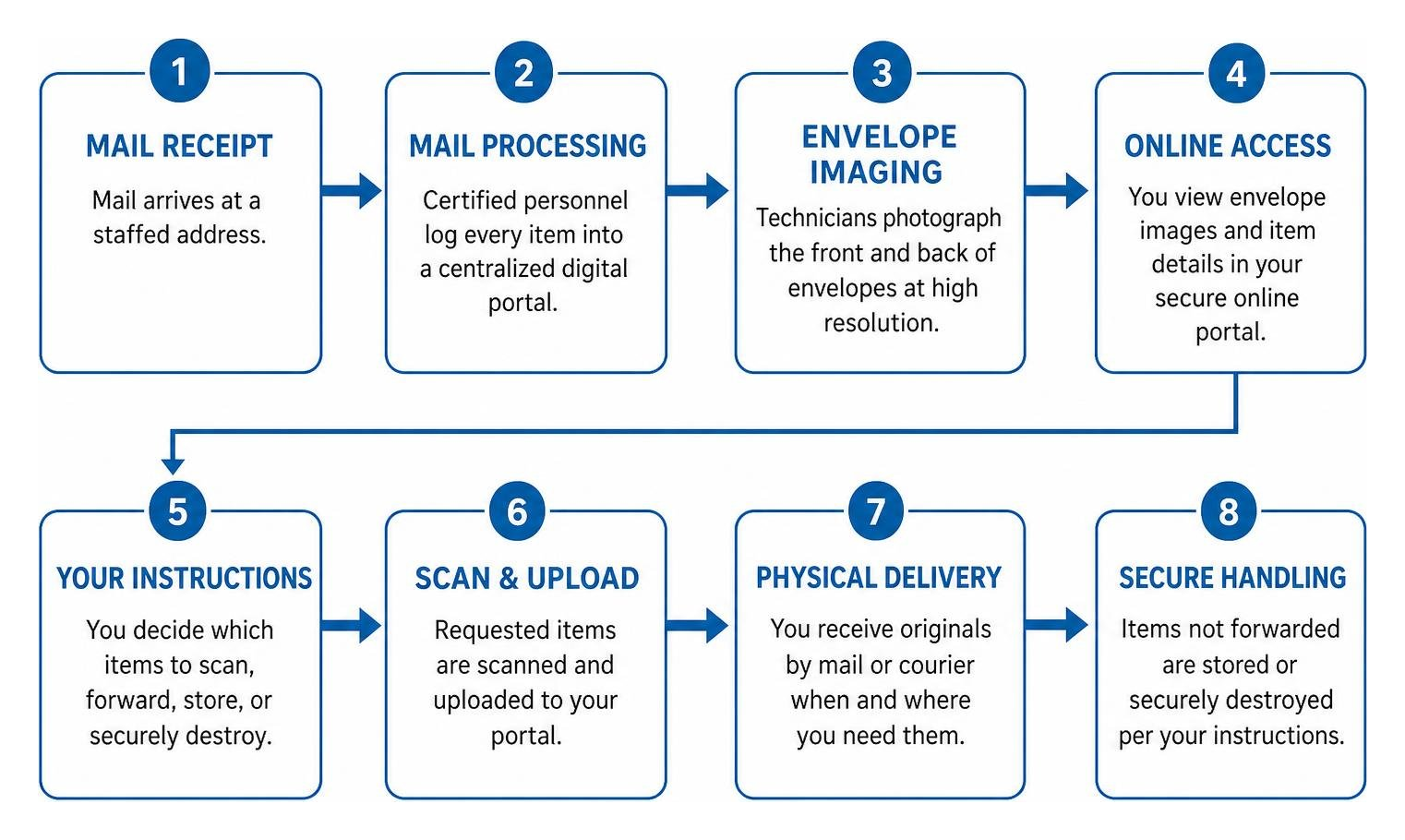
When letters, client contracts, and certified notices arrive at the commercial facility, certified personnel log every item into a centralized digital portal. From there, you maintain complete administrative control over each document's lifecycle without stepping foot inside a physical office.
Core Capabilities of a Professional Mail Forwarding Service
When evaluating enterprise-grade platforms, look for operational infrastructure that matches your daily administrative requirements:
- Envelope Exterior Imaging: Technicians photograph the front and back of incoming envelopes at high resolution, capturing sender details, postmarks, and tracking barcodes within hours of arrival.
- Content Scanning on Demand: When an envelope contains time-sensitive material, you can request digital opening and scanning to review high-resolution searchable documents through a secure portal.
- Multi-Carrier Acceptance: Unlike federal post office boxes, a commercial facility accepts packages and courier envelopes from FedEx, UPS, DHL, and local couriers.
- Physical Forwarding and Distribution: Original documents, client checks, and dimensional parcels can be bundled and dispatched to your primary office, a satellite location, or a traveling executive. You can also explore specialized regional solutions like a Virtual Mail Service & K Street Address when establishing an executive presence in key markets.
Virtual Mailbox vs. Traditional PO Box and USPS Forwarding
Organizations frequently confuse virtual mail platforms with standard postal boxes or temporary carrier redirections. Each tool serves a distinct operational purpose:
- Traditional PO Boxes: Provided directly by post offices, these boxes hold standard postal deliveries. However, private couriers cannot deliver to standard PO boxes, and staff will not open, scan, or digitize correspondence for remote teams.
- USPS Temporary Forwarding: When relocating, you might submit a standard change of address or coordinate a USPS hold mail service for short-term gaps. While helpful for basic transitions, standard postal redirection only lasts for a limited period and lacks digital indexing.
- Virtual Commercial Mailboxes: A commercial address operates indefinitely, assigns your firm a genuine suite number on a recognized street, accepts shipments from all commercial freight carriers, and converts paper streams into actionable digital workflows.
| Feature | Traditional PO Box | USPS Standard Forwarding | Virtual Business Mailbox |
|---|---|---|---|
| Address Type | Numbered postal box | Temporary redirect | Real commercial street address |
| Courier Delivery (UPS/FedEx) | No | No | Yes (all carriers accepted) |
| Digital Content Scanning | No | No | Yes (on-demand optical scans) |
| Service Duration | Subscription renewal | Limited duration | Permanent ongoing availability |
| Check Deposit / Shredding | No | No | Yes (certified workflows) |
Key Features and Security Protocols to Look For
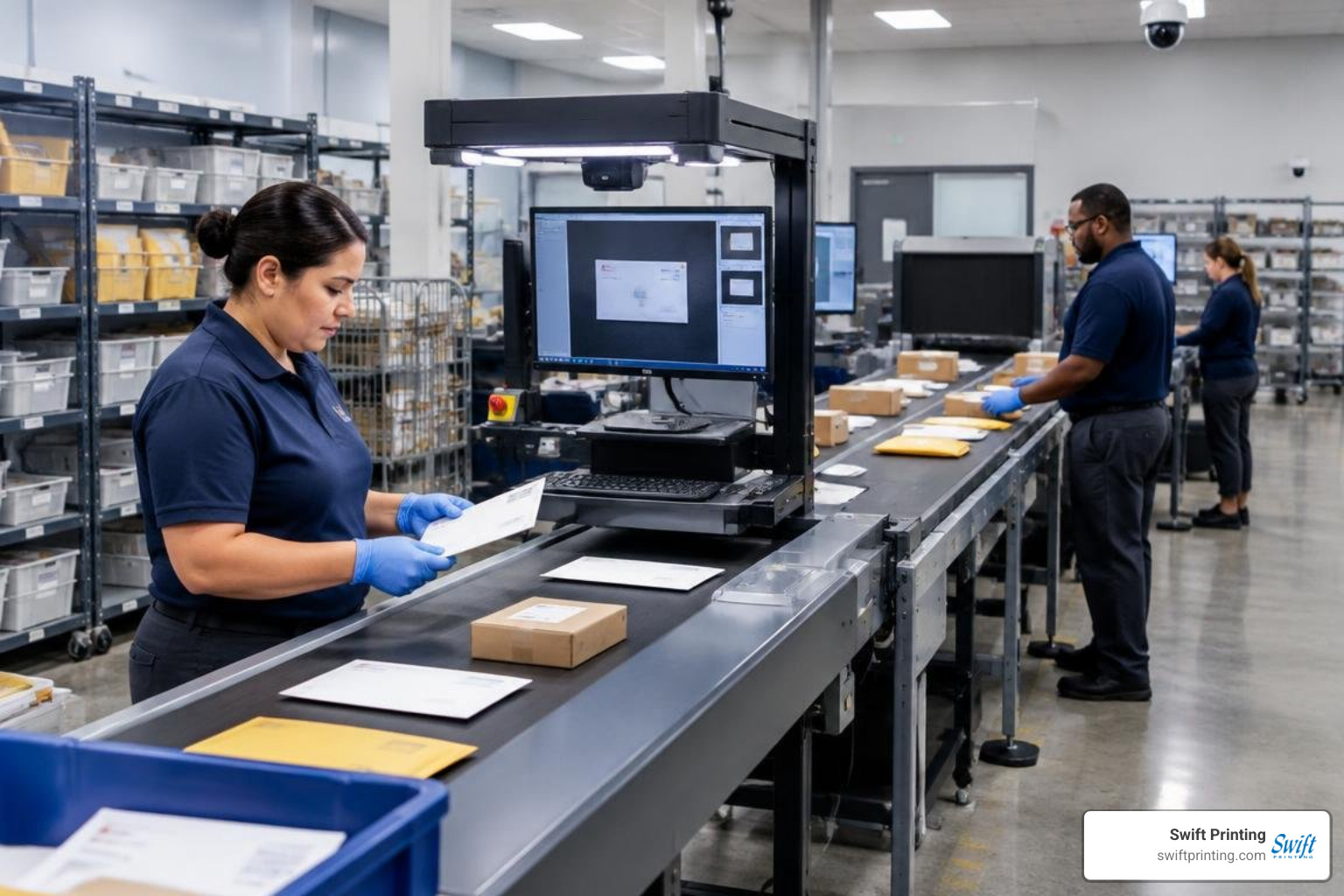
For organizations handling privileged records, operational security is non-negotiable. Law firms, healthcare groups, and financial consultancies must ensure that sensitive client records remain protected throughout every stage of physical handling and digital transmission.
Document Scanning, Consolidation, and Secure Shredding
A robust service platform should streamline physical mail volume while preserving critical records:
- Optical Character Recognition (OCR): Advanced platforms run OCR on scanned correspondence, turning static images into text-searchable files that integrate smoothly with cloud document repositories.
- Package Consolidation: When multiple packages arrive across various business days, intake teams can repackage items into a single consolidated container, reducing dimensional parcel volume and shipping overhead.
- Certified Destruction: Unneeded physical files, sensitive records, and marketing mail can be processed through commercial on-site shredding protocols with documented disposal logs.
Compliance, Privacy Standards, and Data Protection
Maintaining client confidentiality requires documented technical safeguards. When assessing potential vendors, verify their security credentials:
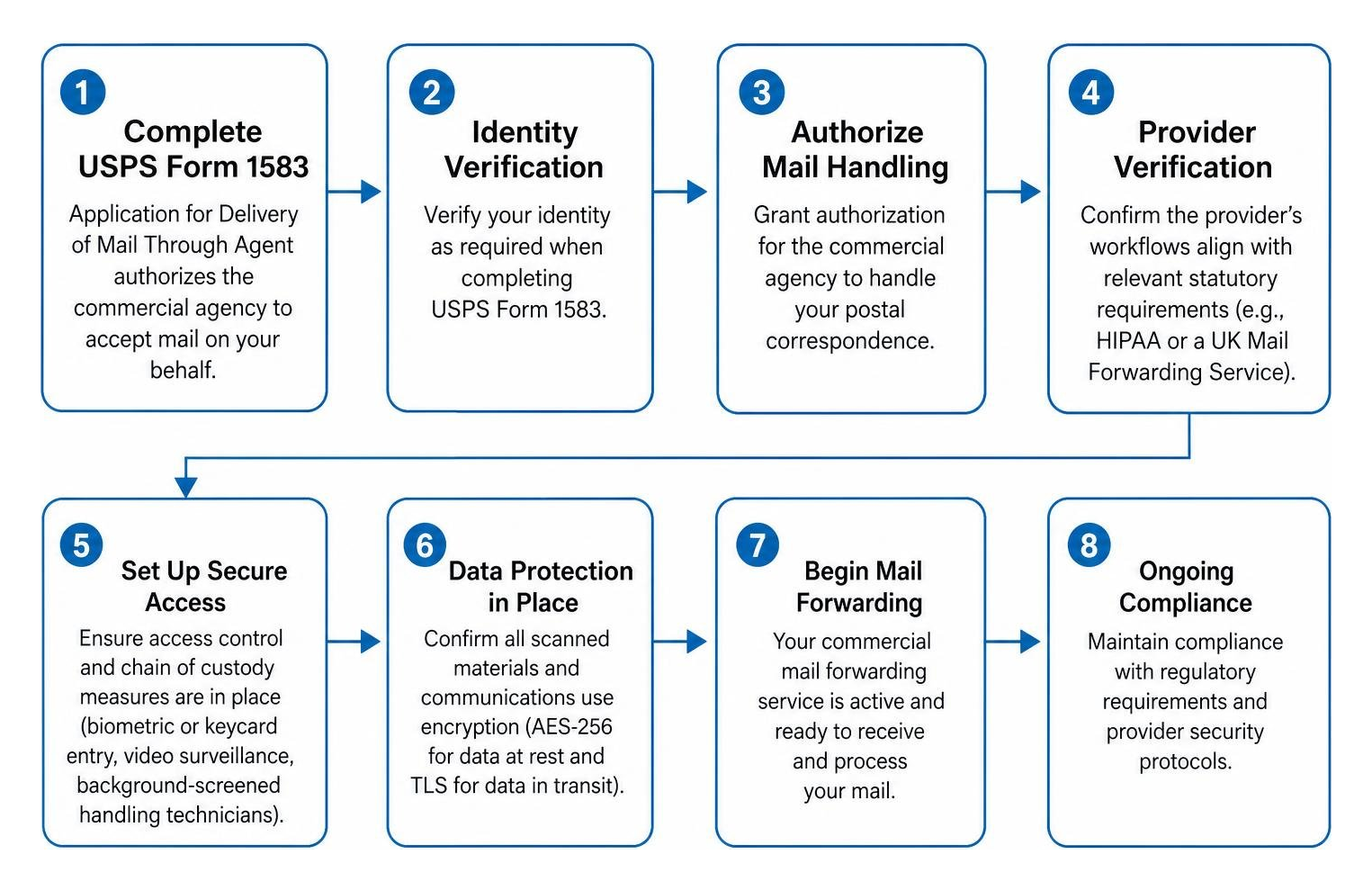
- Access Control & Chain of Custody: Intake processing rooms should require biometric or keycard entry, continuous video surveillance, and background-screened handling technicians.
- Data Encryption: All scanned materials, administrative dashboards, and client communications must use modern encryption standards (such as AES-256 for data at rest and TLS for data in transit).
- Regulatory Compliance: Ensure the provider's workflows align with relevant statutory requirements, such as HIPAA standards for medical records or statutory frameworks like a UK Mail Forwarding Service when operating international entities.
How to Set Up Mail Forwarding and Navigate Legal Requirements
Establishing a commercial forwarding workflow requires specific regulatory steps to authorize the receiving facility to handle your postal stream.
Completing USPS Form 1583 and Identity Verification
Under federal regulations, every individual or commercial entity establishing a virtual mailbox must complete USPS Form 1583 (Application for Delivery of Mail Through Agent). This document authorizes the commercial agency to accept mail on your behalf.
To successfully execute Form 1583:
- Complete Business Details: Identify your corporate entity, primary operating address, and the specific suite address assigned by your service provider.
- Provide Acceptable Identification: You must submit two forms of valid identification, with at least one containing a clear photograph (such as a state driver's license, passport, or corporate identification card) and one confirming physical address (such as a utility bill, deed, or voter registration).
- Complete Notarization: Form 1583 must be signed in the presence of a licensed notary public. Most top-tier providers now offer online remote notarization, allowing you to complete identity verification digitally in under thirty minutes.
- Implement Best Practices: Review essential mailers best practices & ways to keep the USPS happy to ensure standard formatting on all inbound filings.
International Shipping Regulations and Address Standards
For multi-regional organizations, distributing physical correspondence across borders requires careful attention to customs protocols:
- Customs Documentation: Packages containing commercial goods, tangible assets, or legal instruments crossing international boundaries require accurate customs declarations and commercial invoices.
- Standardized Labeling: International transit demands flawless layout accuracy. Double-check proper address formatting to eliminate misrouting, carrier delays, and returned shipments.
- Restricted Materials: Ensure internal teams understand export control classifications, as forwarding facilities will not transport hazardous materials, currency, or perishable items overseas.
Comparing Solutions: Finding the Best Fit for Your Organization

Finding the right operational match depends on your organizational structure, mail volume, and specific compliance requirements.
Service Models and Operational Workflows
Evaluate how a provider's operational tiers align with your organizational scale:
- Administrative & Legal Support: High-volume practices need instant scan-to-cloud integrations, priority notification triggers, and dedicated handling staff for urgent correspondence.
- Logistics Coordination: Organizations that routinely move physical product samples, bulk marketing proofs, or physical portfolios should ensure their forwarding platform connects directly with a full-service shipping and mailing service.
- Workflow Integration: Look for platforms that allow multiple department heads to triage, tag, and route inbound mail items directly to responsible practice groups.
| Requirement | Virtual Commercial Mailbox | Hybrid Office Suite | Dedicated Freight Forwarder |
|---|---|---|---|
| Primary Focus | Daily document digitization | Physical meeting space + mail | Heavy freight & bulk cargo |
| Scanning Speed | Same-day digital indexing | Next-day or weekly processing | Minimal or exterior scan only |
| Physical Storage | Secure short-term vaulting | On-site reception holding | Warehouse pallet storage |
| Best Suited For | Professional service firms | Regional satellite offices | E-commerce distribution |
Specialized Use Cases for Law Firms, Medical Practices, and Remote Teams
- Legal Practices: Attorneys use commercial mail services to secure a stable business presence across multiple jurisdictions, manage court notices instantly, and maintain strict attorney-client privilege.
- Medical & Healthcare Consultancies: Specialized practices rely on secure scanning workflows to process administrative notices, insurance correspondence, and patient records without physical mail sorting delays.
- Distributed Executive Teams: Remote organizations and traveling partners maintain central operational continuity, ensuring vital corporate filings and board communications are reviewed in real time from any location.
Frequently Asked Questions About Mail Forwarding
What types of mail or packages cannot be forwarded?
Commercial receiving facilities adhere to strict postal and freight regulations. The following items cannot be accepted or forwarded:
- Hazardous materials, flammable liquids, and pressurized containers.
- Perishable food items or biological specimens requiring temperature control.
- Uncertified cash, currency equivalents, or negotiable bearer instruments.
- Items restricted by federal aviation or export control regulations.
Can a virtual mailbox address be used as a legal business address?
In most jurisdictions, a commercial street address provided by a licensed CMRA can serve as your official corporate mailing address, public contact address, and billing address for corporate banking. However, regulatory requirements vary by state for statutory Registered Agent roles and physical domicile determinations. Always consult your legal counsel regarding specific state corporate filing rules.
Conclusion
A well-chosen mail forwarding platform brings order, speed, and security to your inbound correspondence. By combining real-time digital access with professional physical handling, your team can review critical notices immediately, eliminate office clutter, and maintain seamless business operations from anywhere.
When your business correspondence requires professional outbound communications, high-impact presentation materials, or direct customer outreach, Swift Printing is here to assist. As a premier boutique commercial printer, we set the standard for quality, precision, and reliable execution. Whether you are coordinating high-volume corporate mailers or aligning your ongoing office operations with a USPS hold mail service, our team ensures your printed materials reflect the highest standards of professional excellence.