By Swift Printing Company: West Michigan’s trusted print partner since 1950
Walk into any West Michigan business, scroll through a nonprofit website, or open a fundraising newsletter, and you’ll likely see a familiar sight, smiling strangers shaking hands under bright office lights or volunteers with perfectly staged food drives.
There’s just one problem.
None of those people actually work for you.
For years, stock photography has been the swift fix for brands that needed polished visuals fast. But in 2025, audiences are craving authenticity more than perfection and stock photos are falling flat. Whether you’re creating a printed annual appeal, updating your business cards, or designing banners for your next event, using real photos can make or break the connection you build with your audience.
Let’s look at why it’s time to ditch stock images for good, and how your own photography, even taken on a smartphone, can transform the impact of your print materials and online brand.

Pictured is me and my ol’ ABWA pal. You can tell we are really happy to see each other and that emotion comes through, even if the photo is clearly dated in style and quality.
1. Authenticity Builds Trust
People can spot a stock photo a mile away. It’s not just the lighting or the perfectly diverse office team high-fiving in formation, it’s that the emotion feels rehearsed.
When donors, customers, or community partners see your people, your staff, your volunteers, your real spaces, they feel an instant sense of trust. That authenticity is gold in marketing and fundraising.
According to several nonprofit research studies, campaigns featuring real imagery from within the organization receive significantly higher engagement and donation response rates. Why? Because people want to see who their dollars support and where the impact happens.
When it comes to business printing in West Michigan, a genuine image can elevate a simple brochure or postcard into something that truly connects.
2. Your Brand Story Deserves to Be Told, Not Borrowed
Every business and nonprofit has its own story, the one that can’t be duplicated or bought from a stock image library.
Think about your annual appeal letters, newsletters, or promotional mailers. These pieces work best when they show your mission in motion. Your team handing out meals. Your volunteers setting up tents. Your customers proudly displaying your printed materials in their shops.
When your audience can see themselves reflected in your story, they’re far more likely to respond, share, and support.
Pro Tip: Marketers and Communication professionals, not everyone likes their photos taken. It’s best to always ask if it’s OK to take someones photo, even if you miss the shot. Photo’s taken without consent cans invoke many emotions. Even if you organization has a policy that folks automatically consent to such things, I still think asking is always the best thing to do.
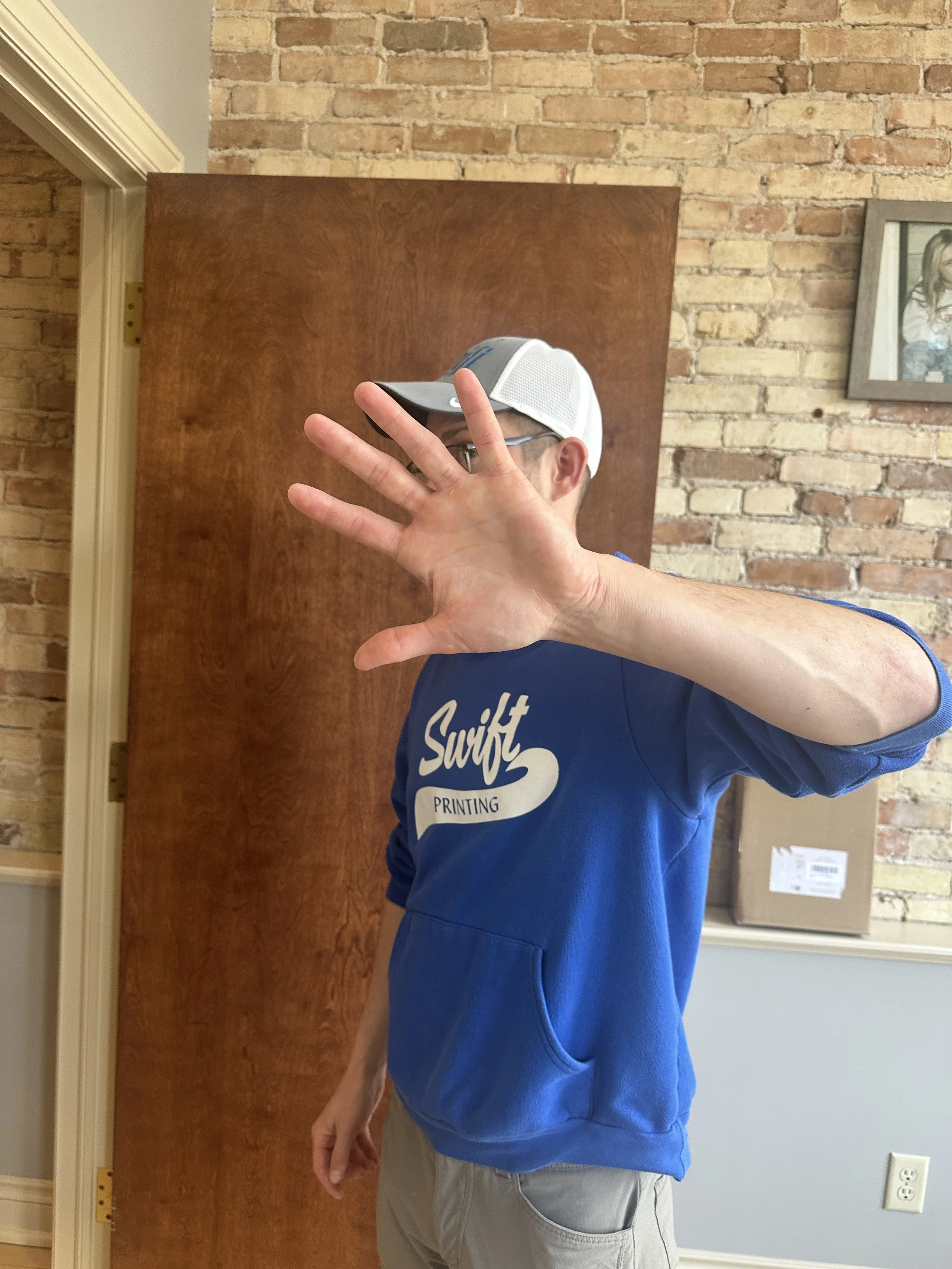
Our team and family all have different opinions on if they want to be included in our social media and print. Here’s Walt posing for me as “do not take my photo.”
3. Stock Photos Dilute Local Connection
West Michigan audiences, from Grand Rapids to Rockford to Holland, take pride in supporting local. That pride extends to the businesses and nonprofits they choose to work with.
Using stock photos from a corporate library in another state (or country) can unintentionally send the wrong message. It tells your audience that your visuals could belong to anyone, anywhere.
But when you feature photos from recognizable local spaces, the Grand River skyline, your team volunteering at a Cannon Township event, or your storefront on Bridge Street, you strengthen that hometown bond. Your marketing feels personal, grounded, and real.
At Swift Printing, we often see clients’ campaigns look really sharpe because they used local imagery instead of generic content. People notice.
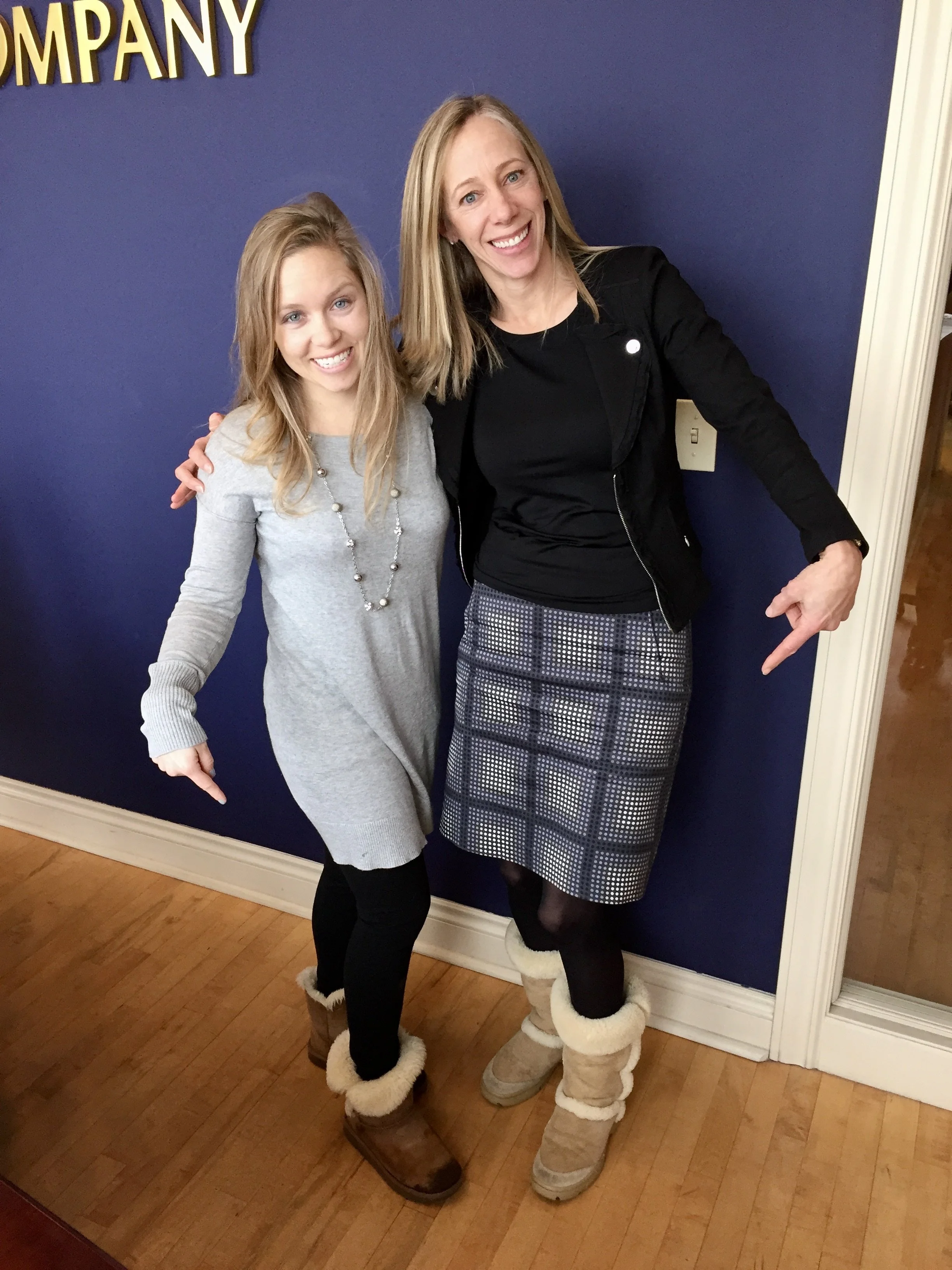
Look for moments for any and all photo opportunities. (but also, take the social cues!) Pictured is our old Xerox rep Stephanie. We both had fur Ugg boots on and posed together.
4. Real Images Increase Engagement Online and in Print
When you send out your quarterly newsletter or annual appeal, the first thing readers notice isn’t the text, it’s the photos.
Whether printed on 100# gloss cover or featured in your digital PDF, high-quality original photography makes your piece come alive. Studies show that donors spend 60% more time reading materials with authentic visuals compared to those using stock photos.
If you’re investing in printing in West Michigan, from direct mail to event signage, don’t undermine your message with imagery that doesn’t represent who you are.
Pro Tip: You also have to make sure it’s relevant to your industry. How many skyline logos have you seen where the business doesn’t match the artwork at all? There’s an art to getting it right.
5. You Own the Rights (and the Reputation)
One overlooked risk of using stock images? You don’t truly own them. Even royalty-free photos come with fine print: limited licenses, no exclusivity, and the risk that the same “employee team” photo appears on another company’s billboard down the road.
Using your own images not only protects your brand but also gives you full control over where and how your visuals are used across your brochures, flyers, postcards, and social media.
For nonprofits, this also eliminates concerns about depicting “generic” acts of service rather than the real people impacted by your mission.
6. Photography Is More Accessible Than Ever
The excuse that professional photography is too expensive doesn’t hold much weight anymore. Today’s smartphones are capable of stunning, print-ready images.
With a few simple lighting and composition tricks (we’ll share some below!), even a small nonprofit or family-owned business can produce high-quality visuals good enough for print or digital use.
At Swift Printing, we can even help color-correct and prepare your photos to look their best on press.
Pro Tip: A bad photo is a bad photo, if the images are really dark, blurry or cropped poorly don’t use it, but I’d always opt for no photo over a stock image. What do you think? Send me a message at Jes@swiftprinting.com
7. Real Photos Strengthen Every Type of Print Material
Here’s where authentic imagery shines:
Annual appeals – Feature real stories and faces of your staff or those you serve.
Newsletters – Use event photos, candid shots, and behind-the-scenes moments.
Brochures – Highlight your team at work, not actors pretending to be them.
Post Cards – Personalize your design with subtle brand imagery or your actual workspace.
Event signage and banners – Use original photography that ties back to your location or community.
When those pieces are printed with premium printers and the right paper finish, they don’t just look professional, they feel genuine.
8. It’s Easier to Build a Consistent Brand Look
Stock photos often vary in tone, color palette, and lighting. When you mix them, your marketing materials can start to feel disjointed.
Creating your own photo library ensures that your visuals stay on brand, same lighting, same mood, same sense of place.
Pro tip: organize your images by category (events, staff, community, products) and resolution, so they’re easy to find and ready for both print and web. I know it’s a pain to rename photos. I dislike this very much. It takes a lot of time, but how much time does it take to look for an image later on. Was it in April 2023? Or was it July 2020. I too need to take my own advice more on properly labeling. I find it best when you set a formula for naming something. For example, one of my favorite mentor’s Lorrie Walker taught me to label documents Year_Month_Relivant topic(s) and I try to always follow that format for easy search-ability.
Also, you want fast loading (low resolution) for the internet and high resolution for print. Keeping two copies can be a challenge. What tips do you have for organizing those photos best?
9. Real Photography Helps Your SEO, Too
Authentic imagery isn’t just a creative decision, it’s a strategic one. Google favors original content, including visuals. When your photos are unique and properly tagged with local SEO terms (like “Swift Printing team in Grand Rapids” or “nonprofit printing in West Michigan”), it boosts your search visibility.
Pair those photos with locally focused blog posts, annual report PDFs, or press releases, and you’ll see stronger organic traffic over time.
10. It’s Simply More Fun
Let’s be honest, photo days are fun. (For some of us, that is!) Whether you’re capturing your team behind the presses, celebrating a project launch, or laughing over coffee in the break room, these moments tell your story in ways stock photos never could.
And for your audience, seeing those smiles makes you approachable. Real humans doing real work, that’s what people connect with most.
10 Tips for Better Photos (Even Without a Pro)
You don’t need a photography degree or studio lighting to create standout photos for your annual appeal, newsletter, or brochure. Try these 10 tips:
Find natural light.
Window light is your best friend. Avoid harsh overhead lighting whenever possible.Face the light, don’t fight it.
Position your subject toward the light source to eliminate dark shadows.Avoid cluttered backgrounds.
A clean, simple backdrop keeps the focus on your people or product.Use consistent angles.
Capture eye-level shots for people, slightly higher angles for flat-lay products or printed pieces.Get candid moments.
Real smiles beat posed ones every time. Encourage laughter, movement, and conversation.Keep your branding in frame.
Include subtle details: your logo on a shirt, a banner in the background, or your storefront sign.Mind your color palette.
Coordinate outfits and backgrounds to match your brand colors for a cohesive look in print.Take more photos than you think you need.
Lighting shifts quickly. Snap 10 versions of each shot — you’ll thank yourself later.Edit lightly.
Adjust brightness and contrast, but don’t over-filter. You want authentic, not airbrushed.Save at high resolution for print.
Use at least 300 DPI for anything being printed, whether postcards, posters, or your annual appeal booklet.
How Swift Printing Can Help
At Swift Printing, we’ve worked with hundreds of West Michigan businesses and nonprofits to turn authentic imagery into stunning, effective print campaigns.
From annual appeal printing to custom newsletters, postcards, banners, and brochures, our team can help you:
Optimize your photos for clarity and color accuracy.
Design layouts that showcase your images beautifully.
Ensure consistent branding across all touchpoints.
Because at the end of the day, your story is too good to borrow, and too important not to share.
Pro tip: If you have a budget, always hire a professional photographer if you can. It’s a balancing act. I know it’s a paradox. Sure you can’t book one for every event and cause, but special milestones, like 75th Anniversaries can capture moments that can be shared for years. ;)
The Takeaway
Stock photos might seem convenient, but they can’t capture the heart of your work, your people, your impact, your community. Whether you’re a growing business in Grand Rapids or a nonprofit serving Kent County, your visuals should be as unique as your mission.
When you invest in authentic imagery and high-quality printing, you don’t just create marketing materials, you create trust.
So next time you’re tempted to grab a stock image, remember: the best picture for your business is the one you take yourself. (or a professional does!)