What Is the Format of a Postal Code?

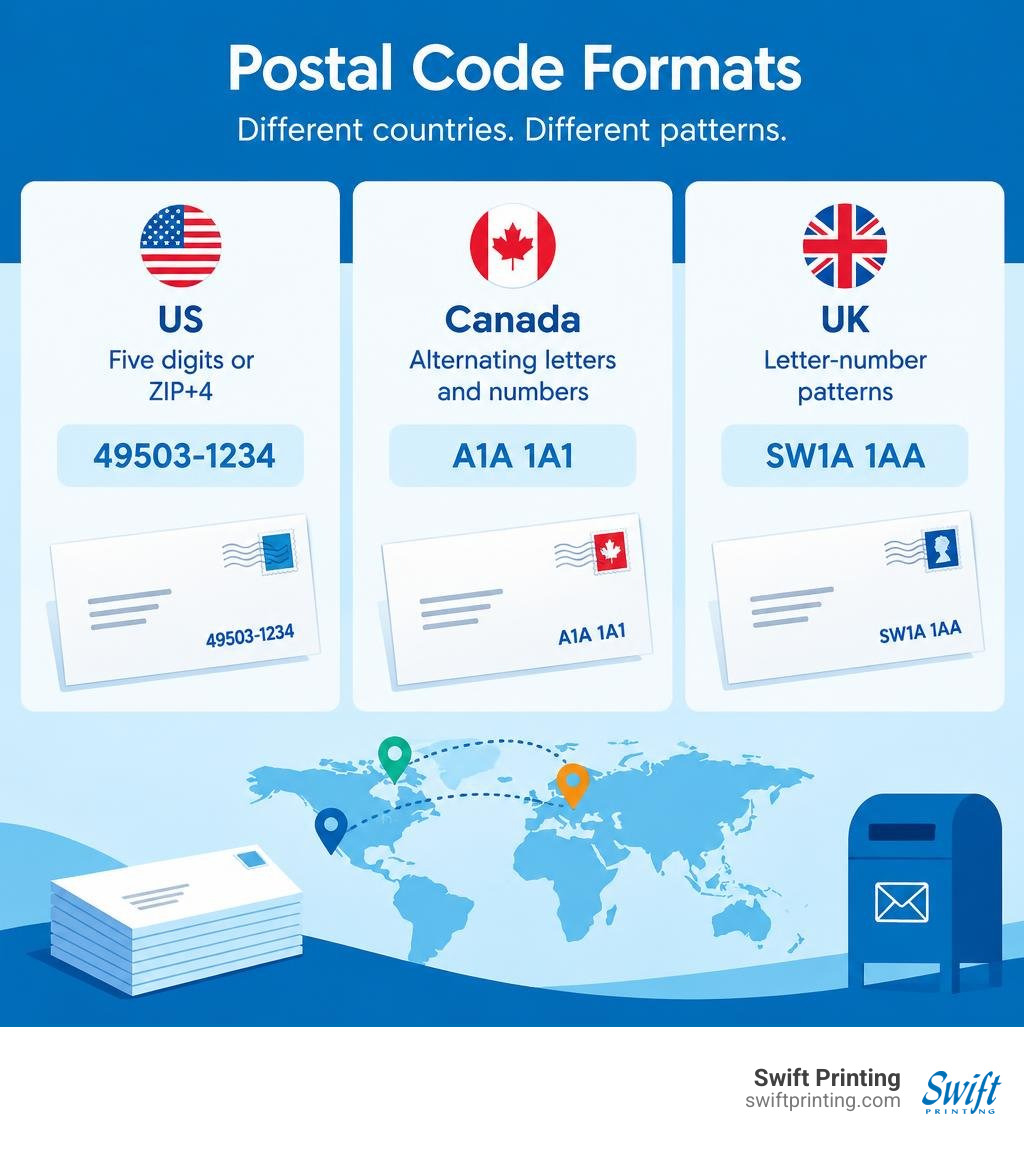
The format of a postal code depends on the destination country. A US ZIP code has five digits, with an optional four-digit extension, such as 49503-1234. Canada uses alternating letters and numbers, such as A1A 1A1, while the UK uses several letter-and-number patterns. There is no single worldwide format. For a clean mailing list, check each code against its country’s rules and store it as text so leading zeros stay in place.
I’m Jessica Gutowski-Slaydon, president of Swift Printing, where I help organizations plan boutique-quality print and direct mail projects. My hands-on work with mailing lists and postal preparation has shown me why the format of postal code data matters before a mailing goes to print.
Understanding the Core Format of Postal Code Systems Worldwide
Postal code systems serve as the navigational backbone for global logistics. Every domestic and international postal service relies on standardized alphanumeric or numeric strings to translate physical geography into machine-readable routing instructions. When mail pieces enter high-speed automated sorting equipment, optical character readers scan the address line to decipher the destination territory, distribution facility, and final delivery route.
Without consistent coding frameworks, postal logistics networks would grind to a halt under manual sorting overhead. To streamline international distribution, global guidelines developed by the Universal Postal Union help harmonize how sovereign nations define their routing notations. Understanding how these geographic sorting codes work ensures your mail pieces reach their intended recipients without friction or delay.
How Postal Codes Differ from US ZIP Codes
While the terms are frequently used interchangeably in conversation, a ZIP code is simply the trademarked domestic implementation of a postal code within the United States. The generic term "postal code" encompasses every national routing framework on Earth, ranging from simple numeric markers to intricate multi-part strings.
The United States Postal Service introduced the Zone Improvement Plan (ZIP) code in 1963 to manage surging post-war mail volumes through automated processing. The system partitioned the nation into designated geographic sectors to accelerate mail flow. When preparing international mailings or reviewing global guidelines outlined in official Postal Addressing Systems documentation, you will find that different postal authorities adopt distinct conventions for assigning delivery points and routing sectors.
Numeric vs. Alphanumeric Postal Code Systems
National postal administrations generally adopt either purely numeric systems or alphanumeric structures. The choice impacts how finely a postal code can pinpoint a delivery location:
- Numeric Systems: Use fixed-length strings of digits (commonly 4 to 6 numbers). Numeric codes are straightforward to key and validate on physical machinery, but their geographic capacity is constrained by total numerical combinations.
- Alphanumeric Systems: Combine letters and numbers to achieve massive permutation capacity within relatively short character counts. Systems in nations like the United Kingdom, Canada, and the Netherlands can identify distinct street segments, large corporate complexes, or even single residential addresses.
To prevent sorting errors, alphanumeric systems intentionally omit letters that look similar to numbers on low-resolution sorting cameras. For instance, postal authorities frequently prohibit the characters D, F, I, O, Q, and U to prevent confusion with numerals like 0, 1, or 8.
| Country | Code Name | Format Pattern | Example | Granularity Level |
|---|---|---|---|---|
| United States | ZIP / ZIP+4 | 5 digits (or 5+4) | 49503 or 49503-1234 | Facility / Delivery Segment |
| Canada | Postal Code | ANA NAN | M5V 2T6 | Forward Sortation Area / Street |
| United Kingdom | Postcode | AN NAA to AANN NAA | SW1A 1AA | Sector / Unit (Property Cluster) |
| Germany | Postleitzahl (PLZ) | 5 digits | 10115 | Region / Delivery District |
| India | PIN Code | 6 digits | 110001 | Zone / Local Post Office |
| Netherlands | Postcode | 4 digits + 2 letters | 1012 AB | Street Segment / House Range |
Comparing Postal Code Structures: US ZIP vs. International Systems
Executing accurate mailings requires recognizing how different jurisdictions structure their delivery data. When mail operations cross borders, adhering to regional address conventions prevents costly misrouting.
Anatomy and Format of a Postal Code in the United States
The standard domestic system relies on the five-digit ZIP code established in 1963, enhanced by the nine-digit ZIP+4 system introduced in 1983. Each numeral in a US postal code provides hierarchical routing instructions:
- First Digit: Identifies a broad group of US states or territories, moving sequentially from 0 in the Northeast toward 9 on the West Coast.
- Second and Third Digits: Designate the Sectional Center Facility (SCF), the central mail processing hub for a specific metropolitan or regional zone.
- Fourth and Fifth Digits: Identify the local post office, delivery station, or specific carrier branch serving the destination neighborhood.
- ZIP+4 Extension (The Add-On): Represents a specific delivery segment, such as a city block, a high-rise office suite, an apartment complex floor, or a dedicated post office box tray.
Following established mailers best practices to keep the USPS happy ensures that high-volume direct mail moves cleanly through processing facilities.
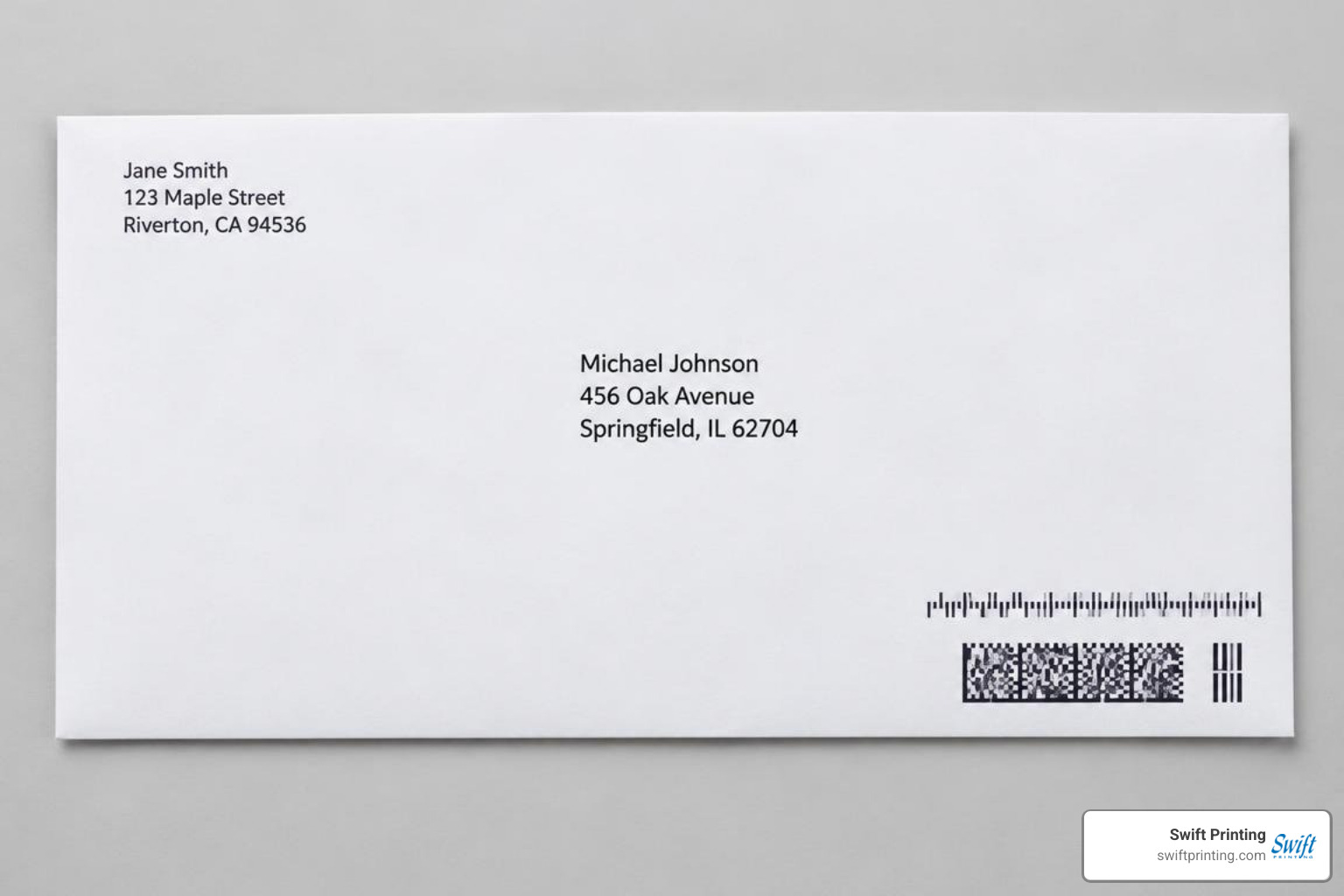
The Alphanumeric Format of Postal Code Structures in Canada and the UK
Alphanumeric formats offer enhanced precision through segmented geographic coding:
- Canada: Uses a six-character string formatted as
ANA NAN(where A is a letter and N is a number). The first three characters represent the Forward Sortation Area (FSA), identifying a major urban zone or rural territory. The final three characters represent the Local Delivery Unit (LDU), specifying particular street blocks or commercial buildings. - United Kingdom: Employs an Outward Code and an Inward Code separated by a space (such as
SW1A 1AA). The Outward Code routes the piece to the regional sorting office, while the Inward Code routes it down to small clusters of approximately fifteen properties. - The Netherlands: Utilizes a four-digit, two-letter format (
NNNN AA). When paired with a specific street number, the Dutch postcode functions as a unique coordinate identifier.
You can explore comprehensive global coding patterns in the List of postal codes to maintain proper address formatting across international mailing lists.
Countries and Territories Operating Without Postal Codes
Not all sovereign nations use postal code infrastructures. Countries such as Angola, the Bahamas, Fiji, and the United Arab Emirates operate without traditional postal codes. In these regions, physical mail distribution relies on named post office boxes, neighborhood descriptions, building names, or centralized administrative collection points.
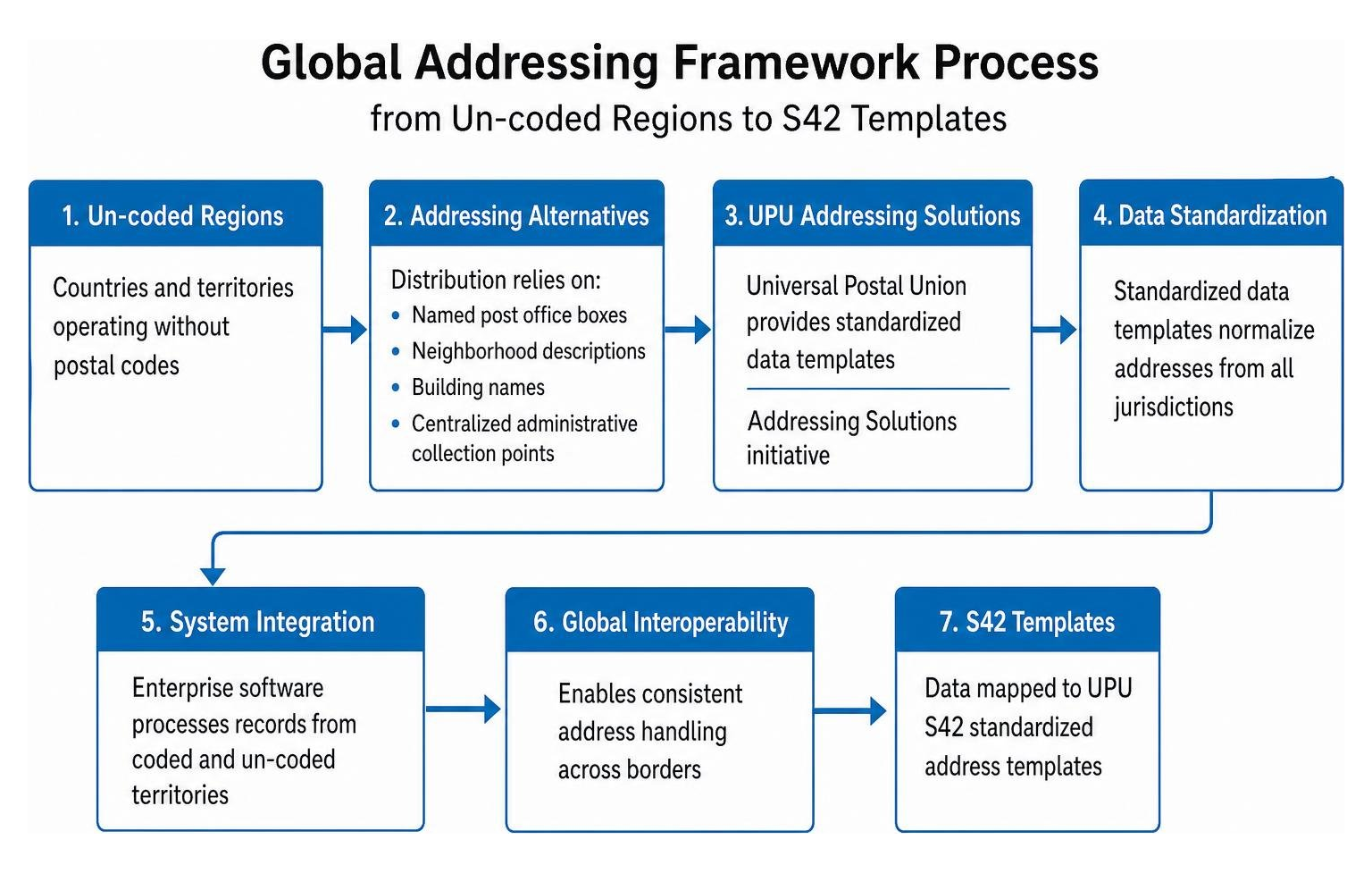
To support global interoperability, the Universal Postal Union provides standardized data templates through its Addressing Solutions initiative, allowing enterprise software to process records from territories lacking conventional postal systems.
Address Cleansing and Technical Validation for Enterprise Mailings
Maintaining clean address records is essential for law firms, medical centers, professional service practices, and government entities that distribute sensitive or high-volume mailings. Data hygiene issues can disrupt communication pipelines, produce delayed notices, and compromise professional presentation.
Regex Patterns and Data Normalization for Database Records
Developers and database administrators rely on regular expressions (regex) to validate user input and standardize mailing lists. Standard validation patterns include:
- United States (5-digit or ZIP+4):
^\d{5}(-\d{4})?$ - Canada:
^[A-CEGHJ-NPR-TV-Z]\d[A-CEGHJ-NPR-TV-Z][ ]?\d[A-CEGHJ-NPR-TV-Z]\d$ - United Kingdom:
^[A-Z]{1,2}\d[A-Z\d]?\s?\d[A-Z]{2}$ - Germany:
^\d{5}$
Spreadsheet software frequently strips leading zeros from postal codes when columns default to numeric formatting. To preserve data integrity, format postal code columns as plain text before importing or exporting contact lists, as detailed in our guide on how to format addresses in Excel or Google Sheets for a mailer.
Postal Hygiene, NCOA, and Enterprise Logistics
Professional direct mail operations run address lists through rigorous data cleansing steps before printing:

- CASS (Coding Accuracy Support System): Verifies that street addresses and postal codes match official USPS address records, assigning accurate ZIP+4 codes and delivery point barcodes.
- NCOA (National Change of Address): Cross-references recipient records against the official USPS database of permanent change-of-address filings, updating outdated records automatically.
- De-duplication and Normalization: Removes duplicate records and standardizes abbreviations (such as St, Ave, or Ste) to optimize high-speed optical scanning.
Applying these processes through dedicated full-service mailing services prevents Undeliverable As Addressed (UAA) mail pieces and protects organizational communications.
Frequently Asked Questions About Postal Code Formatting
What is the standard format of a postal code in the United States?
The baseline format for a US postal code is a five-digit numeric string (such as 49503). To increase routing precision down to a specific block, building, or post office box, mailers use the ZIP+4 format, which appends a hyphen and four additional numbers (such as 49503-1234).
Why do some countries use letters in their postal codes?
Nations use alphanumeric systems to expand the number of unique routing combinations within a compact string. This allows postal authorities to route mail down to small property clusters, specific streets, or individual enterprise high-rises.
How do leading zeros affect postal code validation in spreadsheets?
Spreadsheet software often misinterprets postal codes as mathematical numbers rather than text strings, automatically dropping leading zeros (turning 01234 into 1234). Setting the column data type to "Text" prior to importing or entering address records preserves necessary leading zeros.
Conclusion
Understanding the structure and requirements of postal codes ensures your physical communications arrive accurately, predictably, and professionally. Whether you are managing domestic mailings across West Michigan or preparing international mail, maintaining strict data hygiene protects your organization's reputation and operational workflow.
At Swift Printing, we understand that precision matters for law offices, medical practices, corporate consulting firms, and public agencies. Swift is a high end print shop setting the standard for printing in the boutique business, providing personalized support, dependable execution, and seamless mailing workflows. When you are ready to prepare your next outreach, explore our step-by-step guide on formatting a spreadsheet for a mailing to ensure your data is print-ready from the start.