Best Places to Order Ultra Thick 16 Pt Cardstock
Where to Order Ultra-Thick 16 Pt Cardstock

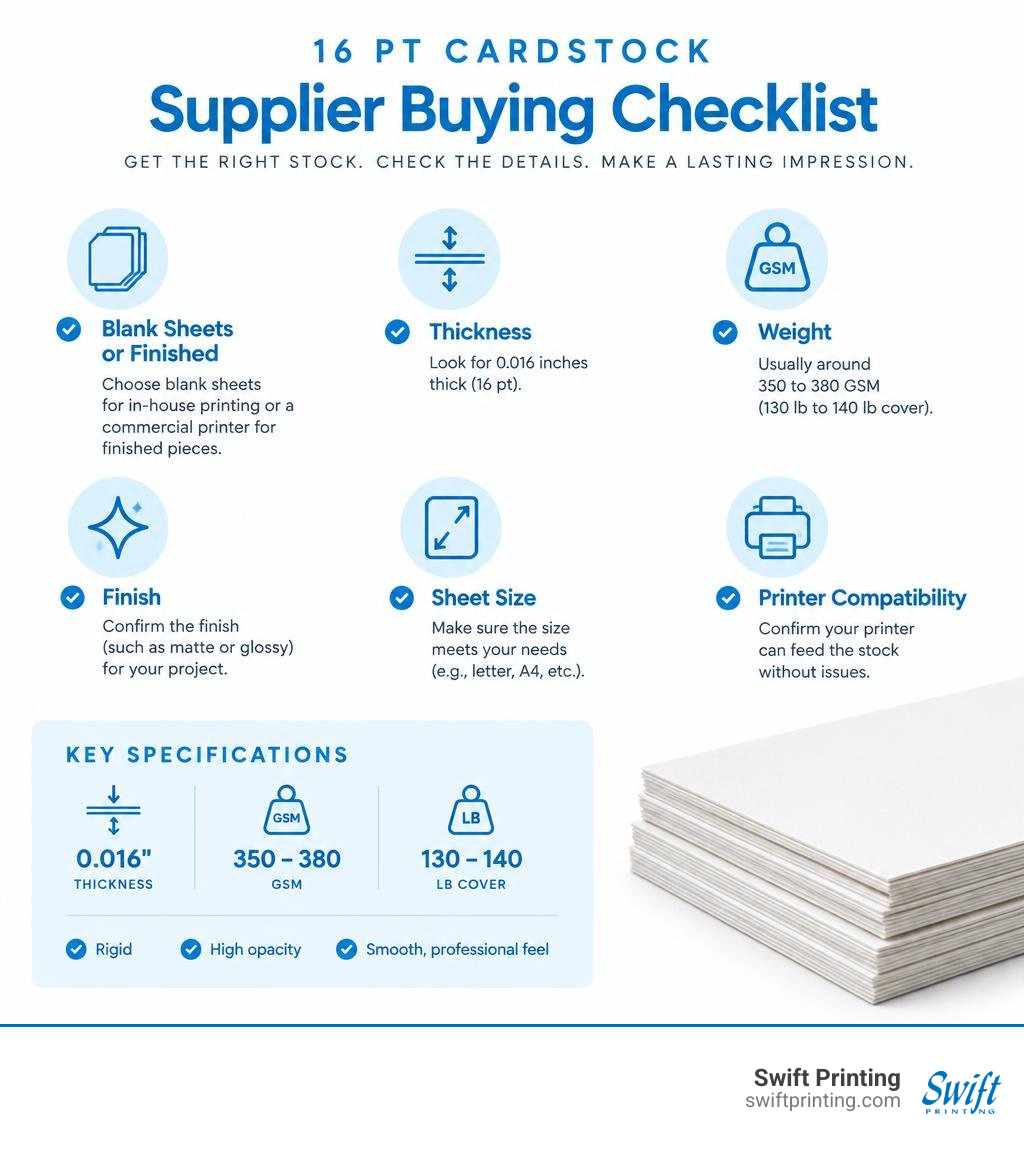
For ultra-thick 16 pt cardstock, start by choosing between blank sheets for in-house printing and a commercial printer for finished cards, invitations, folders, or mailers. Look for stock listed as 0.016 inches thick, usually around 350 to 380 GSM or 130 lb to 140 lb cover. Before ordering, confirm the finish, sheet size, quantity, and whether your printer can feed the stock.
For most professional projects, a print shop is the safer option. Heavy sheets can exceed the limits of many home inkjet and laser printers, and scoring or folding them without cracks takes the right equipment. At Swift Printing, a high-end print shop, we help businesses, law firms, medical offices, consultants, nonprofits, and public agencies choose a thick stock that looks polished and holds up in the real world.
A 16 pt sheet gives business cards, presentation covers, premium invitations, and marketing pieces a noticeably firm feel. It costs more than lighter cover stock, but it can make an important first impression feel more intentional.
I am Jessica Gutowski-Slaydon, President of Swift Printing and a third-generation printing professional with hands-on experience selecting paper, coatings, and finishing for commercial projects. I help customers decide when 16 pt cardstock is the right fit for their budget, brand, deadline, and intended use.
Technical Specifications of 16 Pt Cardstock
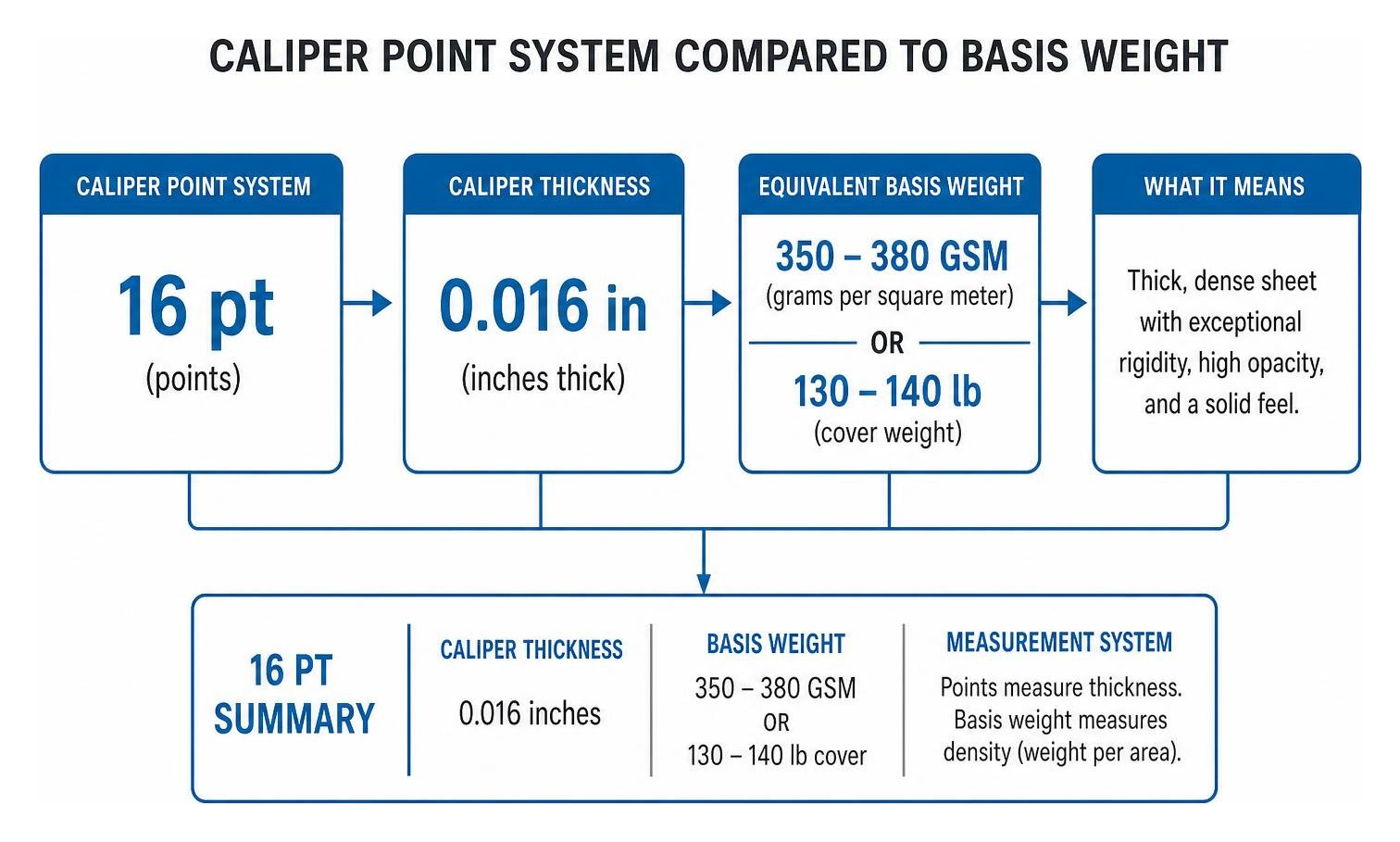
When we talk about paper thickness in commercial printing, "points" refer to caliper thickness. One point equals one-thousandth of an inch (0.001"). Therefore, a 16-point sheet measures exactly 0.016 inches thick. To put that in perspective, stacking three standard copper pennies together gives you a rough idea of how substantial a single sheet of this substrate feels in your hand.
In terms of weight equivalents, 16 pt paper generally aligns with 350 to 380 GSM (grams per square meter) and converts to roughly 130 lb to 140 lb cover weight. The exact grammage depends on the paper mill, fiber density, and whether the sheet has added clay coatings. Because of this density, the sheet provides exceptional structural rigidity, high opacity with zero show-through, and a solid tactile presence that lighter stocks cannot match.
Understanding these measurements helps avoid confusion when comparing different mills. For an in-depth breakdown of caliper standards, you can review print industry specifications on paper caliper. Navigating these metrics gets much easier once you understand common commercial printing terms and how basis weights interact with raw thickness.
Comparing 16 Pt Cardstock to Standard Paper Weights
Selecting the right paper weight is about balancing durability, mailing costs, and the tactile message you want to send to your clients. A standard corporate postcard printed on flimsy paper can bend in transit, whereas heavy stock arrives crisp and unblemished.
The table below illustrates how 16 pt compares to other popular paper grades:
| Stock Type | Caliper (Inches) | Approx. GSM | Common Uses | Durability & Corporate Feel |
|---|---|---|---|---|
| 80 lb Cover | ~0.009" (9 pt) | 216 GSM | Booklet covers, light brochures | Flexible; bends easily under light pressure |
| 110 lb Index | ~0.009" (9.5 pt) | 199 GSM | Internal office forms, tab dividers | Utilitarian; low rigidity, prone to postal creasing |
| 14 pt Cardstock | 0.014" | 300 GSM | Standard business cards, rack cards | Good baseline durability; standard commercial grade |
| 16 Pt Cardstock | 0.016" | 350–380 GSM | Executive cards, luxury folders, invites | Exceptional stiffness; premium executive perception |
| 18 pt Cardstock | 0.018" | 400+ GSM | Heavy packaging, luxury hang tags | Rigid board feel; requires specialized cutting tools |
While 14 pt is a reliable standard for everyday corporate collateral, stepping up to 16 pt adds that unmistakable executive weight. It resists corner bending, withstands postal handling without tearing, and immediately sets a tone of stability and permanence.
Printer Feeder Limitations with 16 Pt Cardstock
A common question we hear from office administrators and marketing directors is whether they can run 16 pt paper through their internal office printers. While blank reams are available online, desktop machines frequently struggle with media of this thickness.
Standard desktop inkjets and office laser printers rely on curved internal paper paths with tight U-turns. Heavy 350 GSM sheets cannot make these bends without causing severe feed roller slippage, paper path jams, and internal gear grinding. Furthermore, laser printing relies on a fuser unit that uses heat and pressure to melt toner onto the page. Thick substrates absorb heat rapidly, often preventing the fuser from reaching the temperature required to bond toner securely. The result is flaking toner, smudged graphics, and uneven coverage.
Even when utilizing a manual rear-bypass tray, desktop feed rollers often fail to grip ultra-dense sheets consistently. If you need flawless consistency and rich solid colors on heavy substrates, utilizing dedicated digital short run printing ensures that calibrated production engines apply the exact heat, pressure, and vacuum feed required for heavy media.
Sourcing Ultra-Thick Stock: Sourcing Channels and Vendor Options
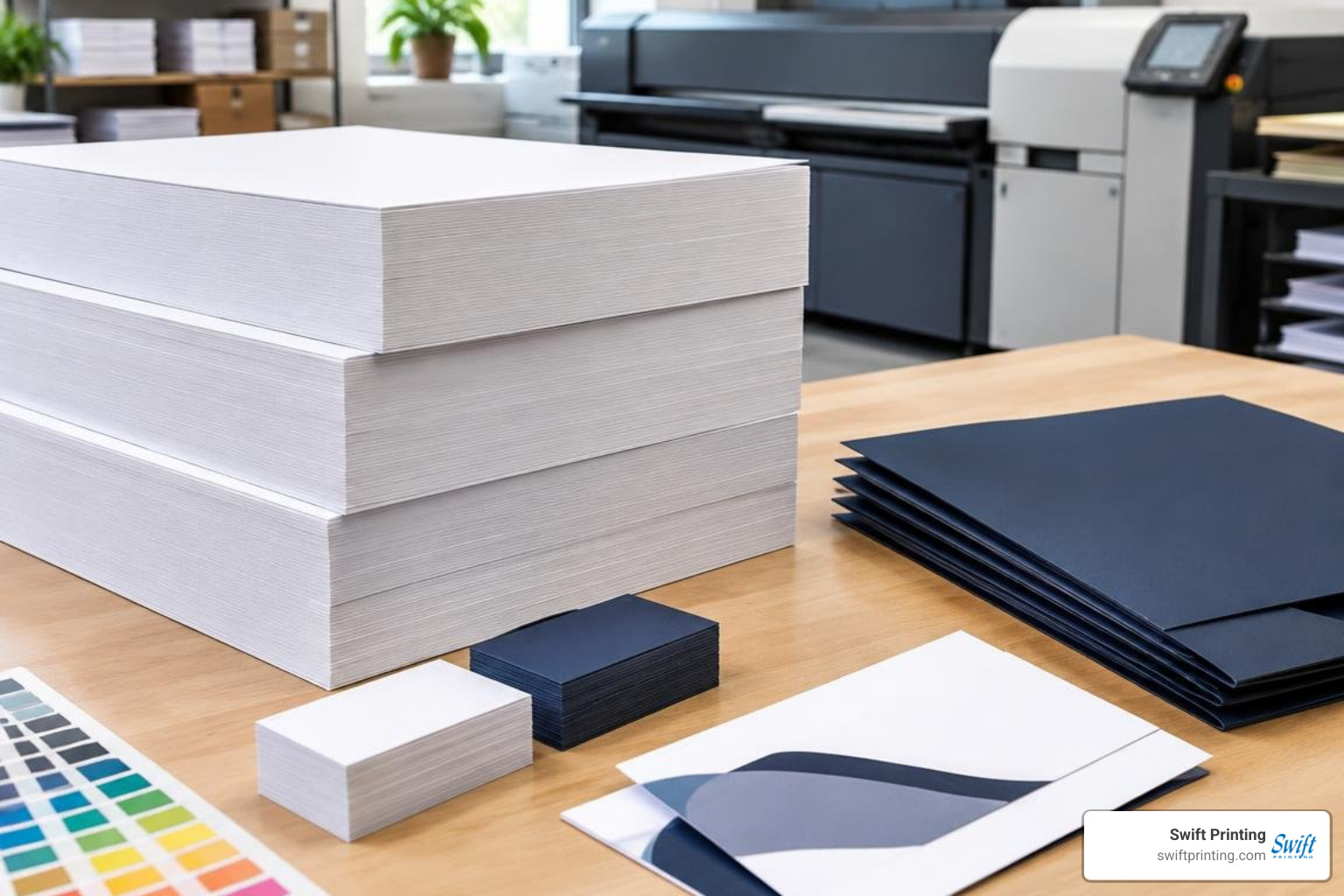
Depending on your production capacity and project goals, there are two primary paths for sourcing 16 pt materials: purchasing blank sheet stock for manual processing or partnering with a full-service commercial facility for finished production runs.
When evaluating vendors, look beyond the unit price. Consider sheet size tolerances, coating uniformity, carton packaging quality to prevent corner dings during transit, and overall lead times. High-volume e-commerce marketplaces carry broad options, but pricing models vary widely based on packaging tiers:
- Craft and Sample Packs (15 to 50 Sheets): Convenient for prototyping or small internal tests. A 15-pack of heavy cover stock generally costs around $6.95 ($0.46 per sheet), while a 50-sheet pack of 16 pt 350 GSM gloss runs around $28.95 ($0.58 per sheet).
- Standard Reams (100 to 250 Sheets): Better suited for small in-house specialty tasks, averaging $0.35 to $0.45 per sheet.
- Bulk Commercial Pallets (1,000+ Sheets): Sourced directly by production printers at wholesale rates, bringing down the base substrate cost while applying commercial-grade presses, trimming, and scoring.
Sourcing Blank Heavyweight Reams for In-House Production
If your facility operates heavy flatbed printers, die-cutters, or specialty craft machinery, sourcing blank sheets in standard 8.5" x 11" or 12" x 18" formats is an accessible route.
When purchasing blank inventory:
- Target 98 to 100 Brightness: Bright white uncoated or semi-gloss surfaces offer the dynamic contrast needed for high-resolution graphics and clear text readability.
- Confirm C1S vs. C2S: Ensure the stock is coated on the correct sides for your planned print process (Coated 1 Side for packaging or Coated 2 Sides for two-sided presentation pieces).
- Inspect Packaging Integrity: Ensure cartons feature reinforced edge protectors so heavy sheets arrive without corner crush or edge curl.
Sourcing Finished Commercial Collateral for Professional Services
For organizations that rely on exceptional presentation—such as law practices, wealth management consultants, healthcare networks, and public institutions—ordering finished materials from an experienced provider removes production risk.
Thick substrates require heavy-toner calibration, precision hydraulic trimming, and calibrated scoring rules. Outsourcing these runs ensures your presentation folders, doctor clinic overviews, and executive suites arrive flawlessly finished. For organizations across Michigan, our team provides full-service commercial printing in Grand Rapids, managing every step from pre-press file validation to final packaging.
Premium Surface Treatments and Protective Coatings

A heavy substrate serves as a sturdy canvas, but surface coatings define how the piece interacts with light and touch. Choosing the right coating protects the sheet from scuffs, enhances color saturation, and reinforces your brand’s visual identity.
- Double-Sided Gloss (C2S): A classic coating applied to both sides of the sheet. It reflects light, making vibrant photographic imagery and bold branding elements pop off the page.
- Matte / Satin Aqueous: A smooth, low-glare finish that softens lighting reflections. It delivers an understated look, making it a preferred choice for legal briefs, financial summaries, and corporate reports.
- Soft-Touch (Velvet) Lamination: This treatment applies a specialized tactile film that feels like smooth suede or velvet. It adds water resistance and a plush texture that commands attention during executive meetings.
- Spot UV Detailing: By pairing an overall matte or soft-touch background with high-gloss liquid UV cured over specific logos or typography, you create a striking contrast between matte and gloss textures.
Selecting the right finish depends on your distribution methods and how the piece will be used. You can explore our complete guide to finishing options for printing to match your design with the appropriate lamination or varnish.
Best Practices for Cutting, Scoring, and Folding Heavy Sheets
Working with 16 pt paper requires specialized finishing techniques. Because the paper fibers are dense and tightly bound, attempting to fold a heavy sheet by hand will crack the paper fibers and split the toner along the spine.

To ensure clean results, commercial binderies follow strict technical steps:
- Aligning with Grain Direction: Paper has a natural grain direction established during mill manufacturing. Folds must run parallel to the grain whenever possible to minimize internal stress on the fibers.
- Channel Scoring Before Folding: Thick stock must never be folded directly. A mechanical scoring blade presses the sheet into a matrix channel, creating an embossed hinge that stretches the outer fibers while compressing the inner ones smoothly.
- Hydraulic Trimming with Fresh Blades: Cutting through dense stacks of 350 GSM stock requires heavy hydraulic guillotine cutters equipped with sharp carbide blades to eliminate frayed edges or paper draw.
Careful file setup also plays a crucial role in preventing trimming errors on thick stock. Reviewing common print file mistakes to avoid will help you establish accurate bleed settings, safety margins, and creep allowances before sending files to production.
Frequently Asked Questions About Heavy Paper Stocks
What is 350 GSM in Cardstock Caliper?
GSM stands for "grams per square meter," which measures the weight of a paper sheet across one square meter regardless of sheet size. In standard commercial paper conversions, a 350 GSM cover stock typically measures between 0.015 and 0.016 inches in caliper (15 pt to 16 pt). The exact thickness can vary slightly depending on paper manufacturing techniques, such as heavy calendering (smoothing rollers) or the volume of surface clay coating applied to the raw pulp base.
Is Heavy Cardstock Recyclable with Specialized Coatings?
Yes, uncoated and standard aqueous-coated 16 pt stocks are fully recyclable alongside normal paper streams. Heavy stocks made with post-consumer waste (PCW) recycled pulp blends offer sustainable strength. When it comes to surface treatments, standard water-based aqueous coatings and light UV varnishes break down cleanly during the municipal paper de-inking and repulping process. However, heavy synthetic plastic laminations (such as thick thermal laminates) may need to be separated before pulping, so consult your local recycling guidelines if maximum sustainability is a core requirement.
What Files Yield the Best Print Sharpness on Thick Substrates?
To achieve crisp typography and razor-sharp imagery on heavy substrates, submit your artwork as a press-ready PDF set to at least 300 DPI at actual output size. Build your design within the CMYK color space to prevent unexpected color shifts, convert all typefaces to vector outlines, and include a 0.125-inch (1/8") bleed margin on all four sides. For step-by-step prepress specifications, read our guide on what format to send your artwork to a commercial printer.
Conclusion
Choosing the right paper stock sets the foundation for your organization’s physical collateral. A 16 pt sheet provides the structural integrity, visual authority, and tactile weight needed to make corporate announcements, executive stationery, and marketing brochures stand out.
At Swift Printing, we combine three generations of craft expertise with modern digital and offset technology. Whether you need executive stationery for your legal practice, durable medical folders, or premium business cards in West Michigan, our team is here to guide you through paper selection, coatings, and custom finishing to ensure your project is completed flawlessly. Reach out to us today to explore our paper samples and start your next print project.